Power Banks & Travel Adapters in China: 2026 Rules for Tourists
Traveling to China? Learn which plug adapters you need, how to charge your devices, and the power bank rules for Chinese flights and high-speed trains.
There are two things every visitor needs to sort out before their phone stays charged in China: the wall plug (travel adapter + charger) and the battery (power bank). We’ll take the adapter first — it’s the one most people get wrong before they’ve even packed — then the power bank, where China’s rules get surprisingly strict.
Quick Answer
The three things foreign visitors ask most:
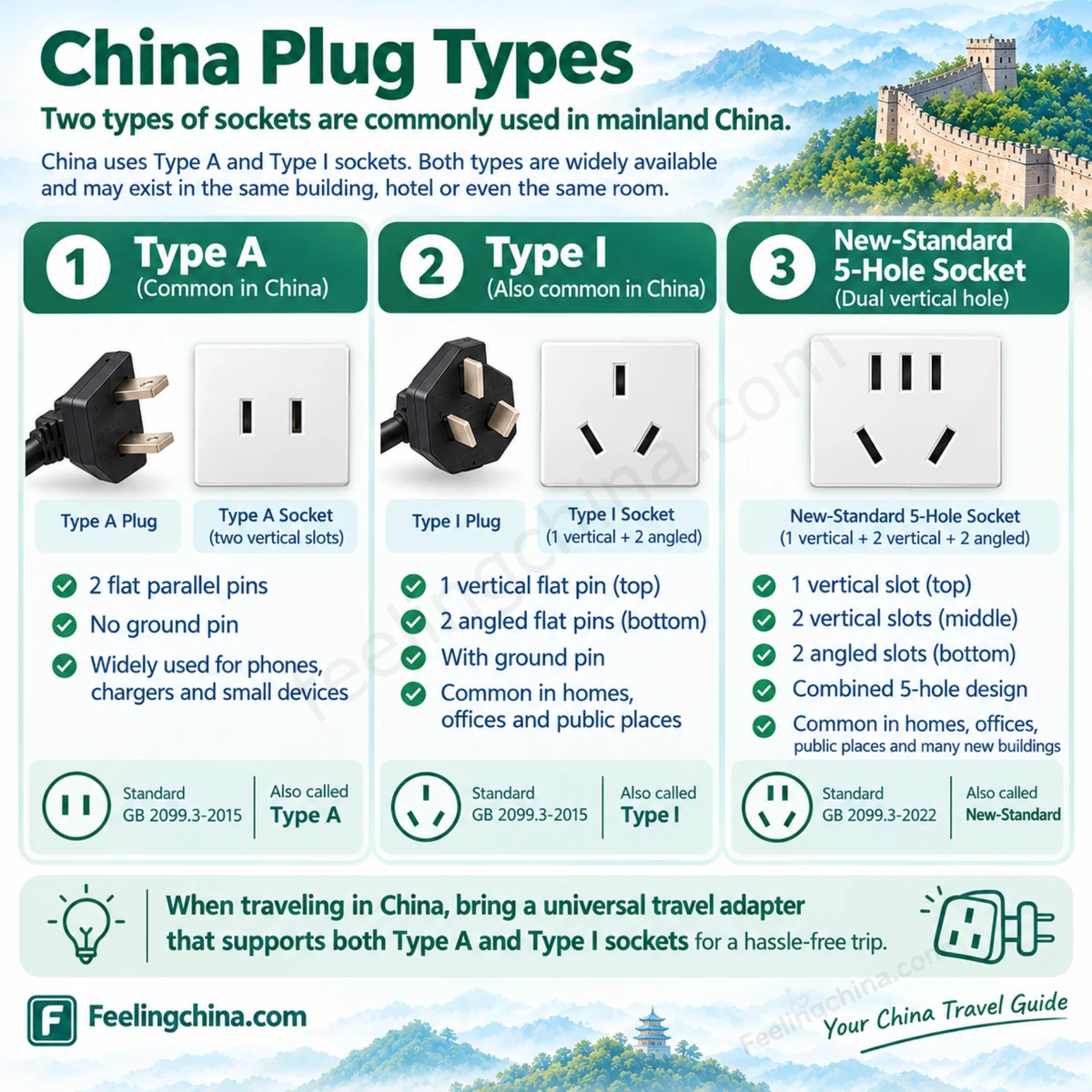
- What plug and voltage does China use? China uses 220V / 50Hz electricity. Common socket types include Type A and Type I, and some outlets also accept two-pin European plugs. Socket compatibility varies, so a universal travel adapter is a practical choice.
- What size power bank should I bring? A 10,000–20,000mAh bank (≈37–74Wh) is the sweet spot — comfortably within the 100Wh limit, easy to carry, enough for a full day out.
- What do flights and trains require? Chinese domestic flights need 100Wh or less + a clear CCC mark and ban recalled models; high-speed trains just need 100Wh or less with a clear label (no CCC for now). Power banks always go in carry-on, never checked baggage — and if your carry-on is checked at the gate, remove your power bank first.
Part 1 — Travel Adapters & Chargers
1. Does China Use 110V or 220V?
China uses 220V / 50Hz.
Good news: almost every modern phone, laptop, and camera charger is built for worldwide use. If your charger says:
Input: 100–240V ~ 50/60Hz
then:
✅ No voltage converter needed.
That covers the vast majority of travel electronics — but always check the rating printed on the device itself, not the device type, since a few specialty items differ.
2. Plug Adapter vs. Voltage Converter
These two get confused constantly, so here’s the clean split.
Plug Adapter
Changes the shape of the plug so it fits the socket. It does nothing to the voltage.
Voltage Converter
Changes the electrical voltage itself.
Examples:
Phone charger: 100–240V → usually adapter only.
Important: Check the voltage and wattage on your hair dryer before using it in China. A plug adapter does not convert voltage. If your appliance only supports 110–120V, use it only with a suitable voltage converter rated for its power requirements — or bring a dual‑voltage appliance instead.
Most travelers only need the adapter. High‑wattage single‑voltage appliances (like many hair dryers) are the exception — and in practice, buying one in China is often easier than hauling a converter.
3. Do I Need a Travel Adapter in China?
It depends where you’re flying in from.
US / Canada
Chinese sockets don’t match US plugs, so you’ll need a plug adapter.
UK
UK plugs are different too — bring a plug adapter.
Australia / New Zealand
These use a different plug shape; an adapter is the safe bet.
Europe
Some European plugs (Type C) may physically fit older Chinese sockets, but many won’t seat securely, and socket types vary between hotels and even between rooms. Don’t assume every device will fit.
The simplest move for anyone crossing borders:
A universal travel adapter is the safest choice for international travelers.
4. What Should I Pack for the Wall Side?
A short, complete list:
- Phone charger (check it says 100–240V)
- USB‑C cable
- Universal travel adapter
- Laptop charger if you need it
Your power bank and your travel adapter solve two different problems: the adapter lets your charger plug into a Chinese wall socket, while the power bank keeps your phone alive when there’s no outlet at all. You usually need both.
Part 2 — Power Banks
5. Can You Bring a Power Bank to China?
Yes — but China’s rules for power banks are stricter than many travelers expect.
Quick orientation before the details:
- ✈️ China’s domestic flights are the strictest case.
- 🚄 Trains follow different, looser rules.
- 🔋 Power banks are judged mainly by their Wh (watt‑hour) rating, not the mAh number printed on the box.
- ✈️ China’s domestic flights also require a valid CCC / 3C certification mark — and ban certain recalled models outright.
- 🔌 Travel adapter is a separate question (covered above).
6. The Quick Answer: What Power Bank Should I Bring?
If you only read one section, read this one.
Recommended for most tourists: 10,000–20,000mAh
| Capacity | Approx. Energy | Recommendation |
|---|---|---|
| 10,000mAh | ~37Wh | ✅ Excellent |
| 20,000mAh | ~74Wh | ✅ Excellent |
| 26,800mAh | ~99Wh | ✅ 100Wh or less |
| 30,000mAh | ~111Wh | ⚠️ Avoid |
For the simplest experience, bring a reputable power bank at 100Wh or less with a clear CCC mark — and make sure it isn’t on China’s recalled‑model list.
This is the safer choice that covers most situations, but you still need to meet the specific flight and railway rules in the sections below.
7. Why China’s Power Bank Rules Are Strict
It’s not passengers China is worried about — it’s the batteries themselves.
Lithium batteries can overheat and catch fire, and a fire in the hold of a plane is far harder to deal with than one in the cabin. After a wave of battery recalls in 2025 — covering several major brands and pulling large numbers of power banks off the market — the CAAC introduced additional restrictions on power banks carried on domestic flights in June 2025, and airport security has enforced them strictly ever since. (Source: Civil Aviation Administration of China — CAAC announcement on power bank restrictions for domestic flights.)
None of this is aimed at tourists. It’s just that the rules are enforced consistently, and “I didn’t know” won’t get a non‑compliant bank past the checkpoint.
8. Flying in China: Power Bank Rules
This is the part that actually matters at the airport.
8.1 Domestic flights
| Power bank capacity | China domestic flights |
|---|---|
| 100Wh or less | Must meet CCC and recall requirements |
| Over 100Wh | Check current airline and applicable aviation rules |
| Over 160Wh | Generally prohibited under standard passenger lithium‑battery rules; verify current applicable rules |
Important: Capacity, the CCC requirement, and the recall ban are three separate conditions — a power bank at 100Wh or less still must have a clear CCC mark and must not be a recalled model. The old “100–160Wh = airline approval” line no longer applies as a blanket 2026 standard; airline and aviation rules change, so confirm before you fly.
Carry-on and onboard rules
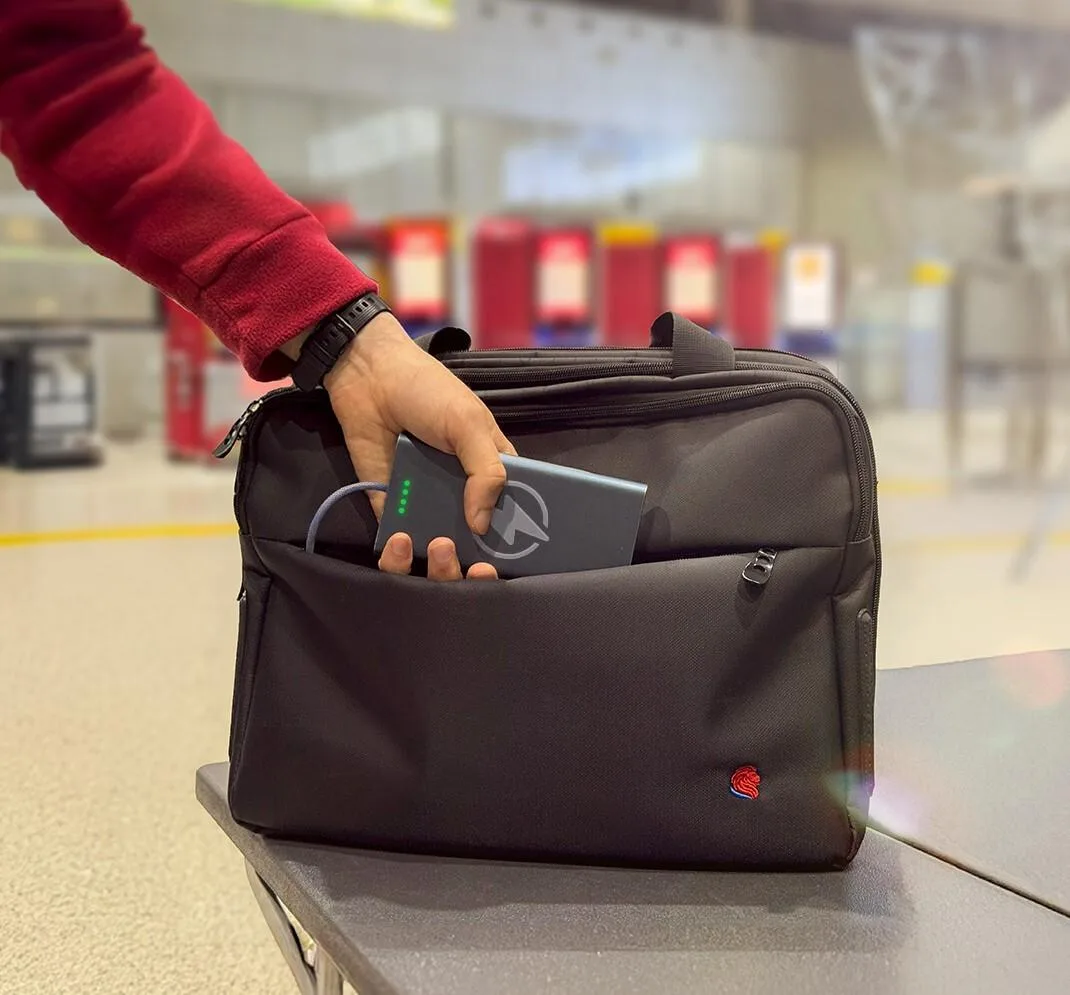
Power banks must be carried in your cabin baggage — never in checked luggage. If your carry-on is checked at the gate, take the power bank out first.
Many airlines now follow 2026 IATA lithium‑battery guidance, which advises:
- Keep the power bank in your carry‑on (not checked).
- Don’t charge the power bank itself during the flight.
- Limit to around two power banks per passenger.
Treat this as guidance — your airline’s published policy is what’s enforced, and quantity or in‑flight‑use limits vary by carrier. (IATA guidance is written for airlines/operators — see IATA: 2026 power bank guidance for operators.)
How to check if your power bank is recalled
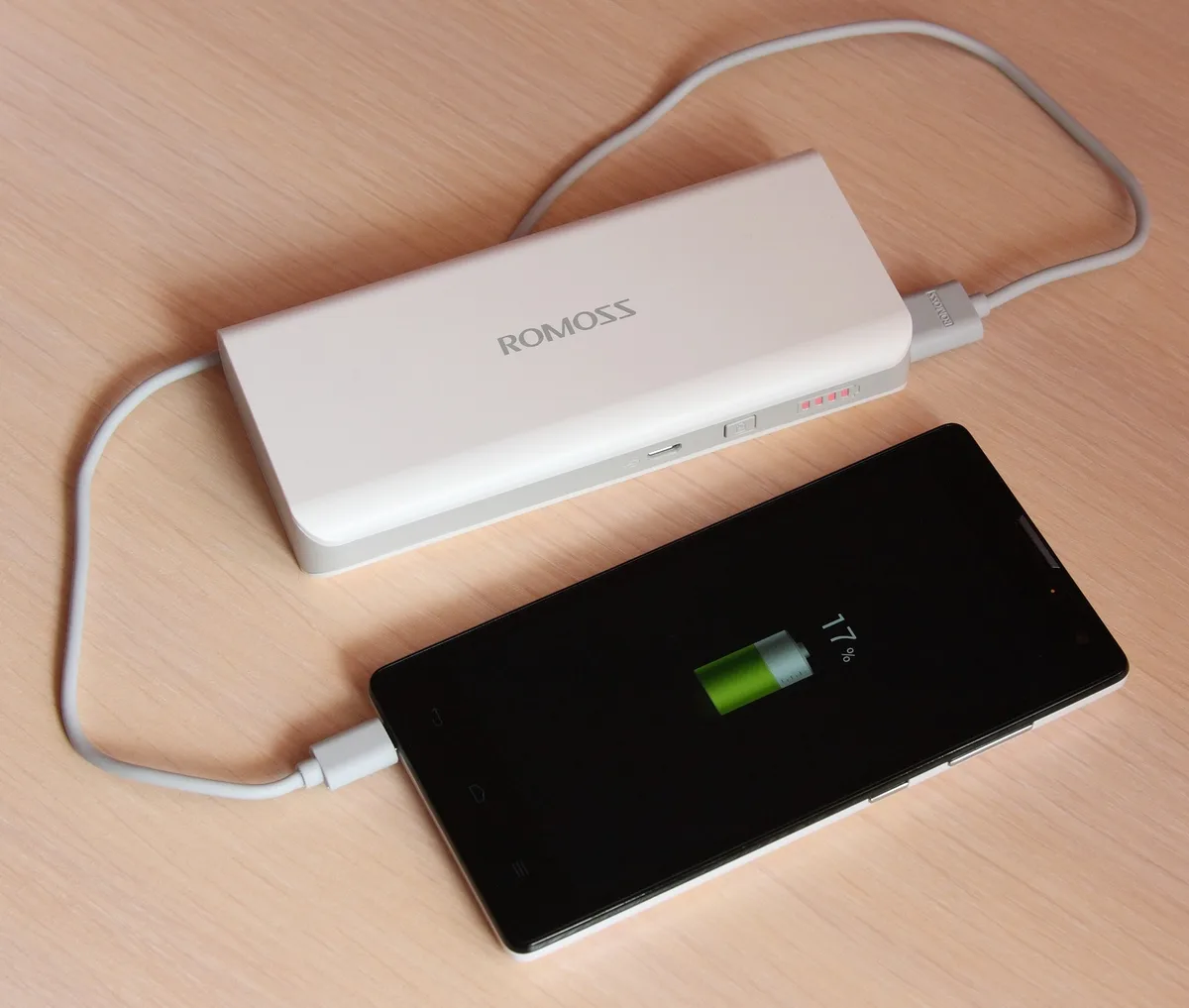
China’s market regulator (the SAMR Defective Product Recall Center) maintains an official, regularly updated recall list — see the SAMR recall announcements and your manufacturer’s official recall page (Anker, Xiaomi, ROMOSS and others publish recall details on their own sites). Recalls are tied to specific models, serial numbers, and production batches, not an entire brand or product line. Before you fly:
- Check the model and serial number printed on the device.
- Look it up in the SAMR recall database.
- Check your manufacturer’s official recall / serial‑number lookup page.
Don’t assume a model is affected just because the brand name appears in recall news.
9. What Is CCC / 3C?
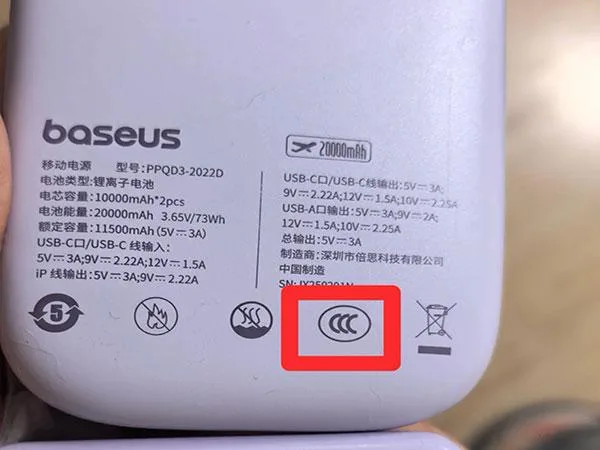
This is the one thing almost every foreign visitor has never heard of, and it’s an important requirement for Chinese domestic flights.
CCC = China Compulsory Certification
CCC is China’s mandatory safety certification. For a power bank, it appears as a small mark printed on the device itself — check the mark on the product, not just the box, and make sure it is clearly visible. Ultimately, what counts is the CCC mark being present and legible on the device when security inspects it.
CE, FCC or UL certification does not replace CCC for Chinese domestic flights.
A lot of travelers from Europe and North America assume their certified device is automatically fine. On a Chinese domestic flight, it isn’t.
10. How to Convert mAh to Wh
The number on the box (mAh) is not the number security cares about. Wh is. Here’s the conversion:
Wh = V × Ah
Many power banks use a nominal cell voltage of 3.7V, but check the rated energy printed on the device. To use the formula, turn mAh into Ah by dividing by 1,000.
| Capacity | Voltage | Energy (Wh) |
|---|---|---|
| 10,000mAh | 3.7V | ~37Wh |
| 20,000mAh | 3.7V | ~74Wh |
| 26,800mAh | 3.7V | ~99Wh |
| 30,000mAh | 3.7V | ~111Wh |
Most power banks print the Wh rating directly on the label now — often next to the mAh.
Don’t judge a power bank only by its mAh rating. Check the Wh rating printed on the device whenever possible.
11. Plane vs. High-Speed Train: What’s the Difference?
This is the core comparison, and it’s the one that saves you from learning two rulebooks.
| ✈️ Plane | 🚄 Train | |
|---|---|---|
| 100Wh or less | ✅ | ✅ |
| 100–160Wh | ⚠️ Check airline & rules | ❌ |
| Over 160Wh | ❌ | ❌ |
| CCC required | Yes for domestic flights | No |
| Recalled model | Banned | No |
| Checked baggage | ❌ | N/A |
| Best choice | 100Wh or less + CCC, not recalled | 100Wh or less |
If you’re taking both Chinese flights and trains, choose a power bank at 100Wh or less with a valid CCC mark that isn’t on the recall list.
For planes, the capacity rows above are not a fixed universal 2026 standard — always check your airline’s current policy (sections 8 and 13).
12. Can I Bring a Power Bank on China’s High-Speed Trains?
Yes.
China’s railway rules currently require a clearly marked power bank rated at 100Wh or less. Unlike Chinese domestic flights, the published railway rules do not specify the same CCC requirement. Always check the latest railway guidance before travelling. (Railway rules: National Railway Administration of China — NRA passenger prohibited/restricted items catalogue.)
What this means in practice:
- Keep each bank at 100Wh or less.
- The capacity label should be clear and readable.
- Carry a bank that is in good condition — damaged or obviously faulty batteries should not be taken on board.
13. What About International Flights to China?
This matters a lot for FeelingChina’s readers, because the rules change depending on which leg you’re flying.
London → Shanghai and Shanghai → Beijing are not the same situation.
Flying into China
You’re subject to several sets of rules at once:
- Your airline’s own policy (including any limits on number or capacity)
- The rules of your departure country
- The security requirements at your Chinese arrival airport
Flying within China
Once you’re on a domestic hop, the CCC requirement and the recall ban above both kick in — even if your home‑country airline didn’t mention them.
Two things to remember: don’t judge an international leg by the CCC mark alone, and don’t assume that because your international flight allows a bank, your domestic connection within China will too. Check both legs separately.
Note on international guidance: IATA’s 2026 lithium‑battery guidance (power banks in carry‑on, not charged in flight, around two per passenger) is written for airlines and operators — it is guidance, not a single global law. Your carrier’s published policy and the rules of each country on the route are what’s enforced.
14. How Many Power Banks Can I Bring?
There’s no single fixed national number we can quote that will stay true forever, so we won’t pretend there is one. What’s safe to say:
- Each airline may set its own limit on the number of power banks you can carry.
- Larger‑capacity batteries (over 100Wh) may need airline approval before you fly.
- Carrying several power banks at once is worth confirming in advance.
If you’re carrying more than one power bank, check your airline’s current policy before flying.
That keeps this advice useful even if one carrier tweaks its rules next season.
Part 3 — Packing & Checklist
15. What Should I Pack for Charging in China?
A simple, complete list covering both the wall side and the battery:
🔌 Charging
- Phone charger (100–240V)
- USB‑C cable
- Universal travel adapter
- Laptop charger (if needed)
🔋 Power
- 10,000–20,000mAh power bank
- 100Wh or less
- Clear capacity label
- CCC mark (for domestic flights)
- Not a recalled model
✈️ Before flying
- Keep the power bank in your carry‑on
- Never put it in checked baggage
- If carry‑on is checked at the gate, remove it first
- Check airline rules for large or multiple power banks
16. China Charging Checklist
Run through this before you leave home.
Before You Leave
- ☐ Travel adapter packed (universal covers most plugs)
- ☐ Charger supports 100–240V
- ☐ Power bank 100Wh or less
- ☐ CCC mark if taking domestic flights
- ☐ Capacity label is clearly visible
- ☐ Power bank is undamaged
- ☐ Power bank is not a recalled model (check SAMR database)
- ☐ Keep it in carry‑on baggage
- ☐ Check your airline’s rules
Sources
Official pages you can check directly:
- CAAC (Civil Aviation Administration of China) — restrictions on carrying power banks on Chinese domestic flights (CCC mark, unclear markings, recalled models/batches, effective from June 28, 2025): caac.gov.cn/…/t20250626_227805.html 中国民用航空局
- CAAC (English version) — English announcement on power bank restrictions for domestic flights: caac.gov.cn/English/…/t20250709_227894.html 中国民用航空局
- SAMR Defective Product Recall Center (国家市场监督管理总局缺陷产品召回技术中心) — official recall announcement database: samrdprc.org.cn/xfpzh/xfpzhgg/
- NRA (National Railway Administration of China) — railway passenger prohibited/restricted items catalogue (power banks with clear labels, ≤100Wh): nra.gov.cn/…/t20220527_326566.shtml 国家铁路局
- IATA (International Air Transport Association) — passenger guidance for lithium batteries and power banks: iata.org/…/travelers/batteries/ 国际航空运输协会
- IATA — 2026 power bank guidance for operators (67th Edition DGR update): iata.org/…/guidance-to-operators---power-banks.pdf 国际航空运输协会
IATA guidance is written for airlines and operators. Your airline’s published policy, departure-country rules, and local regulations are what passengers must follow.
Was this guide helpful?
Frequently asked questions
Do I need a travel adapter in China?
Does China use 110V or 220V?
Can I bring a 20,000mAh power bank to China?
Can I bring a 30,000mAh power bank on a flight in China?
Which power banks are banned in China?
Does my power bank need a CCC mark?
Can I bring a power bank on China's high-speed trains?
Can I put a power bank in checked luggage?
Can I charge my power bank on the plane?
Can I charge my phone on a Chinese high-speed train?
Do I need a voltage converter in China?
Last updated: 2026-10