Longji Rice Terraces (Dragon's Backbone): The Viral Terraces Near Guilin — Where They Are, How to Visit & 2026 Harvest Dates
Those terrace lights, sunrise mists, and golden layers filling your feed are all Longji — the Dragon's Backbone rice terraces 80 km north of Guilin. Here's the trip to book (2 days / 1 night), the four villages and what to see in each, the 2026 harvest dates, and the full logistics from tickets to transport. It's also one of the best places to visit in China in October, when the terraces turn gold.
🌏 South China (Guangxi)
🗓️ Suggested: 1–2 days
Show this to your driver
This is the place filling your feed right now:
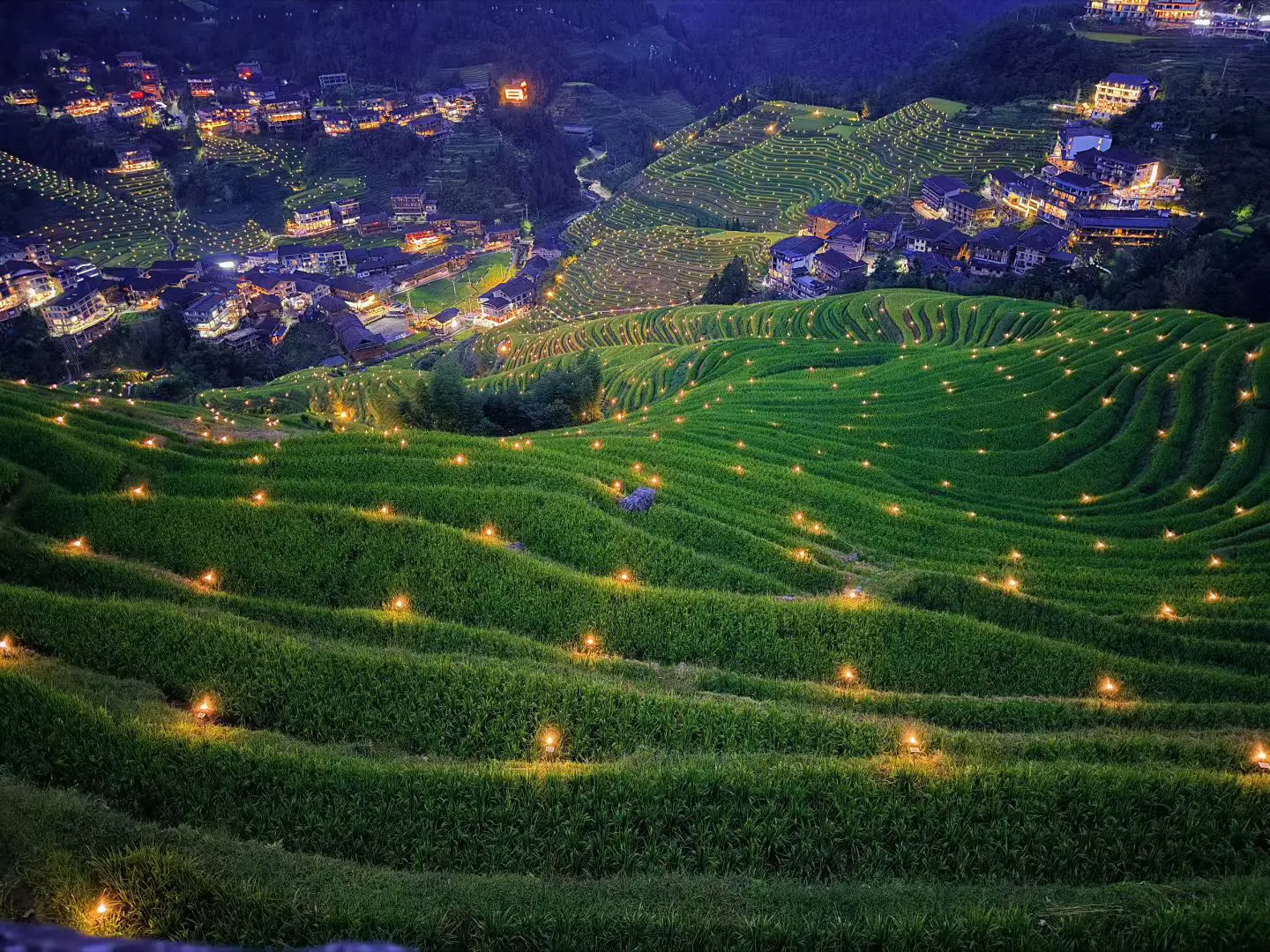
Not a filter. Not Southeast Asia. Not AI. This is Longji (龙脊), the “Dragon’s Backbone” rice terraces — a 650-year-old farming landscape carved by the Zhuang and Yao people into the mountains of Longsheng County, Guangxi, about 80 km (50 miles) north of Guilin.
The viral clips leave out the logistics. So here’s the trip that actually gets you those same frames.
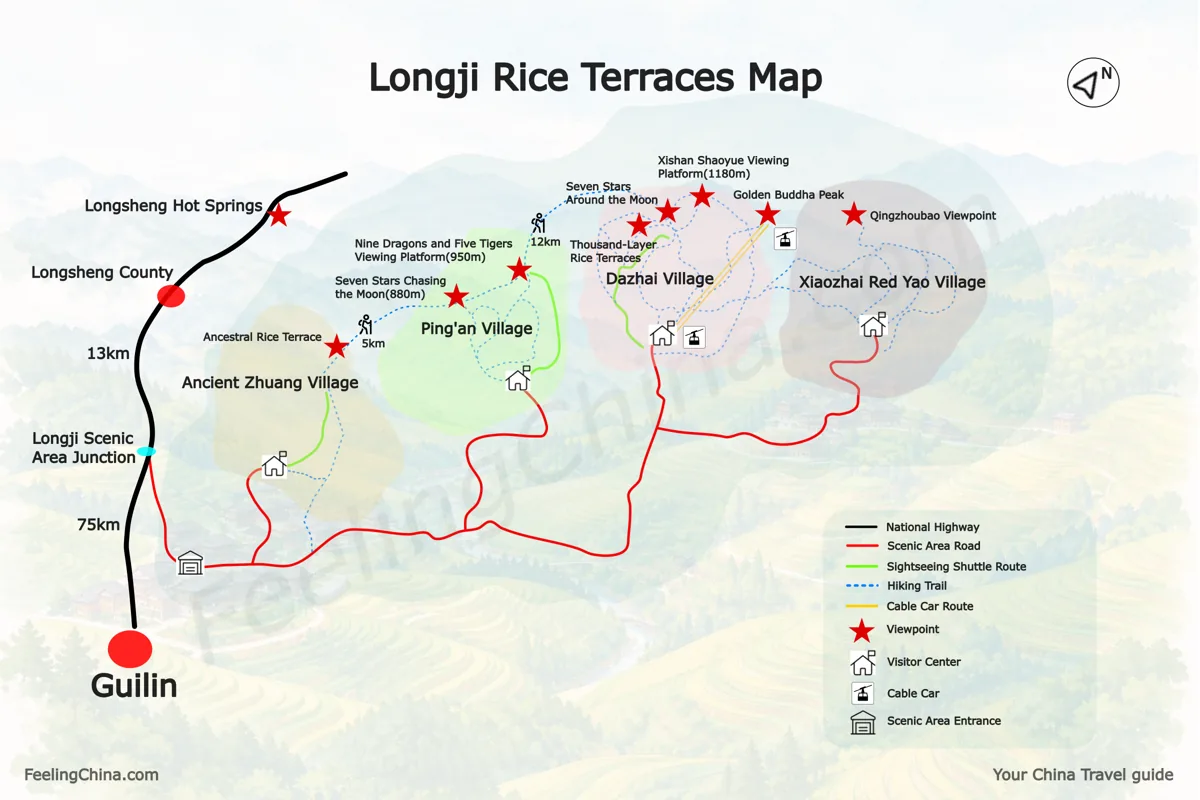
Where the viral shots were taken
| The shot you saw | Where it was taken |
|---|---|
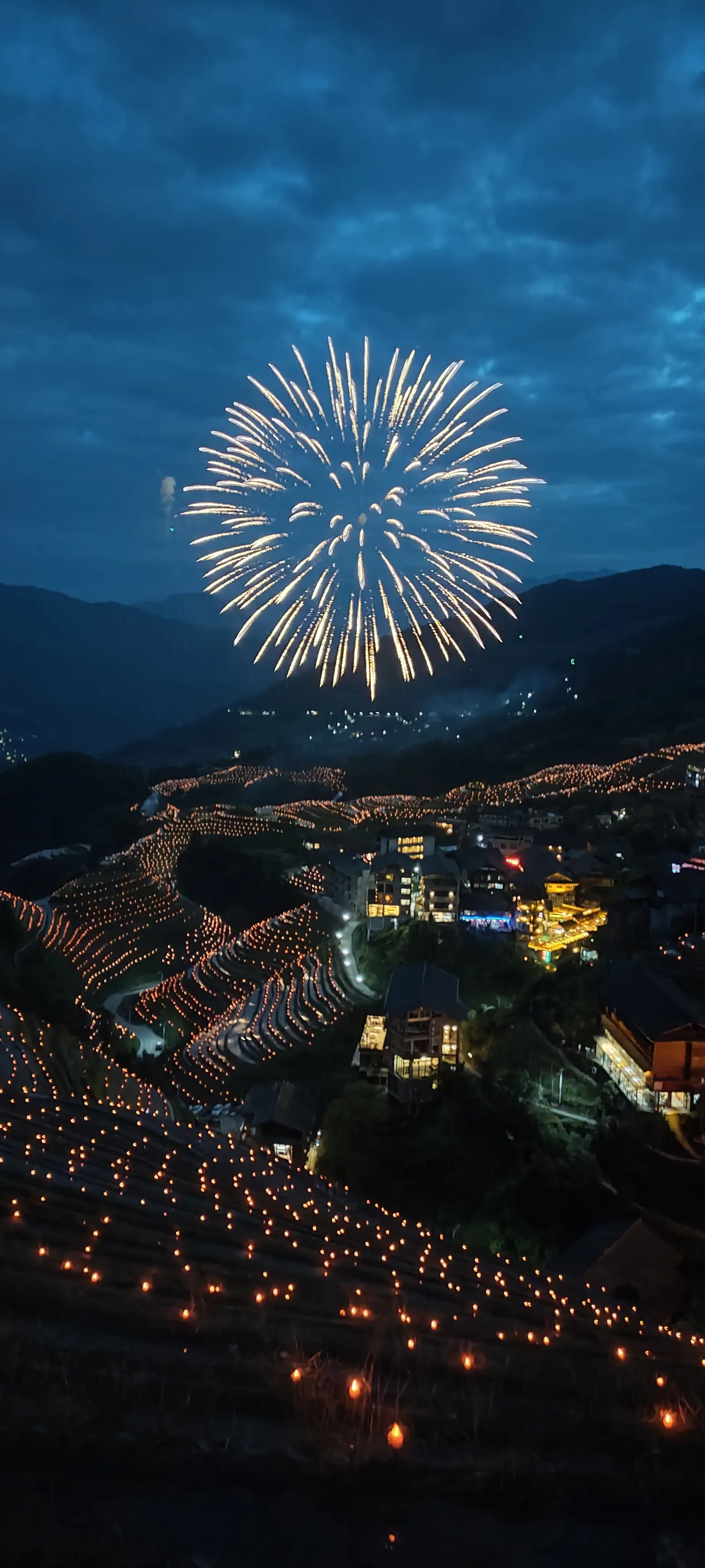
| Terrace lights at night | Any slightly elevated viewpoint — not a drone, not a guesthouse balcony. Walk up to one of the red-star viewpoints on the overview map after dark. |
| “Galaxy” of lights across the valley | A high viewpoint over the Dazhai or Ping’an valley — Jinkeng Dazhai’s West Hill Music / Thousand-Layer Stairs, or Ping’an’s Nine Dragons and Five Tigers. |
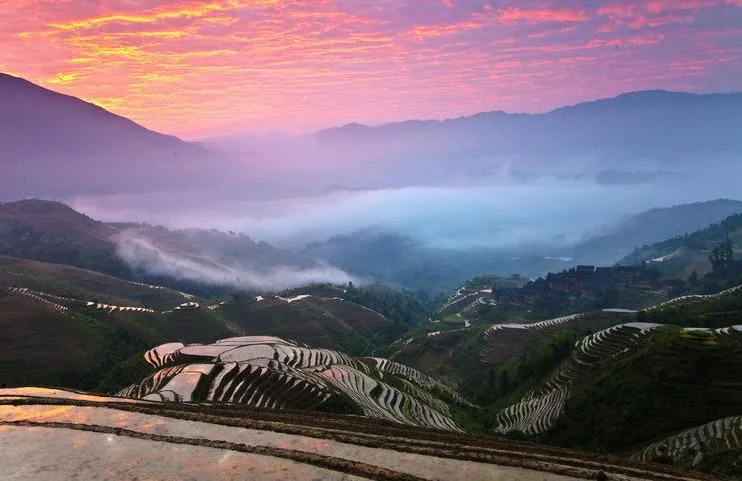
| Sunrise mist over flooded terraces | Viewpoint No. 1 — West Hill Music (Dazhai), at dawn. |
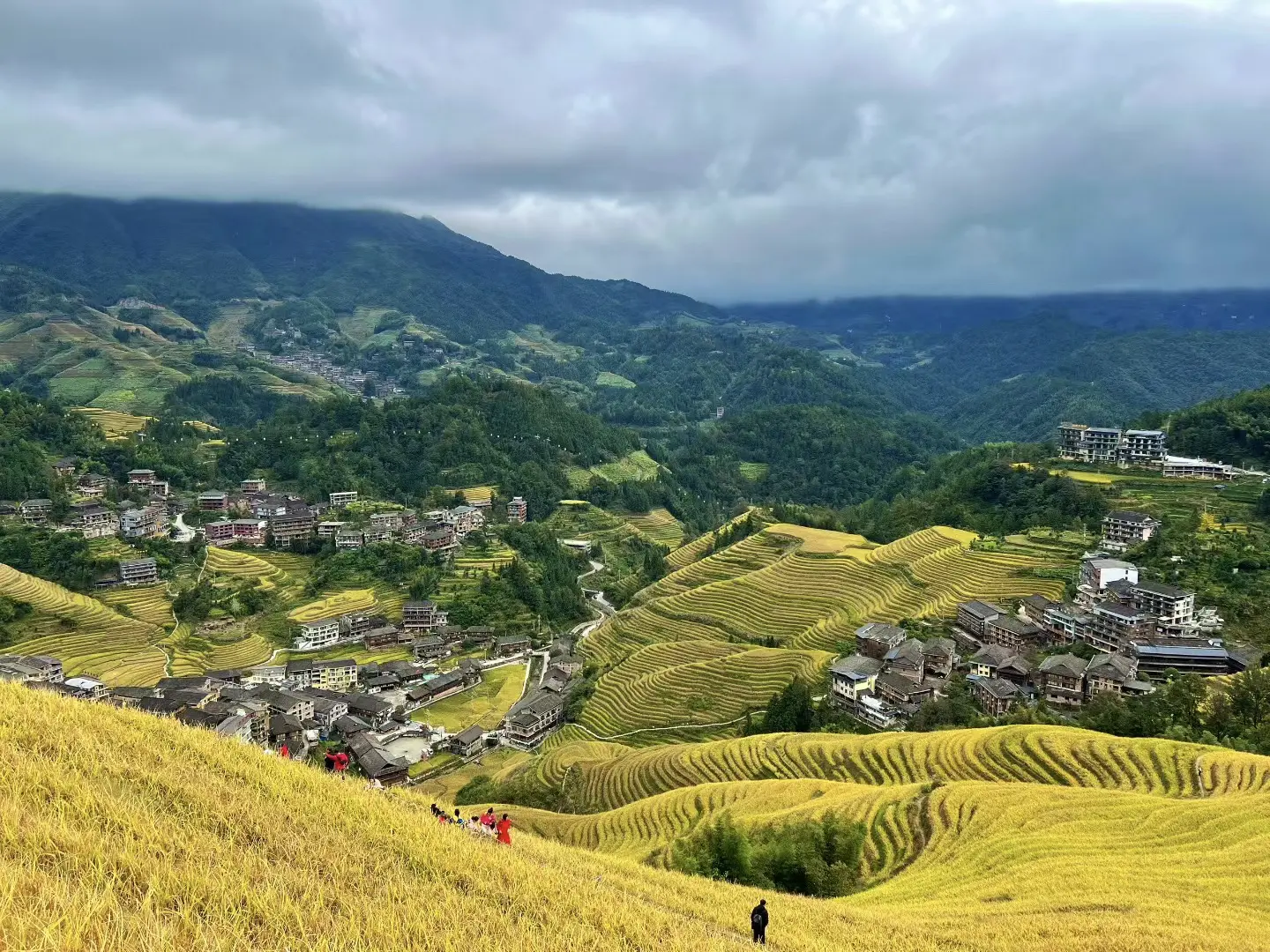
| Golden layered terraces | Viewpoint No. 2 — Thousand-Layer Stairs (Dazhai), or No. 3 — Golden Buddha Peak (Dazhai). |
| Sunset over the ridges | West-facing trails around Dazhai, or Nine Dragons and Five Tigers (Ping’an). |
How to read the map: The red stars on the overview map mark the best viewpoints. Almost every viral Longji photo is taken from one of these higher viewpoints. For first-time visitors, Jinkeng Dazhai’s three viewpoints are the easiest starting point and the ones most often seen in viral clips; Ping’an’s viewpoints are shorter, gentler walks between the terraces — there’s no cable car, the ground is just more level.
Where is Longji? The four villages at a glance
The Longji scenic area is split into four main village clusters, spread across one mountain road. Most visitors only see one or two. The overview map above shows how they relate to each other and to Guilin; here’s the same picture in table form:
| Village / area | Vibe | Best for | Time needed |
|---|---|---|---|
| Jinkeng Dazhai (金坑大寨) | Largest, most dramatic, Yao minority | Viral views, cable car, sunrise/sunset | 1–2 days |
| Xiaozhai Red Yao Village (小寨红瑶村) | Small, quiet, authentic Red Yao culture | Culture, stream-and-stone village walks, escaping crowds | Half-day side trip from Dazhai |
| Ping’an (平安寨) | Classic, polished, Zhuang minority | Easy walks, iconic Seven Stars with the Moon view | Half day |
| Guzhuang / Ancient Zhuang Village (古壮寨) | Oldest, least developed | Old terrace engineering, quiet architecture | 2–3 hours |
If it’s your first visit, go straight to Jinkeng Dazhai (金坑大寨) — the largest village, where the direct shuttles arrive, and the starting point for the most famous viral shots.
The trip to book: 2 days / 1 night
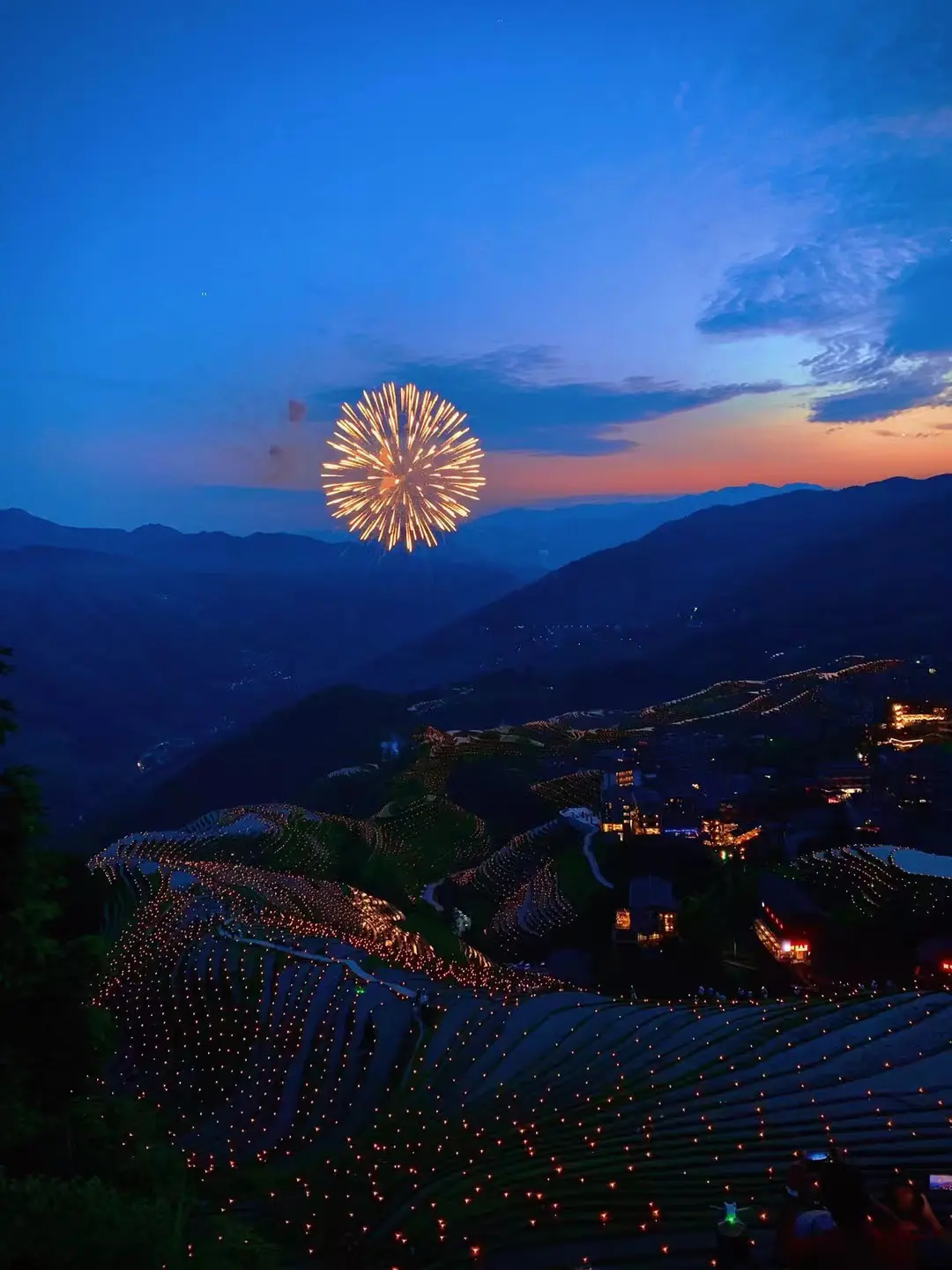
If you want the full scene — evening lights, dawn mist, golden dusk — book one night. A day trip is fine for a quick look, but it can’t deliver the shots that went viral, because all three signature moments fall outside day-trip hours:
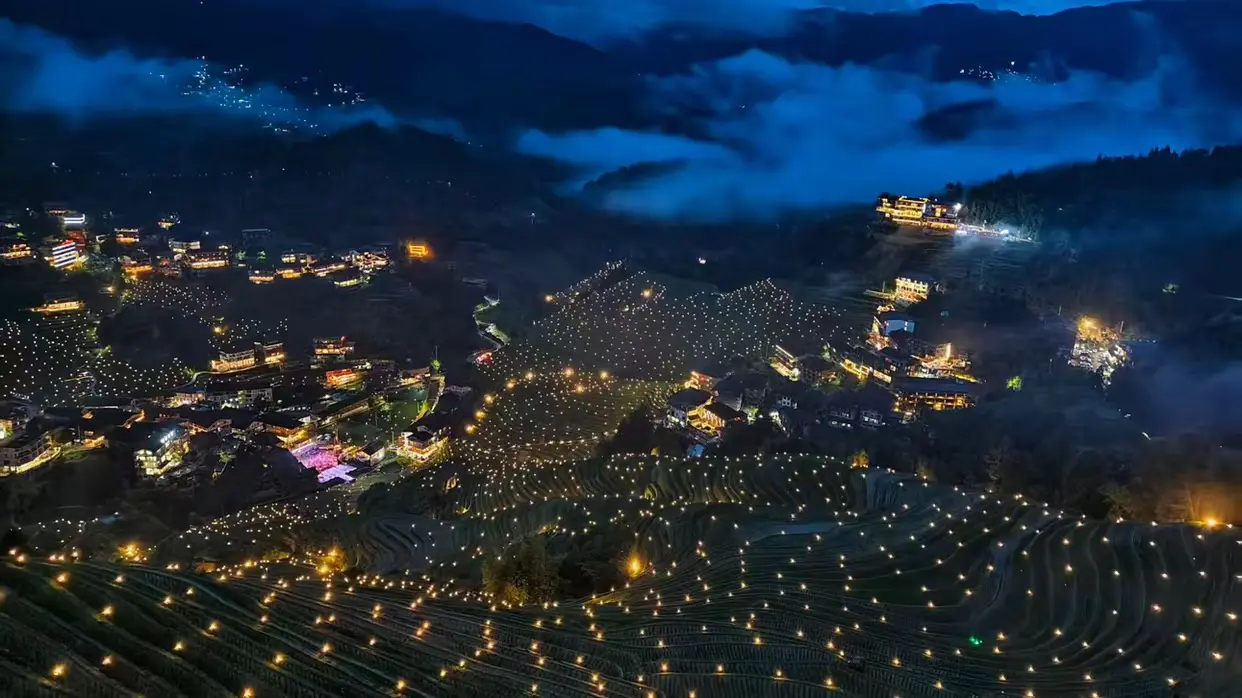
- Evening lights. After sunset the villages switch on and the terraced hillside turns into a field of warm points against the dark ridges. It’s the shot in the viral clips — and it only exists after dark.
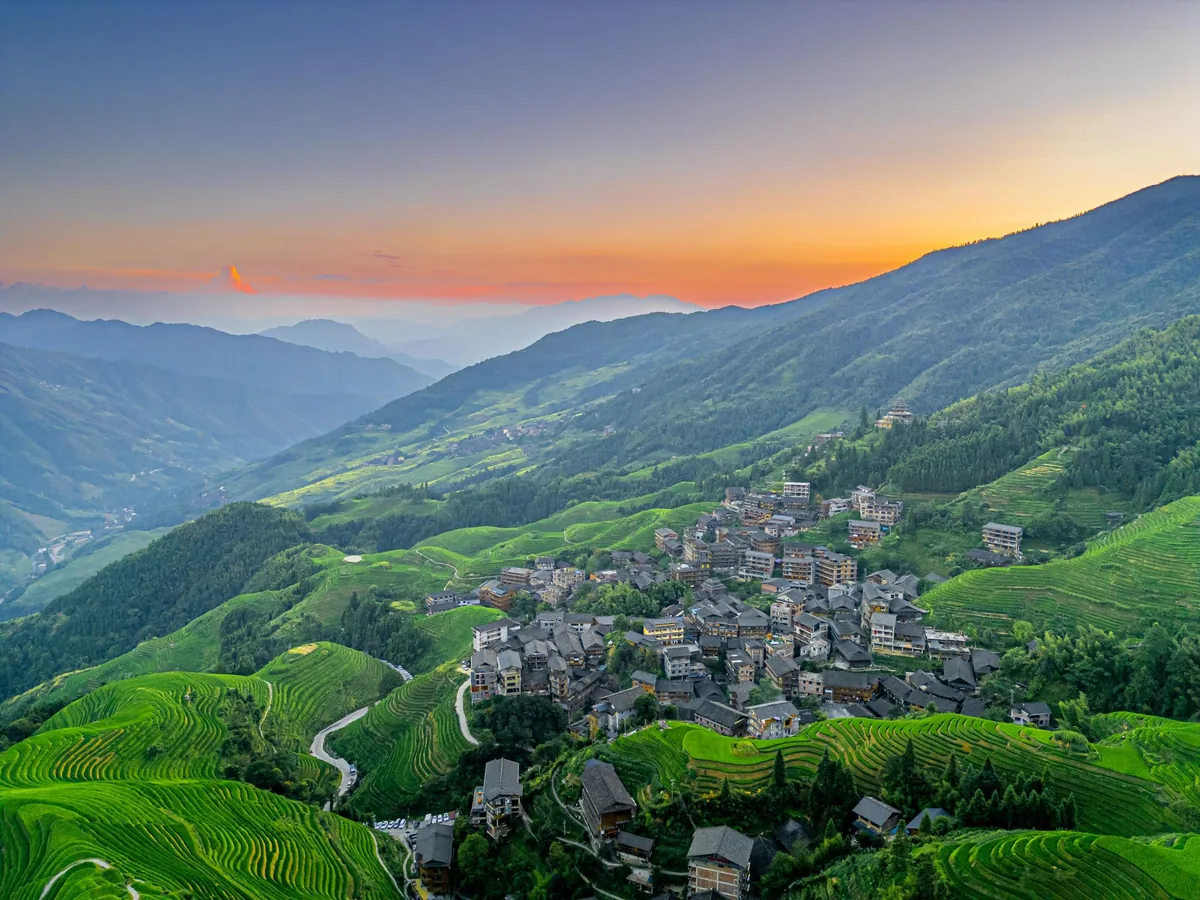
- Dawn mist and sunrise. On a clear morning, low mist fills the valleys and the first light hits the flooded terraces. The classic sunrise shot happens between about 6:00 and 7:30, depending on season.
- Golden dusk. The hour before sunset is when the layers glow. A day trip rarely gives you time to wait for it — the last bus is already leaving.

The 2-day / 1-night itinerary
This is the version of Longji worth traveling for, and the one that produces the viral shots.
Day 1 — Guilin → Dazhai → sunset → village night
- 08:00 — Direct shuttle from Guilin to Jinkeng Dazhai. The ride is about 2.5–3 hours.
- 10:30–11:00 — Arrive, check into your guesthouse, drop your bag.
- 11:30–12:30 — Lunch: bamboo rice, local chicken, or rice noodles.
- 13:00–17:00 — Hike toward Thousand-Layer Stairs or West Hill Music.
- 17:00–18:30 — Find a viewpoint and stay for sunset. This is the payoff.
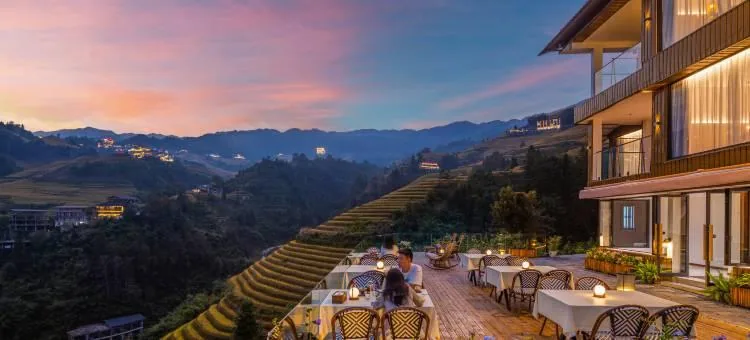
- After dark — Walk the village, watch the lights come on, have dinner at the guesthouse.
Day 2 — Sunrise → more terraces → Guilin
- 05:30–06:30 — Wake for sunrise (time shifts by season). Walk to a viewpoint for the dawn mist.
- 06:30–08:00 — Watch the terraces fill with morning light.
- 08:00–08:30 — Breakfast at your guesthouse.
- 09:00–12:00 — More walking — an easy loop between viewpoints, or a longer hike from Tiantou Village toward higher ground.
- 12:00–13:00 — Lunch.
- 13:00–14:00 — Walk back to the Dazhai parking area.
- 14:00–16:00 — Shuttle back to Guilin.
Confirm your return shuttle on the first day. Mountain schedules shift with season, holidays, and weather.
Jinkeng Dazhai (金坑大寨) — the village to base in
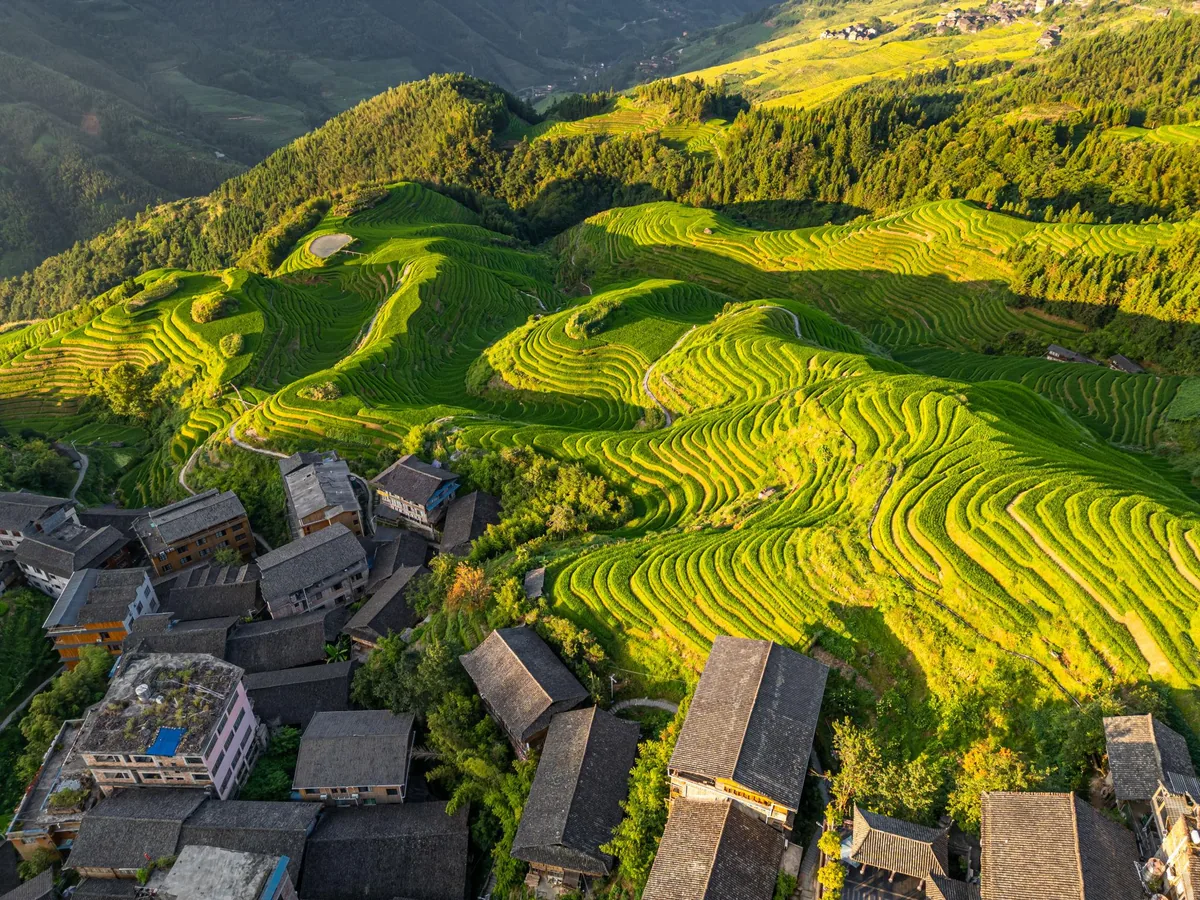
Most of the viral Longji clips are filmed in and around Jinkeng Dazhai, the largest of the four villages and a Yao minority settlement. It’s the easiest base for a first visit because it has the only cable car and direct shuttles from Guilin.
What to see in Dazhai, and how long to spend
Dazhai has three named viewpoints, each with a different payoff. Plan a full day (6–8 hours) if you want to hit all three at the right light; a half-day covers one or two.
- No. 1 — West Hill Music (西山韶乐). The highest viewpoint (~1,180 m) and the classic sunrise + sea-of-clouds spot. It’s a steep hike of about 1.5–2 hours one way from the village (or a longer paved trail from Tiantou). Budget 2–3 hours round trip including photo time if you go for sunrise.
- No. 2 — Thousand-Layer Stairs (千层天梯). Mid-mountain terraces, the most photogenic golden layers and the easiest big-view walk — about 30–45 min walk from the village; allow 45–60 min to enjoy and shoot.
- No. 3 — Golden Buddha Peak (金佛顶). The cable-car viewpoint (¥55 one-way / ¥100 round trip). A 15-min ride up, best for sunset; allow 45–60 min at the top for the light.
Ping’an (平安寨) — the easy, classic Zhuang village
Ping’an (平安寨) is a Zhuang village, smaller and more polished than Dazhai, with shorter, easier walks — a good pick for families or anyone who doesn’t want long stair climbs. It has its own shuttle stop (the Ping’an gate), so it’s reached separately from Dazhai, not through it.
What to see in Ping’an, and how long to spend
- Seven Stars with the Moon (七星伴月). Ping’an’s signature composition: seven small peaks ring a moon-shaped hill, with terraces cradling them. About 20–30 min walk from the village gate; allow 30–45 min to enjoy and photograph. If your feed showed this tidy, intimate terrace-and-hilltop frame rather than the vast Dazhai valley, it was almost certainly Ping’an.
- Nine Dragons and Five Tigers (九龙五虎). A wider panorama where nine ridges look like dragons and five like tigers. About 15–20 min walk from the village; 30 min to take in. It’s also one of the best elevated spots for the night-light views over Ping’an.
- The village itself. Zhuang stilt houses, small cafés and guesthouses, and short lanes between the terraces — easy to wander.
Time needed: a relaxed half-day (4–5 hours) covers both viewpoints plus the village; a full day if you linger over the light. The paths between Ping’an’s viewpoints are relatively gentle and level, so you get the views without Dazhai’s big stair climbs — there is no cable car here, just easier walking.
Guzhuang (古壮寨) — the oldest, quietest village
Guzhuang (古壮寨) is the oldest terrace cluster in the area and the best-preserved Zhuang stilt architecture — the “Longji” name is said to originate here. It’s the quietest and least developed of the four, with few formal viewpoints, so it rarely shows up in the viral clips. Come here for atmosphere, not for a big overlook.
What to see in Guzhuang, and how long to spend
- Ancient terrace walls — some sections are said to be 1,000+ years old, the original Longji engineering.
- Stilt houses and lanes — walk the village to see traditional Zhuang wooden architecture up close.
- The wind-rain bridge (风雨桥) — a covered wooden bridge, a classic minority-village landmark.
Time needed: 2–3 hours for a relaxed walk. There’s no viewpoint to rush to — it’s about the old terraces, the quiet, and the architecture.
Xiaozhai Red Yao Village (小寨红瑶村) — the quiet Red Yao side trip
Xiaozhai (小寨) is the small village on the overview map that’s easy to miss — a Red Yao (红瑶) settlement just east of Dazhai, connected by hiking trails. It’s less polished and far less crowded than Dazhai, but it’s where you go if you want authentic Yao village atmosphere without the main tourist flow.
What to see in Xiaozhai, and how long to spend
- The village entrance — marked by ancient towering trees at the top of the approach, used as village guardian trees.
- Stream, stone bridges, and stilt houses — the stone-paved road follows a stream; stilted wooden houses line both banks, connected by small stone bridges. It’s a quieter version of the classic Longji village scene.
- Xiaozhai Red Yao Costume Exhibition Hall — a small ecological museum showing traditional Red Yao clothing, farming tools, and daily utensils. Good for understanding Red Yao culture beyond the photo spots.
- Qingzhoubao Viewpoint (青州包观景台) — a viewpoint near Xiaozhai looking over the surrounding terraces; useful for a different angle of the area without the Dazhai crowds.
Time needed: about half a day (3–4 hours) as a side trip from Dazhai, either by hiking trail or by arranging a local transfer. Most first-timers don’t base here; they visit from Dazhai. If you want a longer, quieter hike, you can walk between Dazhai and Xiaozhai in about 1.5–2 hours one way, depending on the trail.
What to eat
Food is village style — simple, hearty, built around what grows on the mountain:
- Bamboo rice (竹筒饭) — sticky rice steamed in a bamboo tube, ~¥15 (≈ $2.2) per tube.
- Bamboo-tube chicken (竹筒鸡) — a whole chicken ~¥148 (≈ $22), good for 2–3 people.
- Local free-range chicken stewed with mountain mushrooms.
- Stir-fried rice noodles — ~¥15 (≈ $2.2) a bowl.
- Yao-style smoked bacon, wild mountain vegetables, oil tea (油茶) ~¥10.
Payment tip: You don’t need to carry cash. WeChat Pay is accepted almost everywhere in the villages — even the 80-year-old grandma at the guesthouse uses it. If you haven’t linked a card yet, follow our WeChat Pay setup guide before you arrive.
Where to stay
Base yourself in the viewpoint villages so you’re already at the terraces for dawn. Jinkeng Dazhai — including higher-up Tiantou Village (田头寨), which saves the pre-dawn climb — is the main base, and Ping’an (平安寨) is a good alternative if you prefer the gentler village. Price tiers per room/night:
- Economy — ¥120–200 (≈ $18–30): simple family-run stilt-house rooms.
- Mid-range scenic — ¥200–300 (≈ $30–45): balcony with terrace views.
- High-end panoramic — ¥300–800 (≈ $45–120): floor-to-ceiling terrace views, sometimes sea-of-clouds from bed.
Book ahead for the Golden Week (Oct 1–7) and the September–October harvest — guesthouses charge peak rates and fill up.
When to go: the 2026 harvest calendar
October is one of the best months for travel in China — the summer heat lifts, skies clear, and autumn color peaks across the country. For Longji, it’s the single best window: the rice is gold and the low autumn light is perfect for photography. If you’re drawing up a China October itinerary, Longji is regularly named among the best places to visit in China in October, and it lines up neatly with nearby Guilin and Yangshuo.
Longji has four distinct looks, but two windows produce the iconic photos:
| Season | Months | What you’ll see |
|---|---|---|
| Flooded “mirror” | late Apr – mid Jun | Terraces filled with water, reflecting sky; misty mornings |
| Lush green | Jul – Aug | Cool mountain retreat, ~5–8°C below the city |
| Golden harvest | mid Sep – late Oct | Rice turns gold — the most beautiful ~6 weeks of the year |
| Winter off-season | Nov – Mar | Quiet, possible snow, few crowds |
For 2026 specifically: the rice is scheduled for 统一收割 (uniform harvest) on November 1, 2026. That means you can see golden fields through October 31, but the peak golden color is usually mid-September to mid-October. After November 1 the terraces are cut and the scene shifts to stubble and off-season quiet.
Dates can shift slightly with weather, so double-check with your guesthouse a few days before traveling. Avoid Golden Week (Oct 1–7) if you can — China’s busiest travel week means traffic controls and peak prices.
Option 2 — 1-Day Trip
If you’re short on time, a day trip is fine for a quick look at the terraces — just don’t expect the evening lights or sunrise.
Jinkeng Dazhai is the standard day-trip base because the direct shuttle arrives there. It’s a bigger area with more dramatic viewpoints, but the vertical drop means you’ll climb stone steps.
Ping’an (平安寨) is also a great day-trip choice if you want something easier: smaller vertical drop, shorter walks, and very scenic terraces. You don’t need the long climbs Dazhai requires, and the classic “Seven Stars with the Moon” view is only a 20-minute walk from the village gate.
A realistic day-trip timeline
- 07:30–08:00 — Leave Guilin by direct shuttle (see transport below).
- 10:30 — Arrive at the Longji gate, transfer to the scenic shuttle up to Dazhai.
- 10:30–12:00 — Walk into the village and get your bearings.
- 12:00–13:00 — Lunch in Dazhai.
- 13:00–15:30 — Hike to a viewpoint, or take the cable car up Golden Buddha Peak.
- 15:30 — Start heading down.
- ~16:00 — Board the last direct shuttle back to Guilin.
- 18:30–19:00 — Back in Guilin.
Getting back after sunset (no bus, but a taxi works)
The last direct tourist shuttle out of the Longji scenic area to Guilin — the one that leaves Jinkeng Dazhai — departs around 16:00, before sunset. Local buses from the villages down to Longsheng stop at roughly 16:30–17:00. So if you stay for the evening lights, the public bus is already gone.
You can still get back by taxi / private transfer:
- Taxi / Didi one-way: roughly ¥400–600 (≈ $60–90) from the terraces to Guilin — several times the shuttle fare, because it’s a long mountain drive and cars are scarce up here.
- Shuttle bus one-way: ¥50–65 (≈ $7.5–9.7) each way (Guilin Station / North & West).
- Book ahead. Arrange the taxi through your guesthouse or Guilin hotel before dark — don’t count on hailing one in the mountains after sunset.
In short: a day trip with a taxi return is possible, but it costs far more than the bus and needs planning. Staying one night is the simpler, cheaper way to see the lights.
Tickets & entrance fees (2026)
Prices are in RMB (¥); approximate USD at ¥6.7 ≈ $1.
| Ticket / extra | Price | Notes |
|---|---|---|
| Entry ticket (adult) | ¥80 (≈ $12) | Covers the scenic area, including the four main villages (Dazhai, Xiaozhai, Ping’an, Guzhuang) |
| Entry (discount) | ¥40 (≈ $6) | Students (full-time, with ID), seniors 60–64, children ~1.2–1.4 m |
| Entry (free) | ¥0 | Children under 1.2 m, seniors 65+, military/firefighters |
| Online advance booking | sometimes ¥75 | Check the official platform |
| Scenic shuttle bus | ¥40 round trip (≈ $6) | Gate ↔ village; effectively mandatory (long mountain road) |
| Jinkeng cable car | ¥55 one-way / ¥100 round trip (≈ $8 / $15) | Dazhai only, to Golden Buddha Peak |
| Huangluo Red Yao show | ¥80 (≈ $12) | Optional cultural performance |
Validity (有效期): Your ticket is valid for three consecutive days from your chosen entry date — one purchase lets you stay in the scenic area for up to 3 days, which is the safer choice if you overnight or want to visit more than one village. If you buy online, confirm at the window which version you’ve received.
Where to buy: at the scenic-area gate, or via the official WeChat mini-program (“Guilin Longji Rice Terraces Tourist Fleet”). The interface is Chinese-only and needs a local setup, so most foreign visitors ask their Guilin hotel or a travel agency to book 1–2 days ahead (small ¥5–10 service fee). Bring your passport as ID.
How to get there
From Guilin (easiest)
Direct tourist shuttle — the simplest route for a first visit.
| From | Price (each way) | Departs Guilin | Departs Dazhai (return) |
|---|---|---|---|
| Guilin Railway Station | ¥50 (≈ $7.5) | 08:00, 09:30, 10:55, 12:00, 13:30, 15:00 | 09:00, 10:30, 12:00, 13:30, 14:30, 16:00 |
| Guilin North / West | ¥65 (≈ $9.7) | same as above | same as above |
| Yangshuo | ¥90 (≈ $13) | 08:00, 09:30, 13:30 | 09:00, 13:30, 14:30 |
- Travel time: ~2.5 h from Guilin Station, ~2h45 from North/West.
- Boarding points: Guilin Station — Jinjiang Inn (Two Rivers & Four Lakes); North — No.1 tourist bus parking; West — tourist distribution center parking.
- Drop-off: Jinkeng Dazhai Visitor Center parking (right by the cable car).
Private transfer (with driver) — a chauffeured car, not a self-drive rental: foreign visitors can’t rent and drive in China without a Chinese license. Best for families or flexible sunrise/sunset runs. Around ¥450/day for a 5-seat sedan from Guilin downtown (≈ $67), ¥600 for a 7-seat van. Per person ~¥110–150 if you split four ways. Useful as a backup if you miss the last shuttle.
Budget route (Qintan Coach Station): Guilin → Longsheng (¥37–60, 2 h), then transfer to the scenic shuttle (¥22, 1 h). Slower, more changes, but cheapest.
Getting around inside the scenic area
Once you pass the gate you still have a long mountain drive to the village parking, then a 20–30-minute uphill walk to the guesthouses. Most accommodations will send someone to help with luggage (porters ~¥20–30 per bag). Set your navigation to “Jinkeng Dazhai car park,” not “Longji Rice Terraces” — the main gate is far from the villages.
From Yangshuo
Direct shuttle ¥90, ~4–4.5 h, departures 08:00 / 10:30 / 13:30 (peak season). A day trip from Yangshuo means 8+ hours on the road — not worth it; stay in Guilin the night before.
Practical tips
- Book the shuttle early — seats fill in peak season; there’s no backup if you miss the last departure.
- Wear grippy shoes — the stone paths are polished and turn slippery when wet.
- Set up mobile payment — WeChat Pay and Alipay are widely used in the villages; cards and cash are rarely accepted.
- Download offline translation before you go (remote minority-village area, little English).
- Check the weather — heavy rain means slippery paths and near-zero visibility at the viewpoints.
- Pack light — luggage is carried by porters up to the guesthouses.
Final recommendation
- Two days / one night — the version to book if you want the classic Longji photos: evening lights, dawn mist, golden dusk.
- One day — fine for a quick look, but leave by mid-afternoon and don’t promise yourself sunset or the lights (the public bus is gone by 16:00; a taxi back runs roughly ¥400–600).
If someone says, “I want to see Longji at night,” the answer is simple: stay one night. The buses will already be back in Guilin by then — and you’ll have the terraces, lit up, all to yourself.
Frequently asked questions
Is the Longji Rice Terraces the place in those viral videos?
Do I need to stay overnight, or can I do Longji as a day trip?
How much does Longji cost in 2026?
What time does the last bus leave Longji for Guilin?
When is the best time to visit Longji?
Which Longji village should first-time visitors choose?
Is October a good time to visit China, and should I add Longji?
Last updated: 2026-10