Harbin 3-Day Winter Guide 2027: Ice & Snow World, Russian Streets & Itinerary
Planning China winter travel in January 2027? Harbin is the headline pick. This Harbin 3-day 2-night itinerary is built for foreign visitors — a relaxed, no-fuss route that hits the must-sees without the planning headache. The star of the 2026–2027 season is the 28th Ice and Snow World's first-ever official Disney collaboration: a Frozen (冰雪奇缘) themed zone where real-ice carvings of Elsa, Anna and Olaf glow like a fairytale after dark — a limited-time highlight you'll only catch this winter. Beyond the ice IP, Harbin's own Russian-European charm seals the trip: Saint Sophia Cathedral, Central Street and Lao Dao Wai's Chinese Baroque make this a rare East-meets-West snow journey. Here's your Harbin Ice and Snow World guide for international tourists — routes, costs and what to expect.
🌏 Northeast China
🗓️ Suggested: 3 days
Show this to your driver
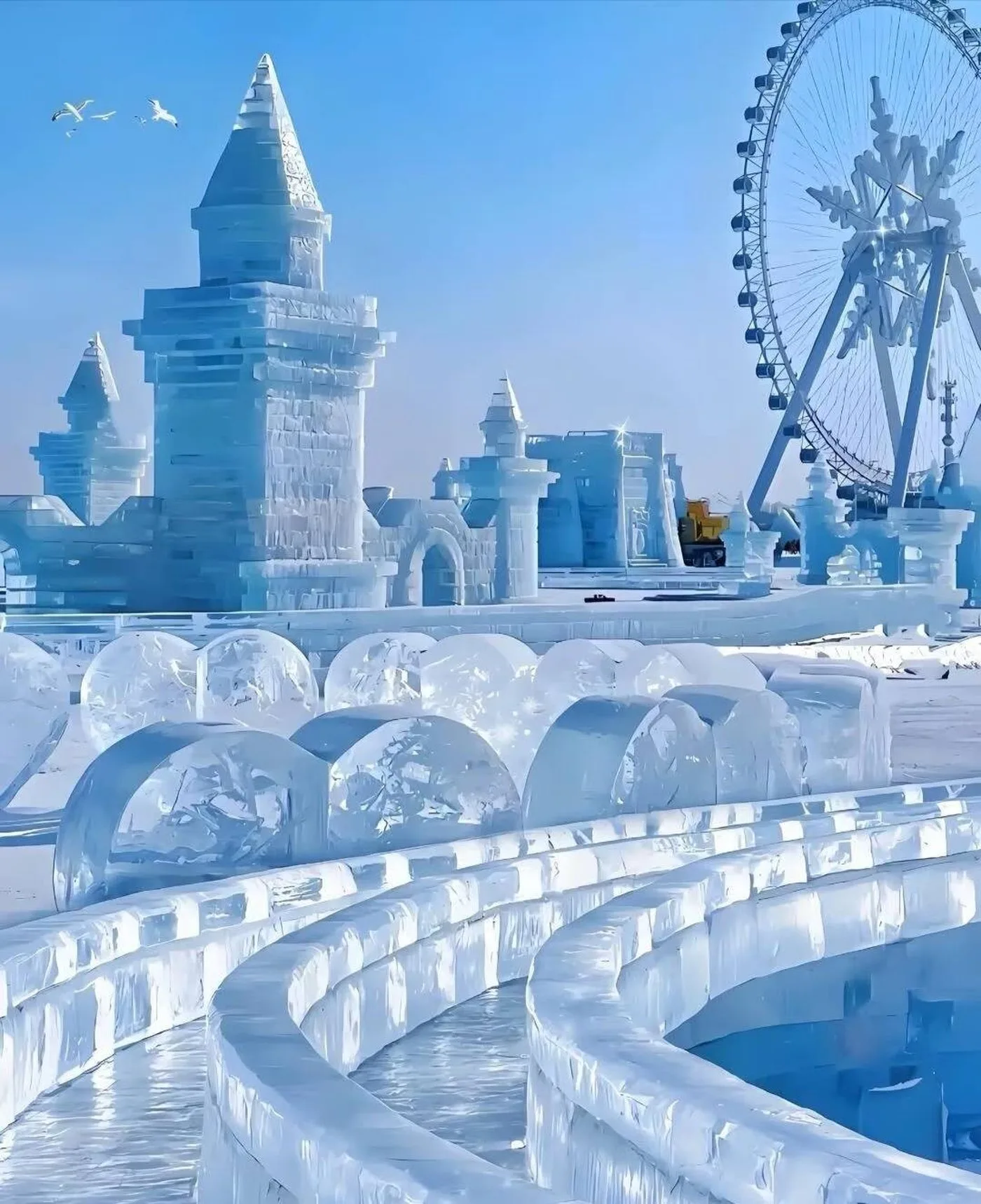
New for 2026–2027: Disney × Frozen Comes to Harbin
This season marks Harbin Ice and Snow World’s first-ever official collaboration with Disney. Announced on 14 October 2026, the 28th edition partners with Walt Disney (China) to build a dedicated Frozen (《冰雪奇缘》) themed zone — the headline attraction of the year. You’ll find life-size ice sculptures of Elsa, Anna and Olaf, immersive scenes from the Frozen story, and a Disney pop-up store on site. The park also expands to a record 1.25 million m² with 400,000 m³ of ice and snow, across six pillars: ice landscapes, rides, shows, snow sports, IP experiences and guest services.
Introduction: Why Harbin
Harbin, capital of China’s far-northeastern Heilongjiang, is known for Russian-style architecture and an ice festival — a city that packs “European street scenes” and a “minus-thirty spectacles” into one winter.
We focus less on a list of sights and more on how to move between the city and Jiangbei, what it costs, and — most importantly —what you will feel and take home. Below is a compact ~3-day route:Daoli old-town walk → north-bank ice line → Lao Dao Wai and architecture, one line per day, no backtracking.
What You’ll Feel & Gain
This is the heart of the guide. Photos of Harbin’s ice lanterns and Russian streets are everywhere online — but what’s worth taking home is the experience below.
A City That Feels Like Another Continent
Harbin’s city center was laid out by Russians in the early 20th century. Walking Central Street, you pass café windows fogged with steam, and locals eating ice pops at −20°C. Many travelers’ first surprise: China hides a slice of “Europe.”
The Scale of a Chinese Winter Festival
Harbin Ice and Snow World uses hundreds of thousands of cubic meters of ice cut from the Songhua River. After dark the ice towers glow — it’s less a “sight” than a spectacle you stand inside.
Minus Thirty, a Kind of Romance
When Ice and Snow World lights up after dark, or you stand on the frozen Songhua watching the city glow across the ice, the cold slips into the background. What you take home is not a “I survived the cold” badge, but a quiet memory lit up by the extreme.
Warmth Inside the Cold
Northeastern hospitality shows in heated kang beds, iron-pot stews, frozen pears, and strangers taping hand warmers to your phone. The cold becomes a shared joke, not a threat.
Unexpected Northeastern Flavors
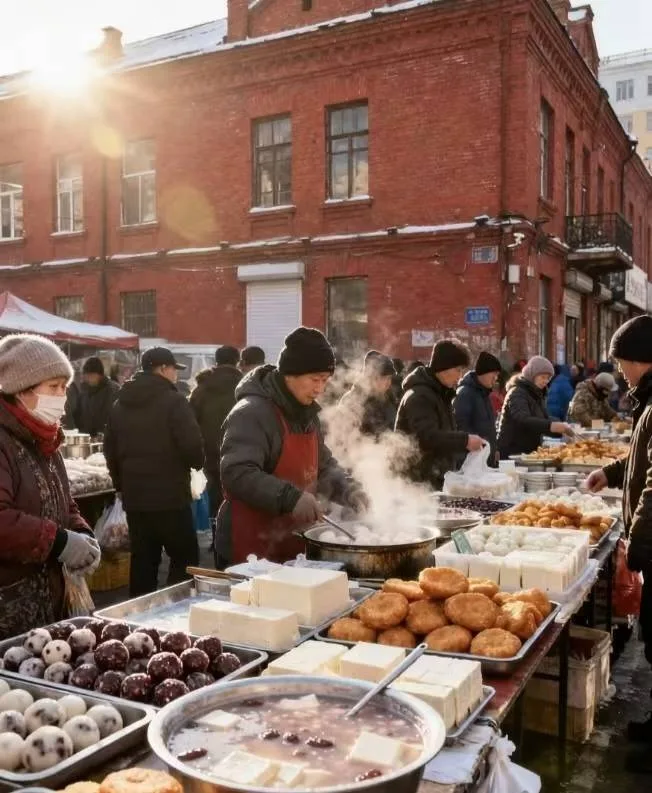
The sweet-sour of guobao rou, the wheat aroma of dalieba bread, the malty fizz of kvass, the comfort of an iron-pot stew — northeastern food’s portions and bluntness will reset what you thought “northern Chinese food” meant. The market’s tofu pudding and fried cakes are the humblest yet most addictive opening of the trip.
The 3-Day Itinerary
Based on flying in and out of Harbin, the 3 days run on three lines:Daoli old-town walk → north-bank ice line → Lao Dao Wai and architecture— one line per day, no backtracking, with the core ice experience all in the city and Jiangbei.
3-Day Attractions at a Glance
| Attraction | Day | Highlights | Cost | Booking |
|---|---|---|---|---|
| Hongzhuan Street Morning Market | Day 1 | Local morning market & northeastern breakfast | Free to browse; food extra | No |
| Saint Sophia | Day 1 | Largest Orthodox church in the Far East; city icon | Exterior free; museum ¥35 (≈$4.9) | No |
| Central Street | Day 1 | Russian-style cobbled street; Madiel ice pops | Free & open | No |
| Songhua ice / Flood Tower | Day 1 | Snow tubes, throwing water to ice, ice motorbikes | Roaming the river is free; rides ¥30 (≈$4.2)/run | No |
| Zhaolin Park | Day 1 | Refined traditional ice lanterns; ice-sculpture contests | Free; no booking | No |
| Siberian Tiger Park | Day 2 | Free-roaming Siberian tigers; tiger-viewing shuttle | Admission ¥90–110 (≈$12.5–15.3, incl. shuttle) | On-site OK |
| Sun Island | Day 2 | Giant snow-sculpture exhibition | Admission ¥198 (≈$27.5) | No |
| Ice & Snow World | Day 2 | Ice castles, light shows, 10,000-person rave | Admission ¥328 (≈$46) | Book ahead |
| Lao Dao Wai | Day 3 | Chinese Baroque old street; local snacks | Free & open | No |
| Architecture detour | Day 3 | St. Alexeyev / Gogol St / rail bridge / Grand Theatre / Music Corridor | Exterior free; shows extra | No |
Fares, booking rules and schedules above are typical and for reference only. In peak winter (Dec–Feb), Ice & Snow World usually requires advance ID-based booking — confirm via official channels (e.g. “Longyue Chuxing”).
DAY 1 · Daoli old town: Morning Market → Saint Sophia → Central Street → Songhua River → Zhaolin Park
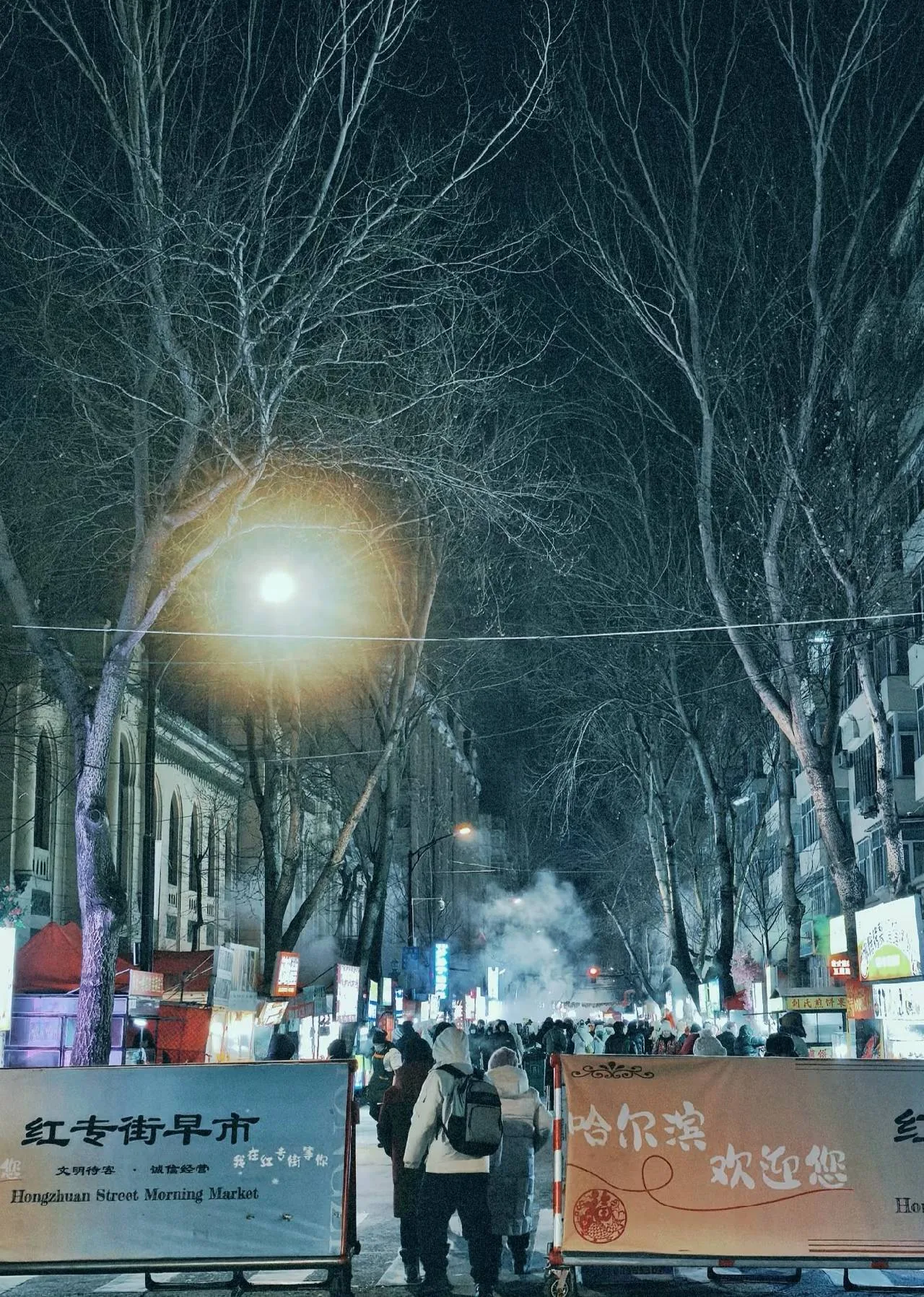
Hongzhuan Street Morning Market
A favorite local market of steaming sticky-bean buns, fried cakes, tofu pudding and kvass — a window into everyday Northeast life.
If you want authentic northeastern breakfast and street life, go early(open ~05:30–08:30).If you’d rather sleep in, feel free to skip it— no regrets, and you’ll save energy for the rest.
walk~10–15 min north along Shangzhi St. from Hongzhuan Market to St. Sophia
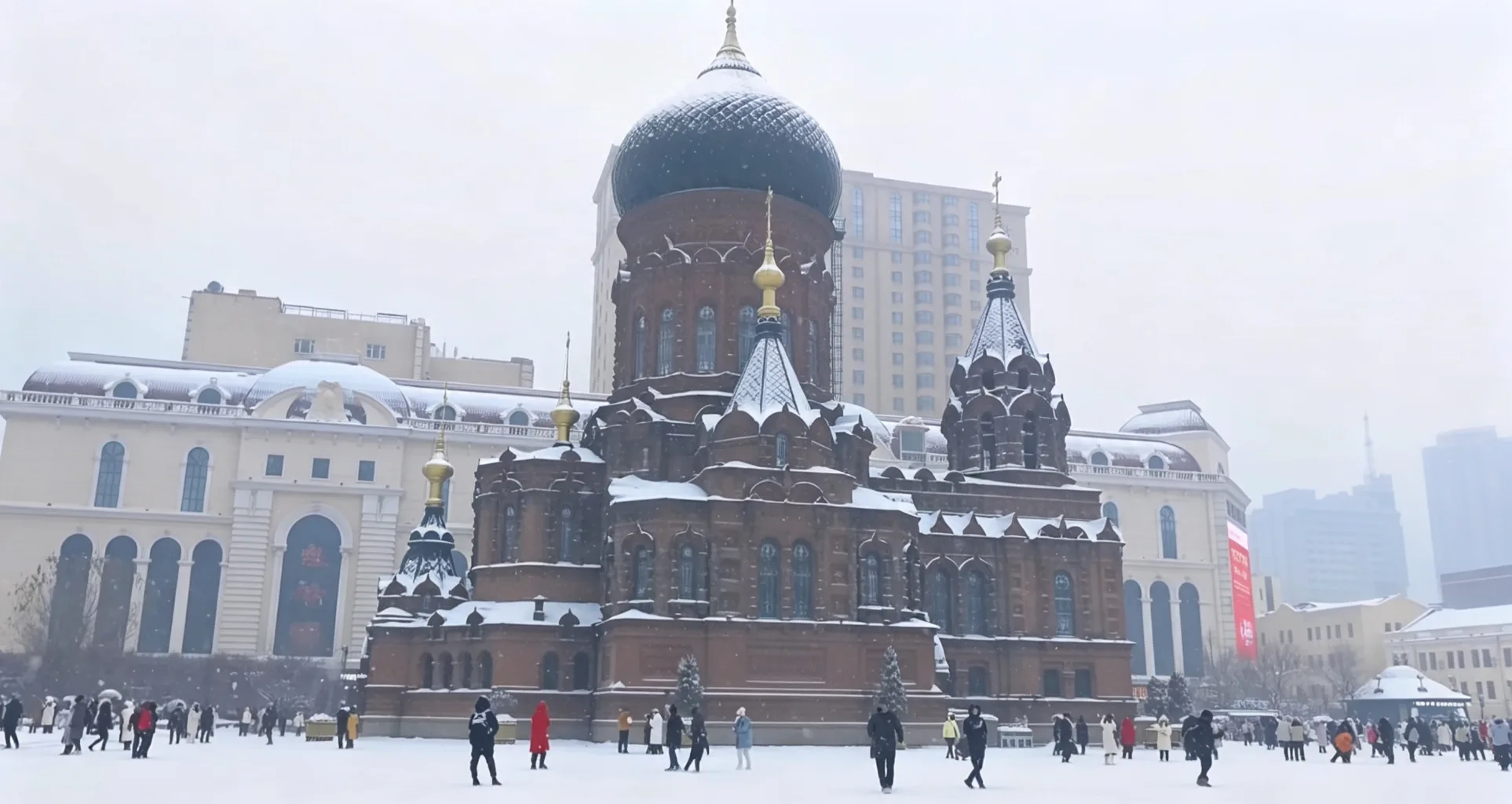
Saint Sophia Cathedral
Harbin’s postcard. Begun in 1907 and rebuilt in brick and stone in Byzantine form by 1932, it was once the largest Orthodox church in the Far East — a dark-green dome on a red-brick body. Inside is now an architecture museum.
Come in the soft morning light — pigeons, snow and the dome in one frame is the most iconic Harbin photo.
walkSt. Sophia and Central Street are both in Daoli — about 10 min apart
Central Street
Central Street is Harbin’s point of origin: it grew up with the wharf district after the Chinese Eastern Railway broke ground in 1898, was first called “China Street”, and in the 1920s was paved with Russian-style cobblestones over its roughly 1,450 metres. More than seventy European buildings line it — Renaissance, Baroque, eclecticism and Art Nouveau — once housing Russian banks, trading houses and cafés. Walk it and you feel the “Moscow of the East” underfoot and overhead.
It is also the best base in town: north to the Songhua, east to St Sophia, and easy for eating, shopping and setting out.
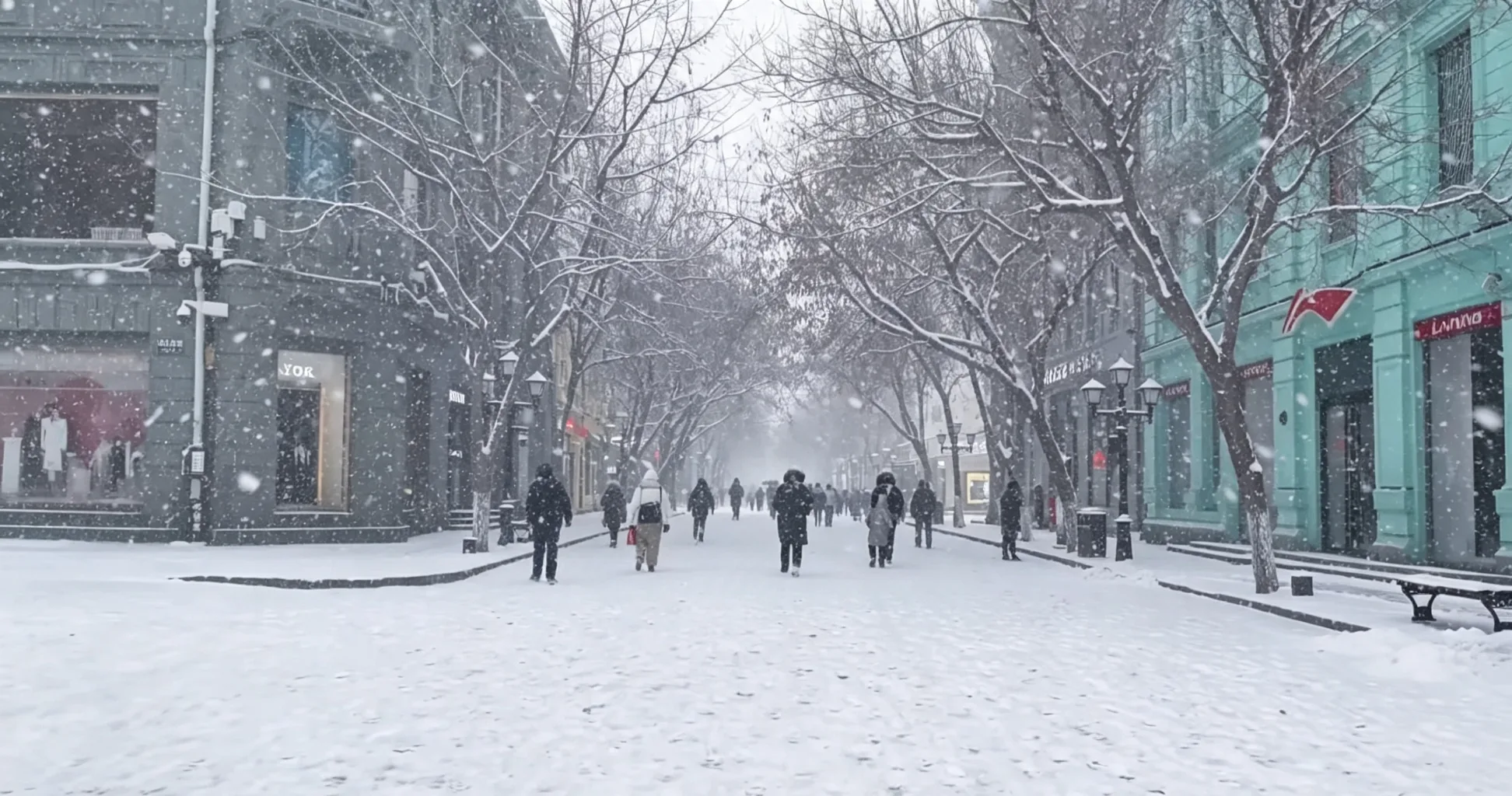
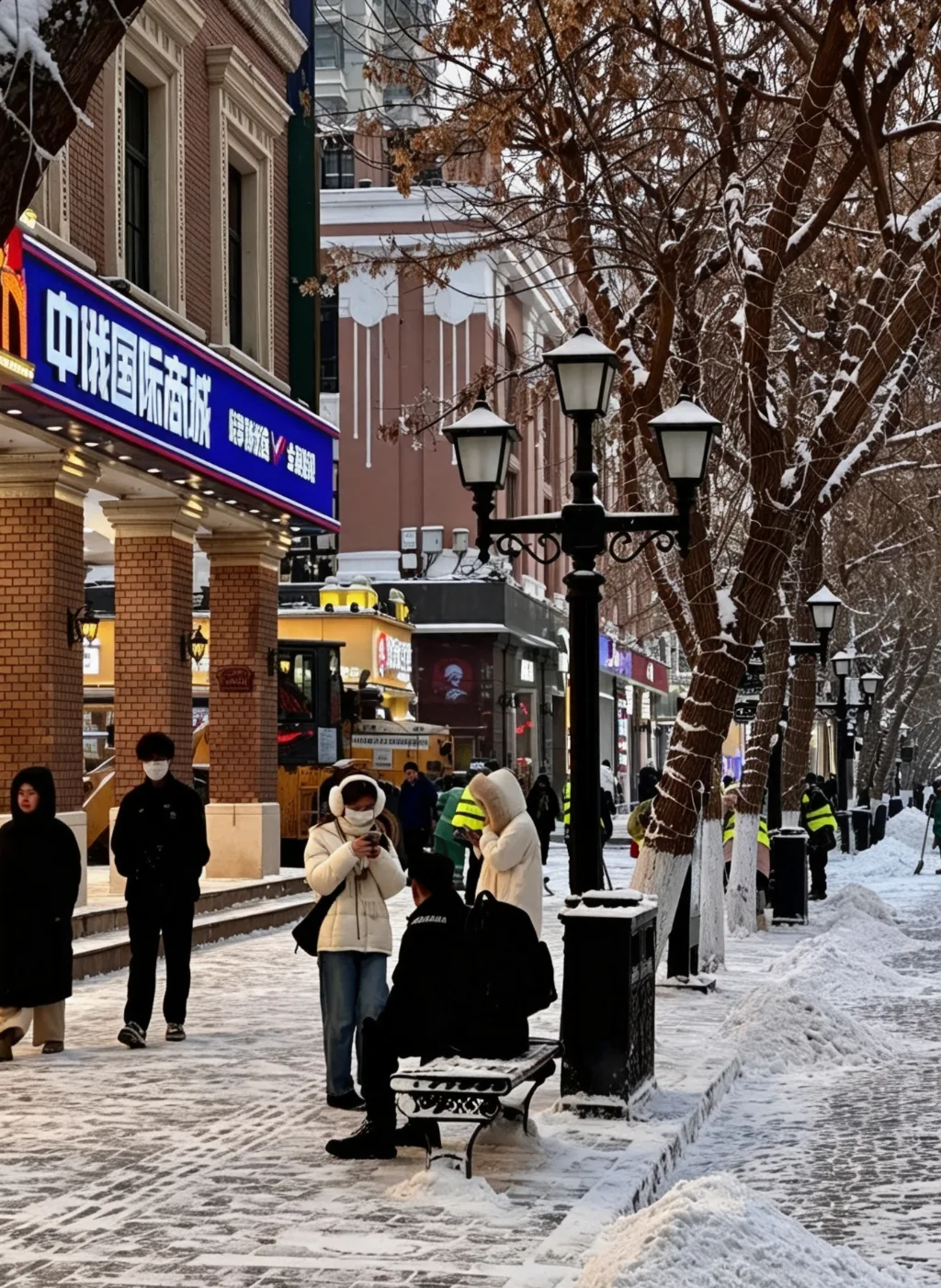
walkCentral Street runs north to the Songhua; down the steps by the Flood Memorial Tower to the frozen river — ~15 min, which is why they share a day
Songhua River ice
On the frozen river, go tubing or try the “hot-water-to-ice” photo on an open, city-facing ice sheet. See this day’s schedule for timing.
Once frozen, the Songhua becomes Harbin’s largest public square: snow walls mark out squares for tubing, ice bikes and off-road cars, and the gaps between them are the walking routes. Getting onto the ice is free; you pay only for the rides.
What to play on the ice
- Snow tubing: ride a big tyre down a snow slope, around ¥30 (≈$4.2) a run — the most popular ride, for kids and adults alike.
- “Hot water to ice” photo: fling a cup of hot water into the air and it freezes into a cloud of mist — only below −20°C, best backlit in the morning.
- Ice bikes / ice off-road cars: lap the squares marked by snow walls — fast and thrilling; dress warm.
- Ice bicycles / spinning tops: slower fun, good with kids and for unhurried photos.
- Sunset & city lights: stand mid-river at dusk and watch the sun drop behind the city as the far bank lights up.
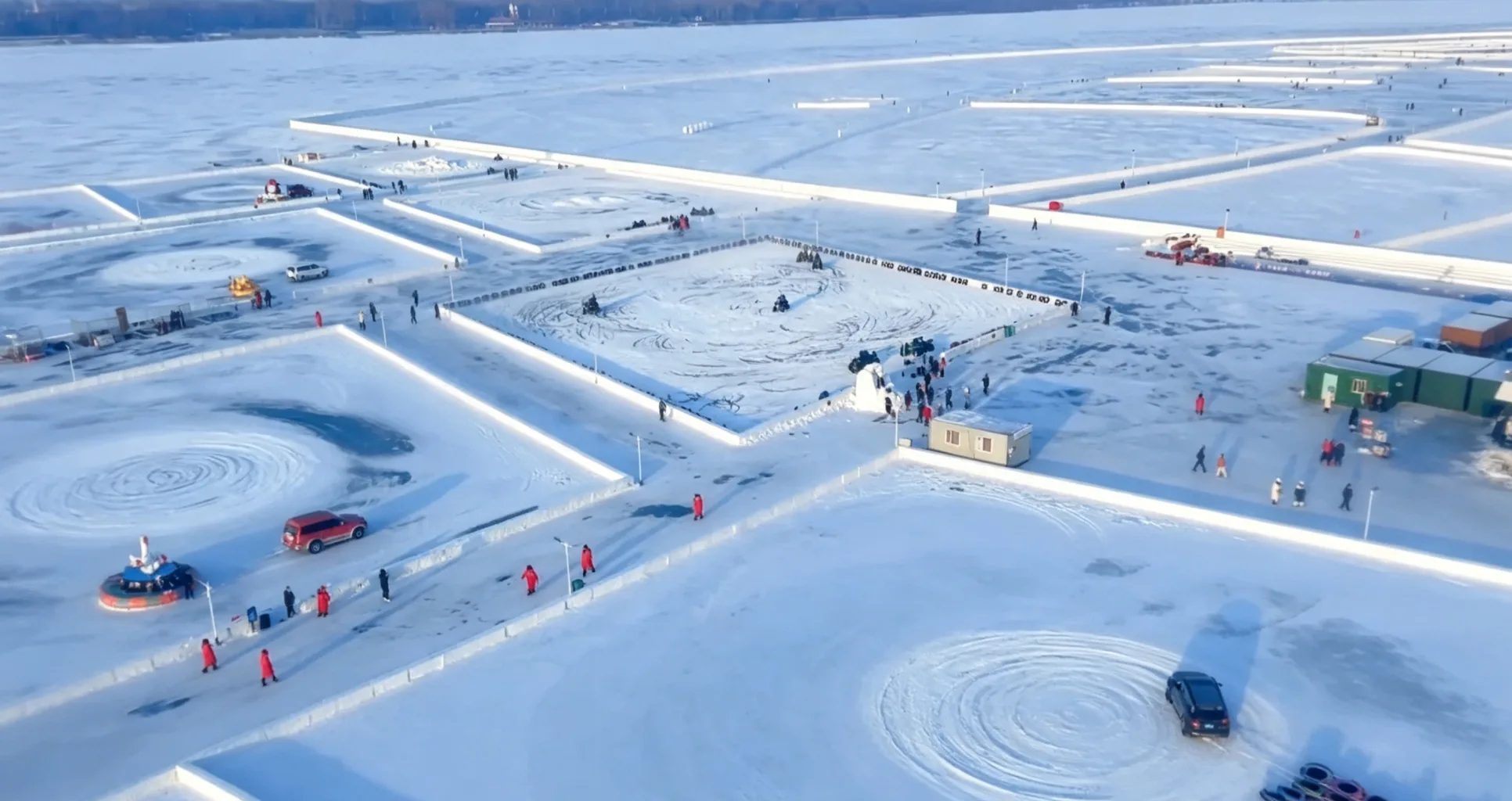
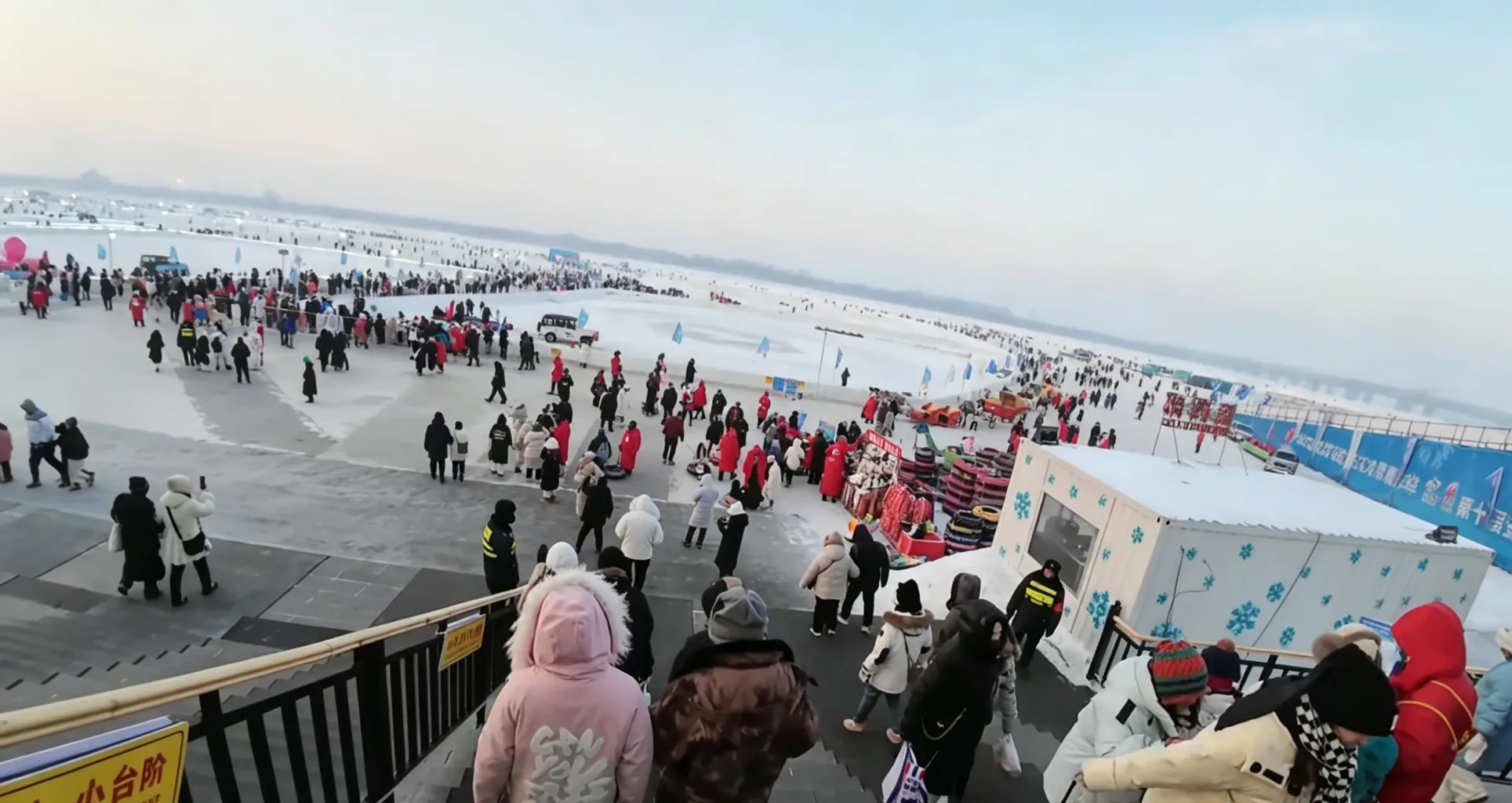
walkZhaolin Park sits by the river at Central St.’s end — about 5 min from the ice
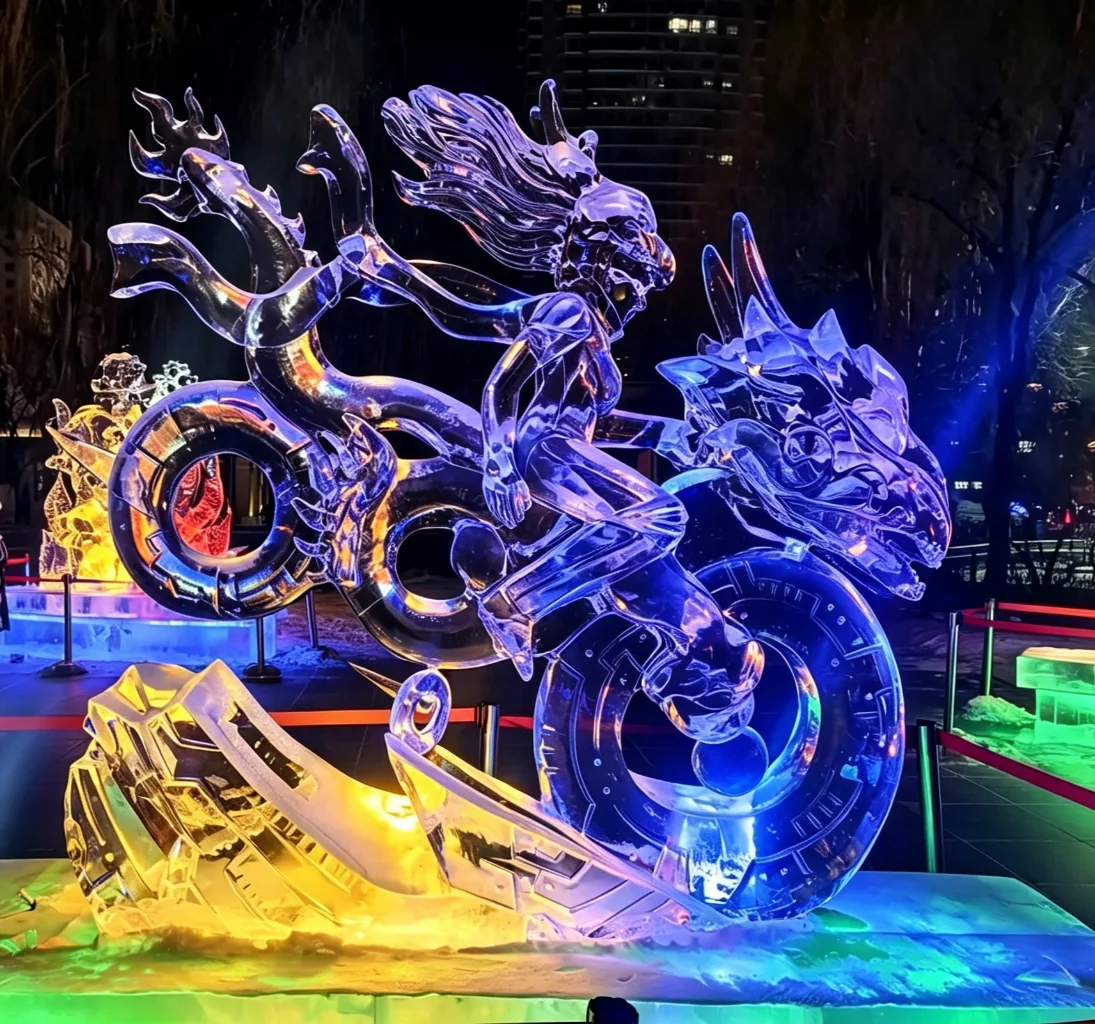
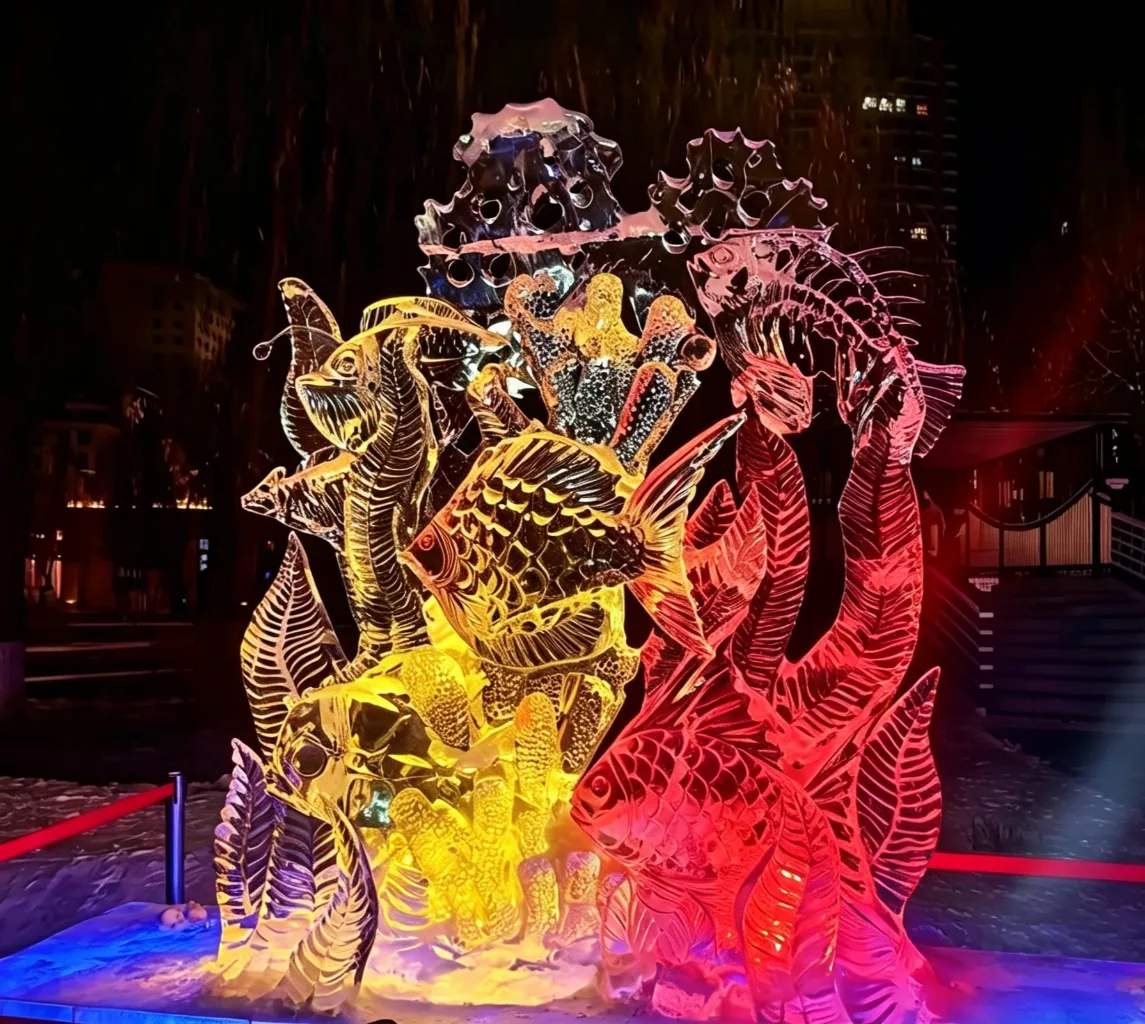
Under construction · stay tuned
Zhaolin Park Ice-Lantern Party — not yet open this season
The works above — Future Machine and Blue Movement — are standout pieces from past editions; this season’s (2026–2027) ice lanterns have not opened and are still being carved. The official opening date is not yet announced; based on past years it should open in late December (often around Dec 30), roughly 10:00–21:00 daily, free and no booking. Exact date and theme follow the official notice — stay tuned.
Zhaolin Park · winter ice lanterns
Right at the end of Central Street by the Songhua River, this is the birthplace of Chinese ice-lantern art — the first ice-lantern garden party was held here in 1963, and it has run for more than fifty editions since. It plays a different game from Ice and Snow World: the latter builds vast ice architecture from hundreds of thousands of cubic metres of ice and adds a giant slide, a Ferris wheel and mass dance parties — a theme park at heart. Zhaolin is aboutrefined, traditional ice lanterns: small sculptures with internally dyed ice, ice corridors and red lanterns, where the draw is light and craft in a compact garden best enjoyed slowly.
The ice-lantern party opens in late December (recently around 30 December) and runs to late February or early March, weather permitting. Hours are 10:00–21:00 daily; it photographs best once the lights come on, so come after 16:30.Entry is free and needs no reservation— just walk in. The garden is small: about 1–1.5 hours to loop and photograph. Metro Line 3 stops at Zhaolin Park.
🍽️ Eating on this day
Breakfastat the Hongzhuan Street Market: tofu pudding, fried cakes, sticky-bean buns and a glass of kvass.Lunchon Central Street — the Modern ice pop is a local ritual even at −20°C; for Russian fare try Huamei or Modern restaurant.Dinnerback near Sophia / Central Street: Laochujia (one origin of guobao rou) or Portman are all within reach.
Day 1 schedule
| Time | Activity | Play | Commute |
|---|---|---|---|
| 06:30–08:00 | Hongzhuan Street Market breakfast | 1.5 h | — |
| 08:30–09:30 | St. Sophia | 1 h | 10–15 min |
| 09:30–11:30 | Walk Central Street | 2 h | — |
| 11:30–13:00 | Lunch | 1.5 h | — |
| 13:30–15:30 | → → Central St. north → Songhua ice | 2 h | 15 min |
| 15:30–17:00 | Warm up at hotel / hot drink on Central St. | — | — |
| 17:30–19:00 | Dinner | 1.5 h | — |
| 19:00–20:30 | Zhaolin Park night ice lanterns | 1.5 h | 5 min |
DAY 2 · North bank: Siberian Tiger Park → Sun Island → Ice and Snow World
Siberian Tiger Park
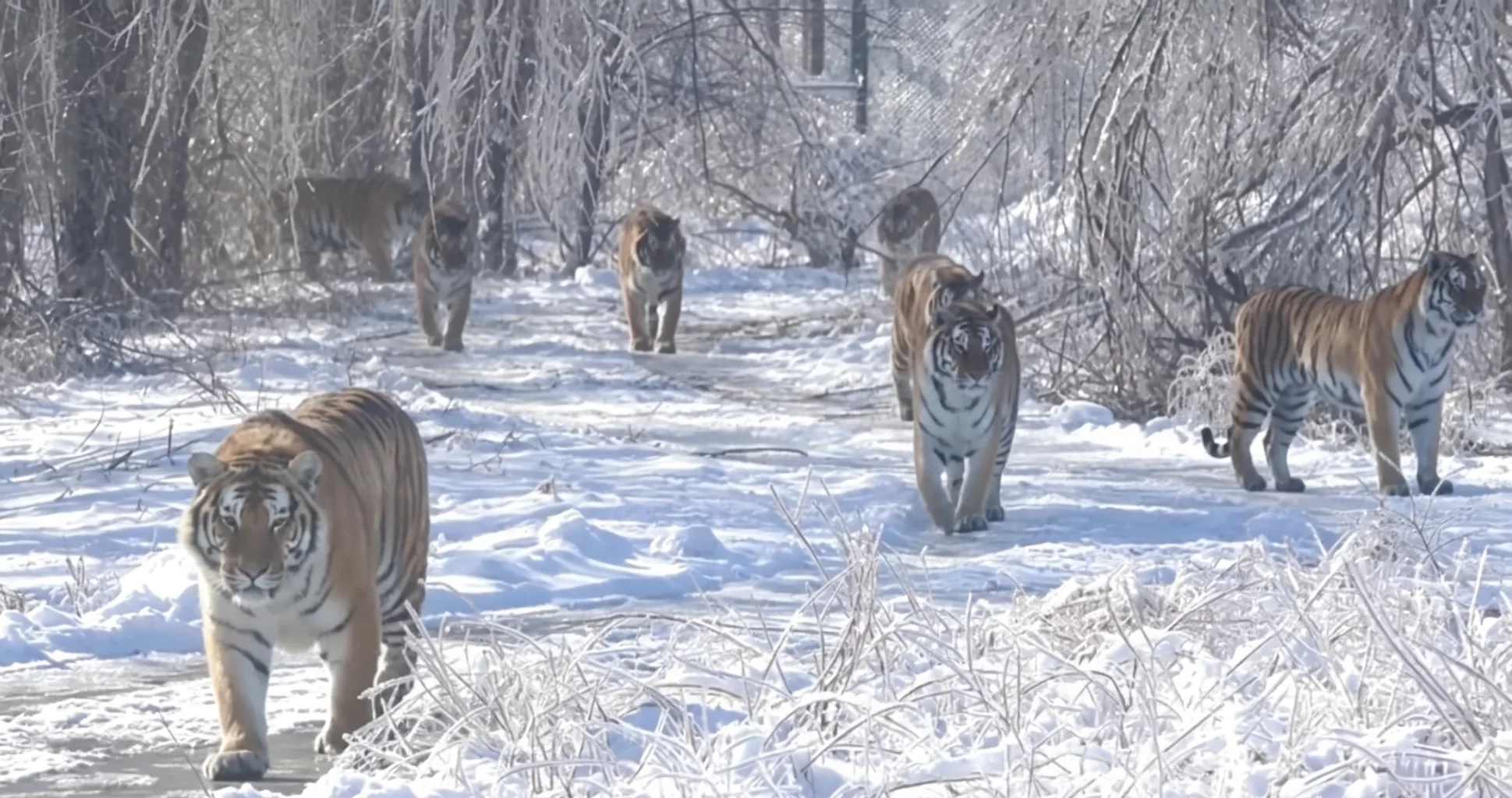
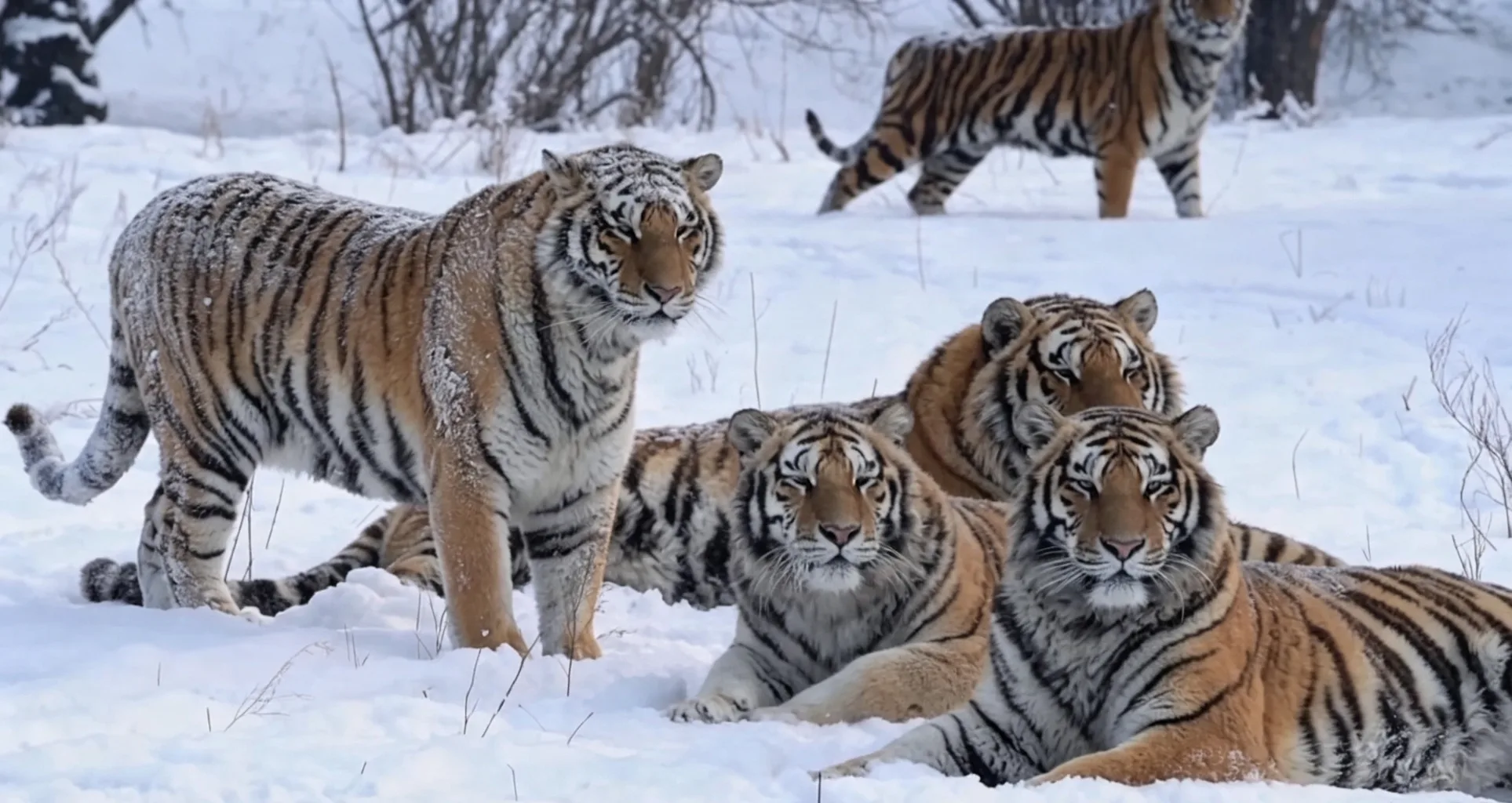
The world’s largest Amur tiger breeding base. Ride the dedicated shuttle into the wild zone to watch free-roaming tigers stroll through the snow; the Northeast “king” is closer than you think.
The park sits in Songbei, about 40 minutes across the river from Central Street. The shuttle is enclosed but the windows crack open, and the tigers often walk right alongside it; they are most active around 9–10 a.m. and mostly still by afternoon. Admission including the shuttle runs about ¥90–110 (≈$12.5–15.3) — check the park’s notice on the day.
taxiThe Tiger Park and Sun Island are ~12 km apart across a river branch — about 20–25 min by taxi/drive, no walk or shuttle
Sun Island snow expo
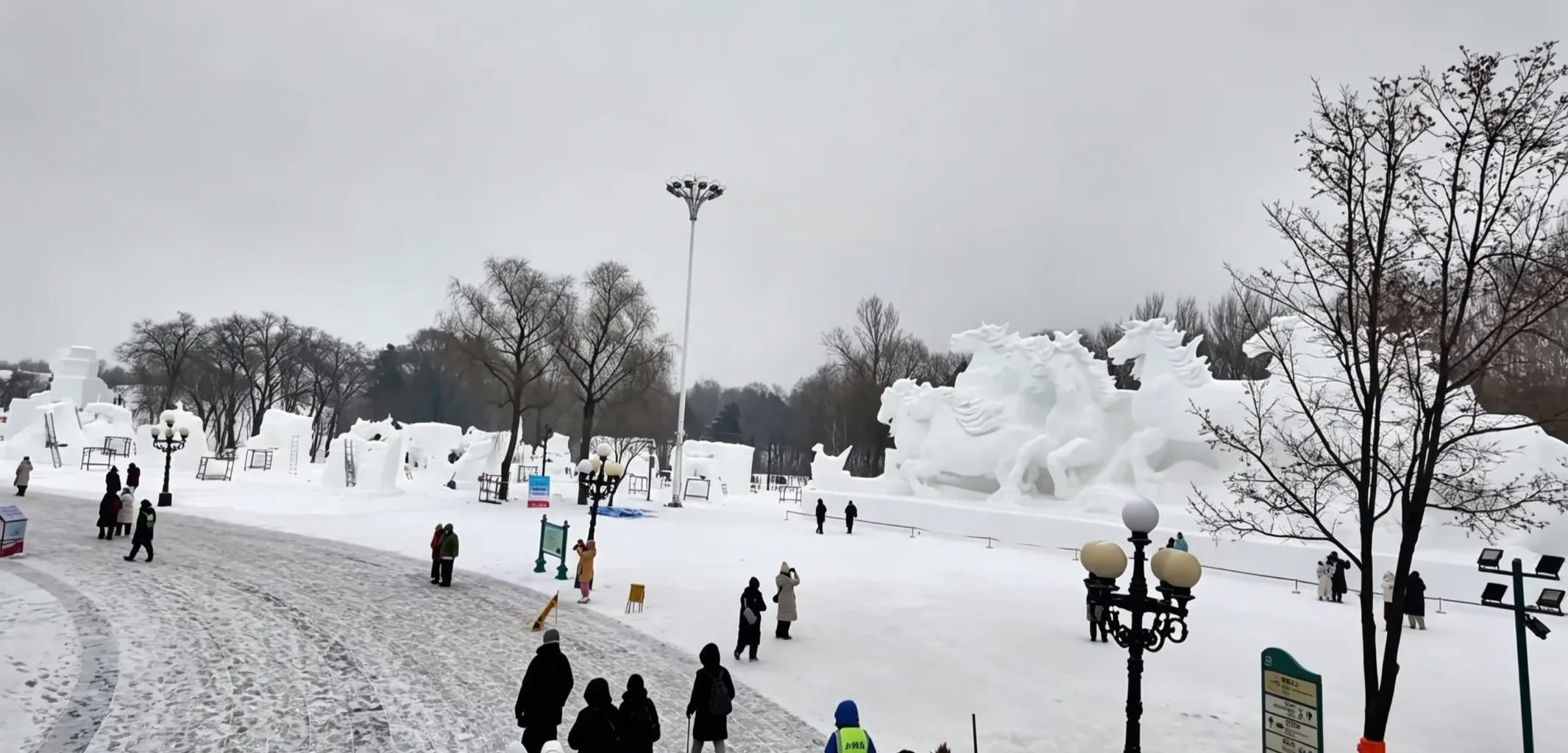
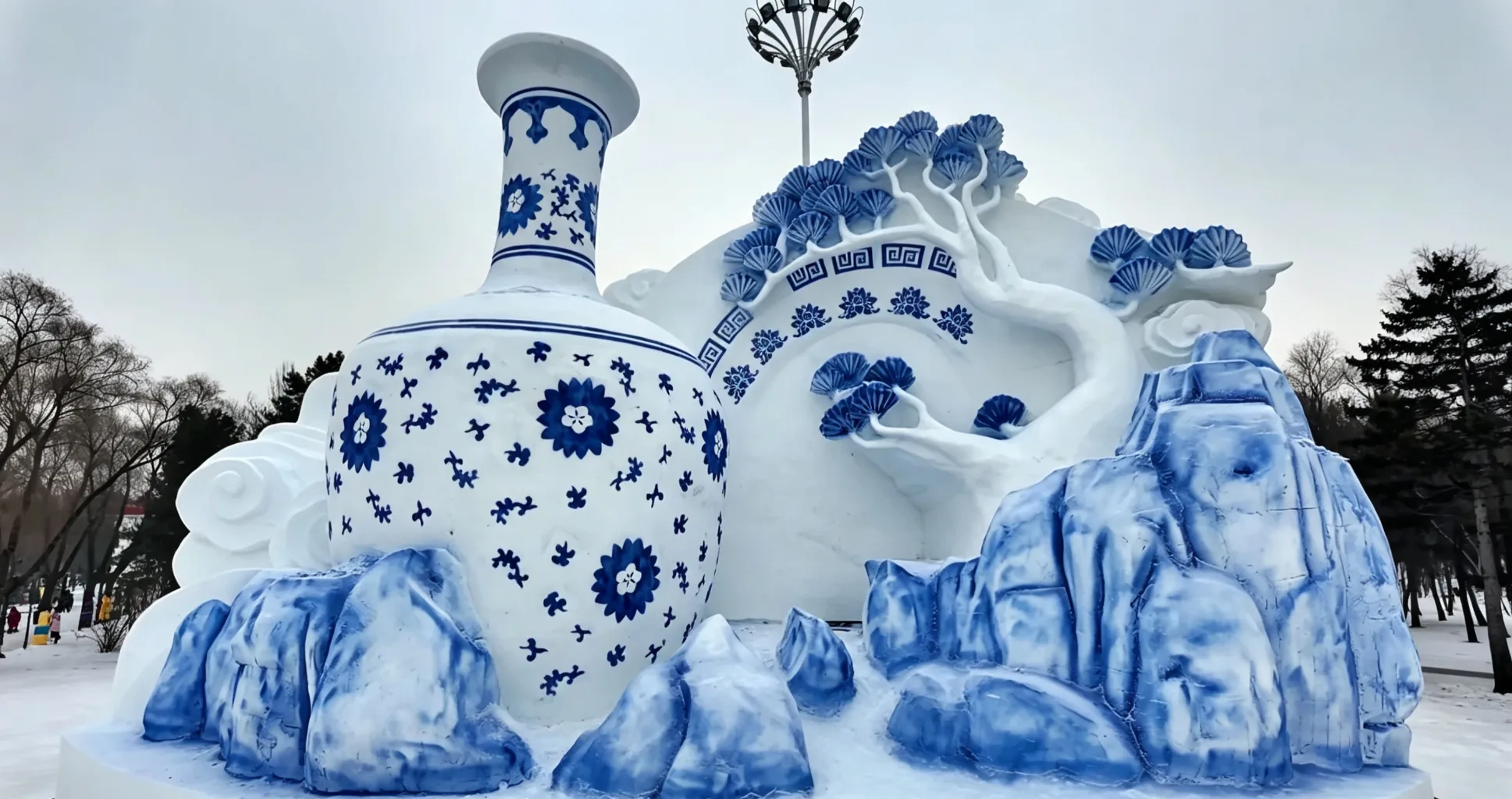
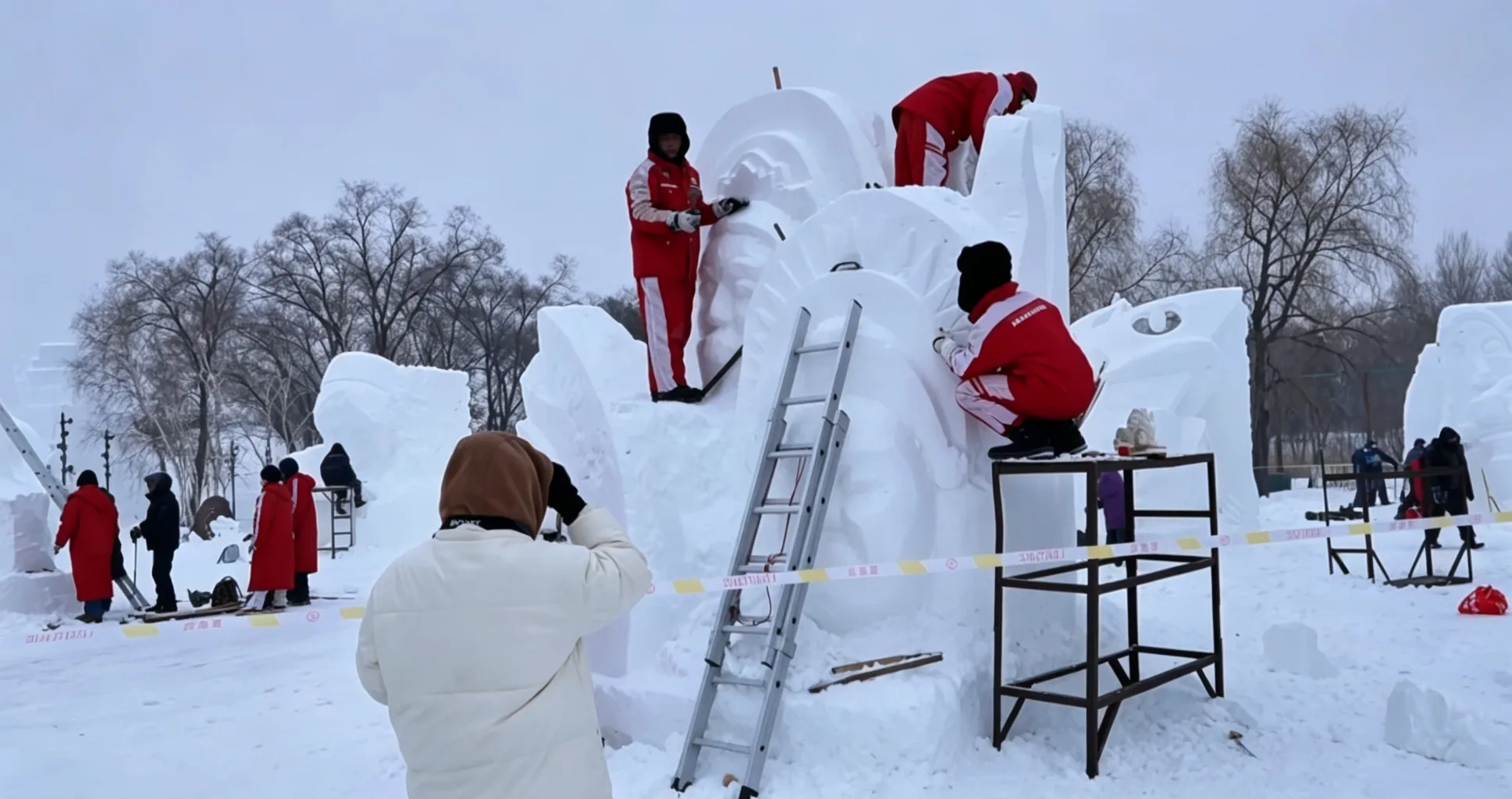
The largest snow-sculpture exhibition in the country, held on Sun Island itself. It opens in late December and runs to the end of February; admission is ¥198 (about $27.5).
Snow sculpture and ice sculpture are two different crafts: ice transmits light and depends on lighting; snow is pressed into blocks and depends on mass and silhouette, so it reads best by day — and best of all under an overcast sky, when there is no harsh sun and every layer shows in shadow. A full loop takes 1–1.5 hours, and the theme changes each year.
Under construction · stay tuned
Sun Island Snow Expo — a new theme every year
The soul of the Snow Expo is its giant snow sculptures, and its theme and forms are renewed every year: last season brought galloping horses and a blue-sprayed porcelain vase; this year may bring something else entirely, with each piece differing in scale, carving and layout — so no two visits look the same. This edition is still under construction; the exact annual theme, opening date and ticket price are subject to the official announcement. Stay tuned.
metroFrom Sun Island to Ice & Snow World, Line 2 takes about 20–30 min (you can warm up at the hotel en route)
Ice and Snow World
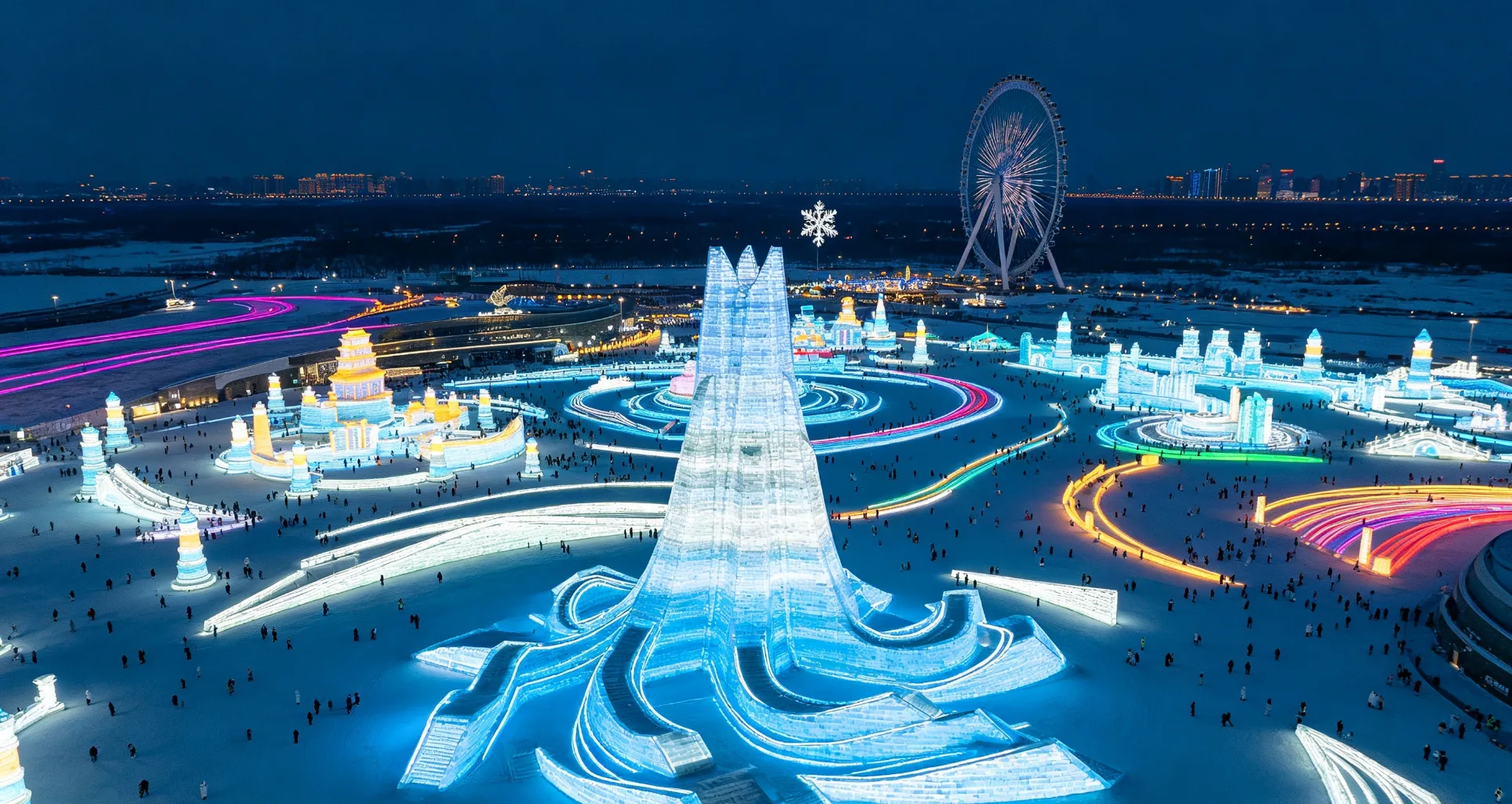
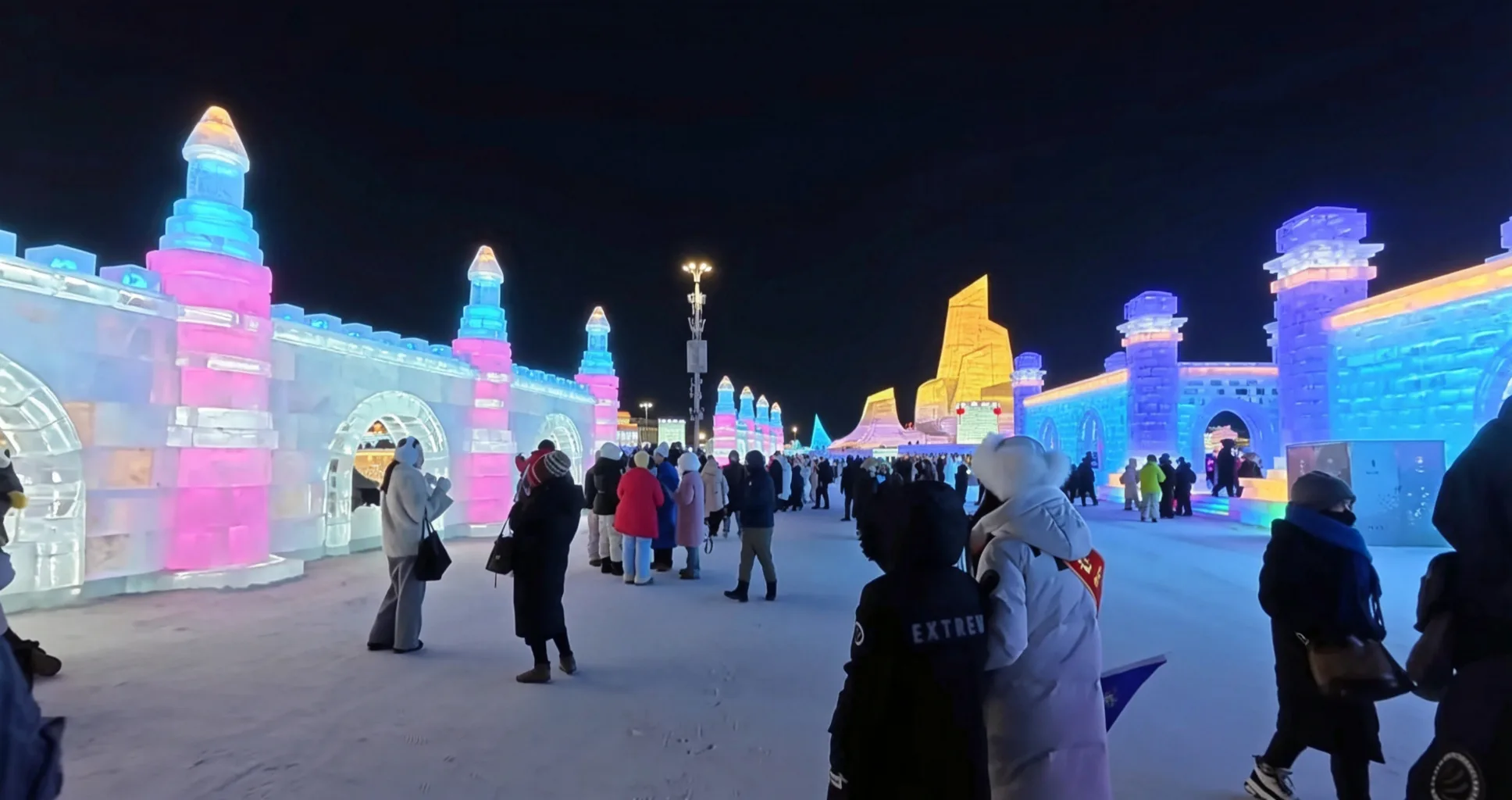
Palaces, slides and light shows carved from Songhua River ice — the world’s largest ice-and-snow theme park.Enter around 16:00: early enough to skip the evening queue peak, yet still see both daylight ice and night lights. Most visitors find it feels like two different places — by day you look at the ice, after dark you look at a city. Daylight ice is pale and translucent: you can see the seams between stacked blocks, the cracks and air bubbles frozen inside. Only when the lights come on does it become that glowing castle from the photos.
What to do at Ice & Snow World
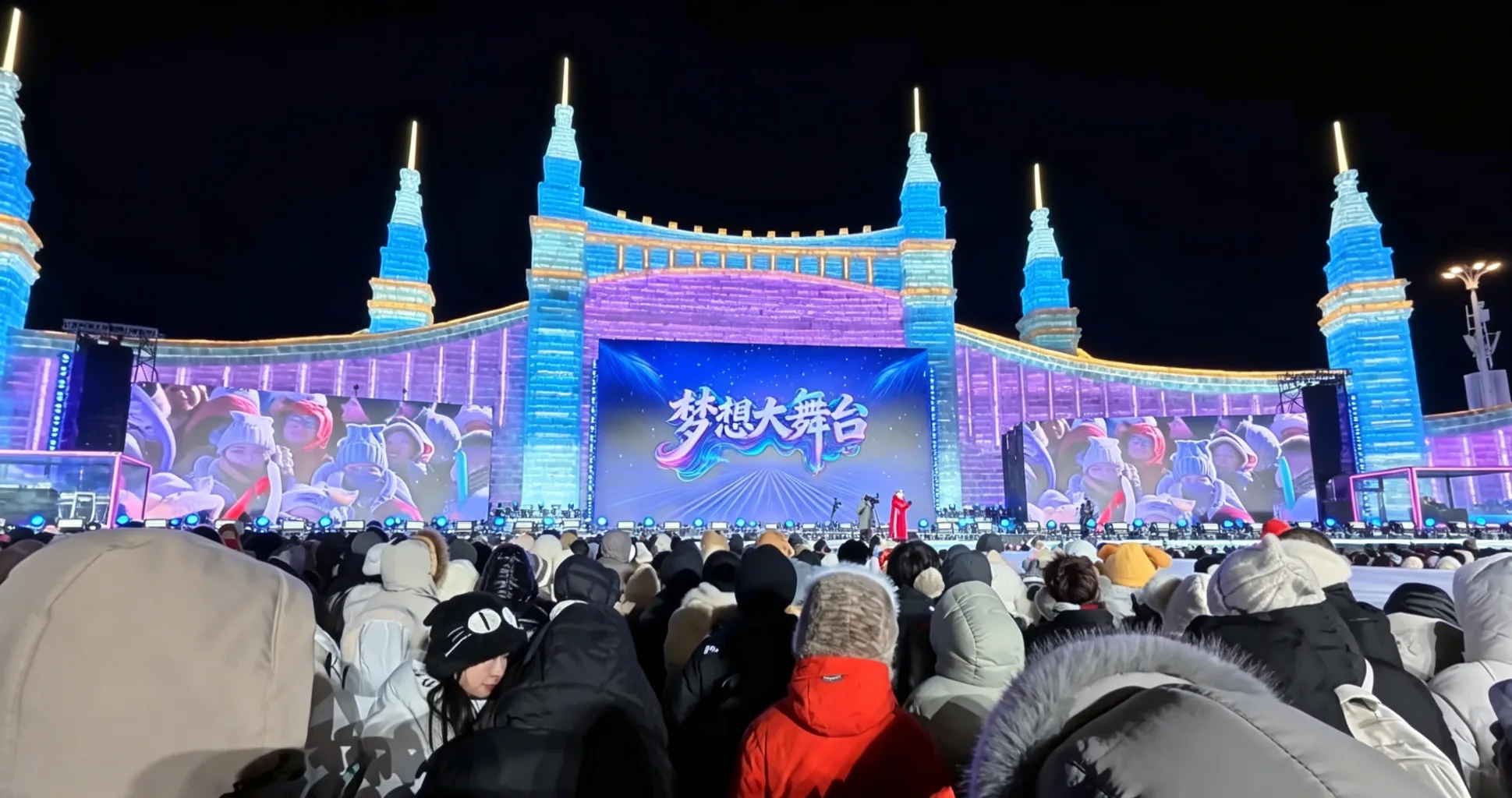
- Mass outdoor disco · Dream Stage: the park’s nightly open-air party — DJ, full lights and thousands dancing at −20°C. The park’s most famous scene; arrive early to get near the front.
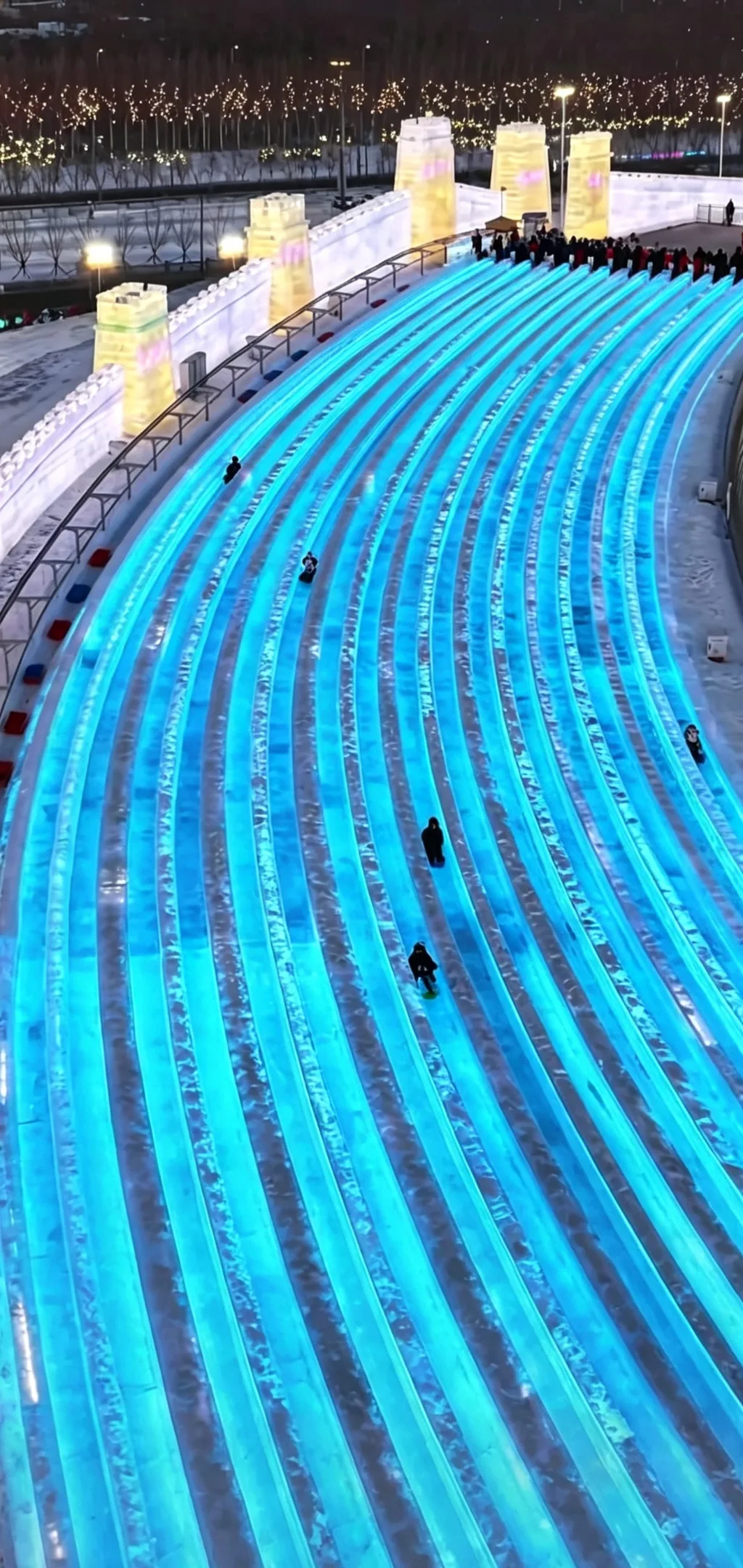
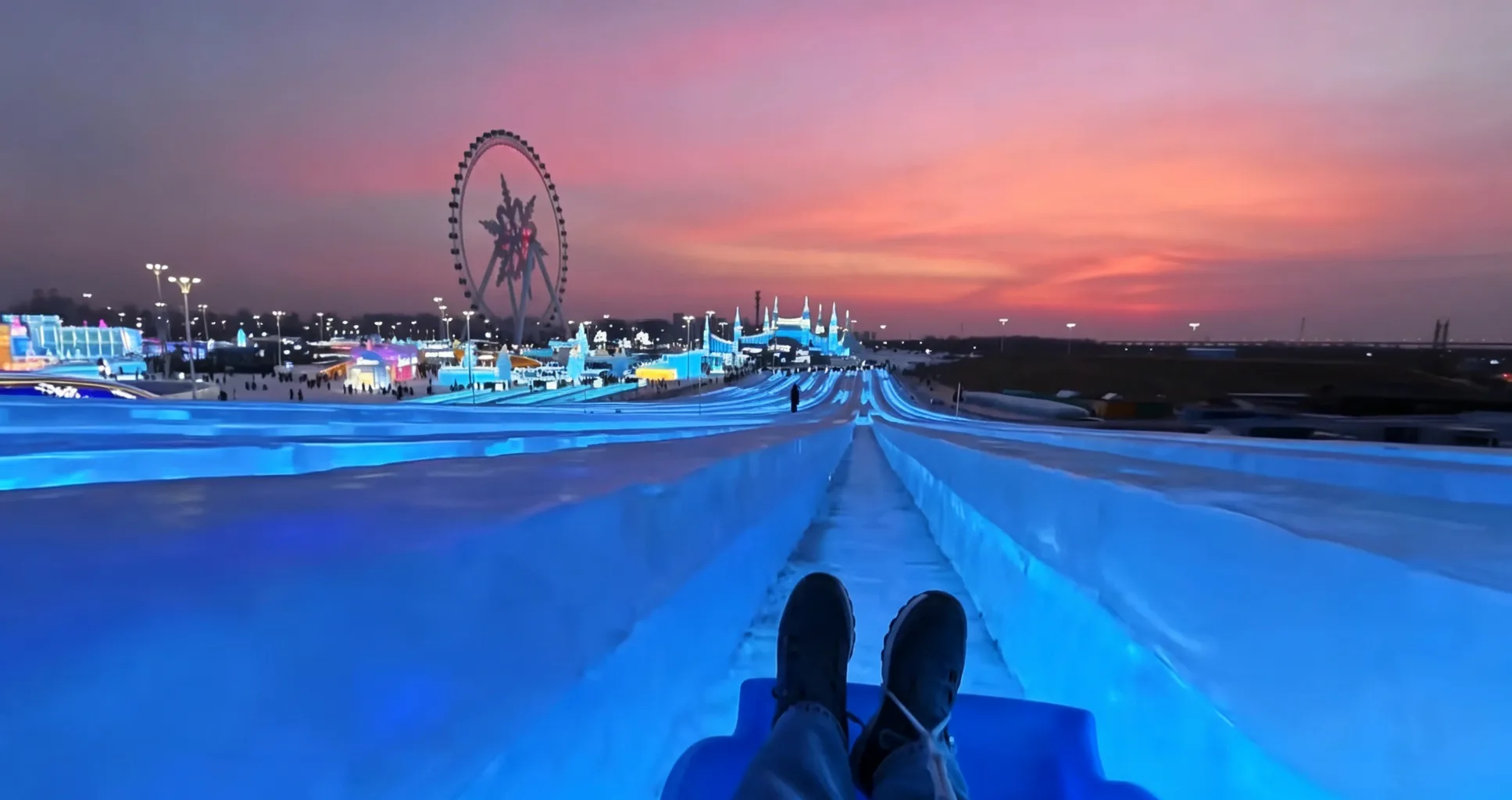
- Giant ice slide: hundreds of metres of track, under a minute down, around a 30-minute queue.Head straight here right after entering— around 16:00–17:00 the lines are shortest and you still catch the afterglow on the ice.
- Snowflake Ferris wheel: ride to the top for the whole park, the Songhua River and the towers of Jiangbei.
- Ice & snow sculpture trail: this season’s DisneyFrozencollaboration — Elsa, Anna and Olaf are all here.
- Ice activities: ice bikes, spinning tops , curling and ice dragon boats — good with kids.
- Light show & performances: check the park’s screens and announcements for show times, and don’t miss the lighting that shifts on the hour.
⏱Queueing tips: the park is huge, and the slide, Ferris wheel and mass disco often mean 30 minutes to over an hour of waiting in peak season. Do the big slide first right after entering (16:00–17:00 is quietest); ride the Ferris wheel after dark when the lights are on and the line moves better; use the heated rooms, hot drinks and restrooms inside to warm up — don’t try to tough it out.
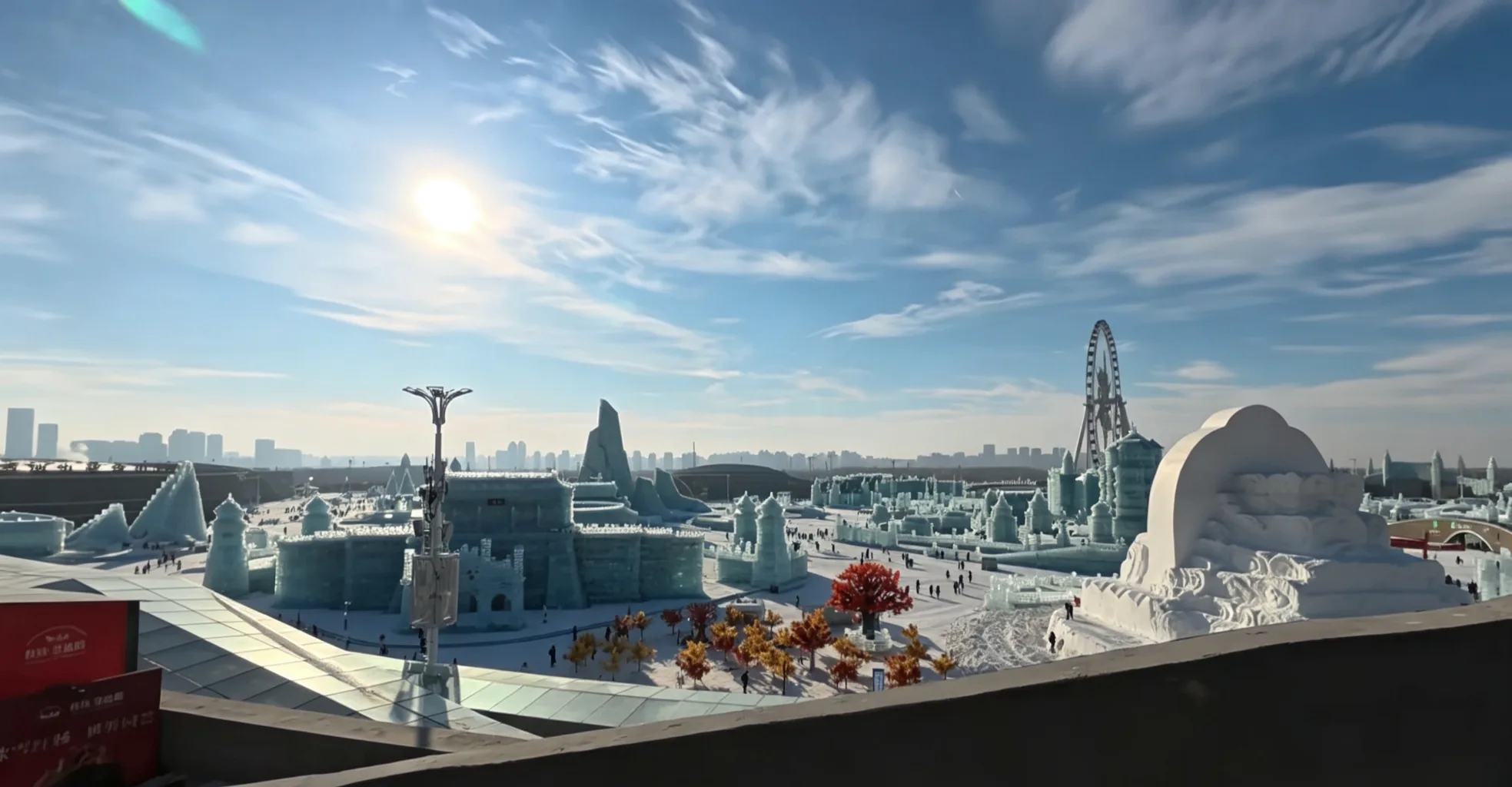
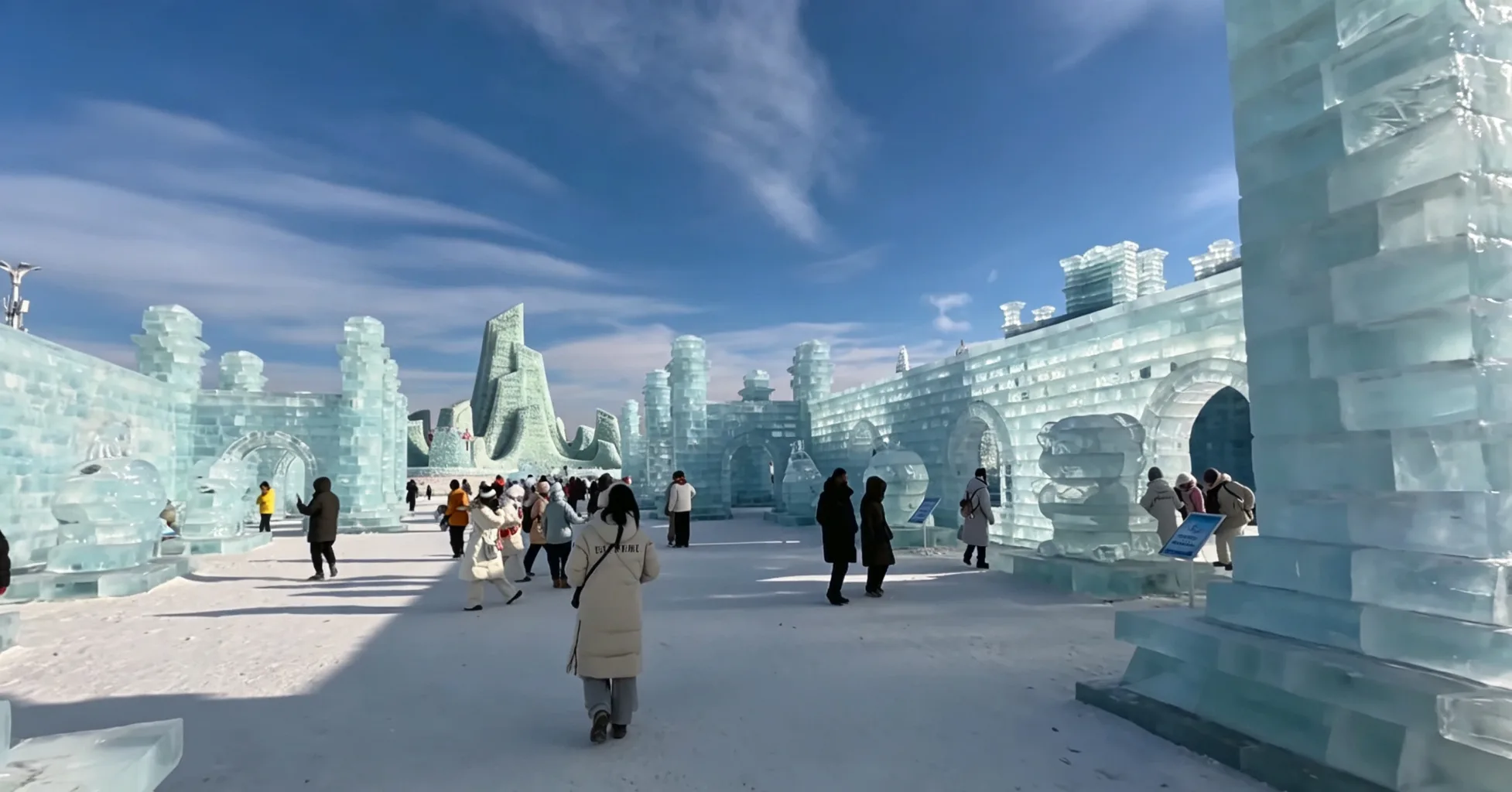
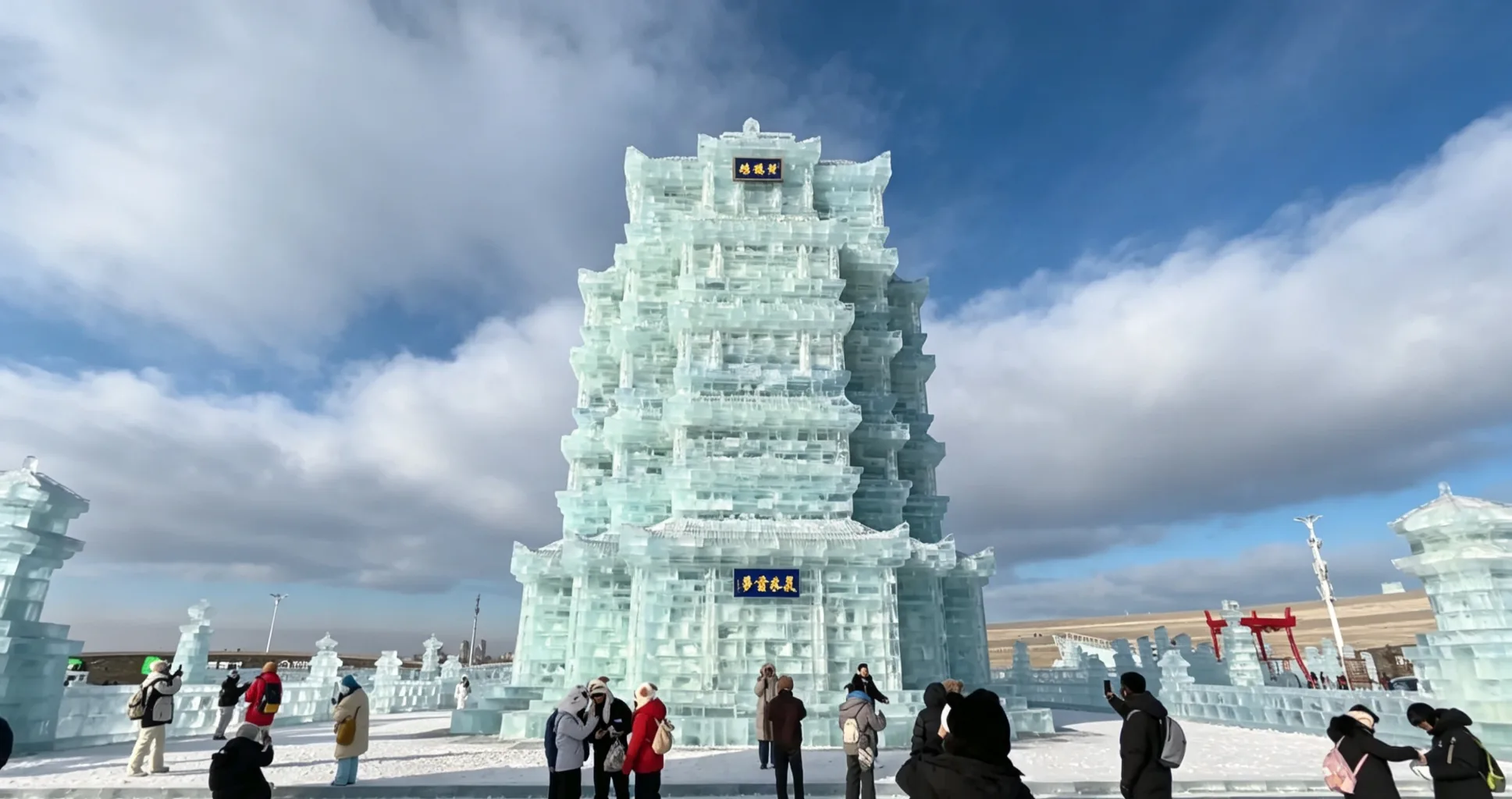
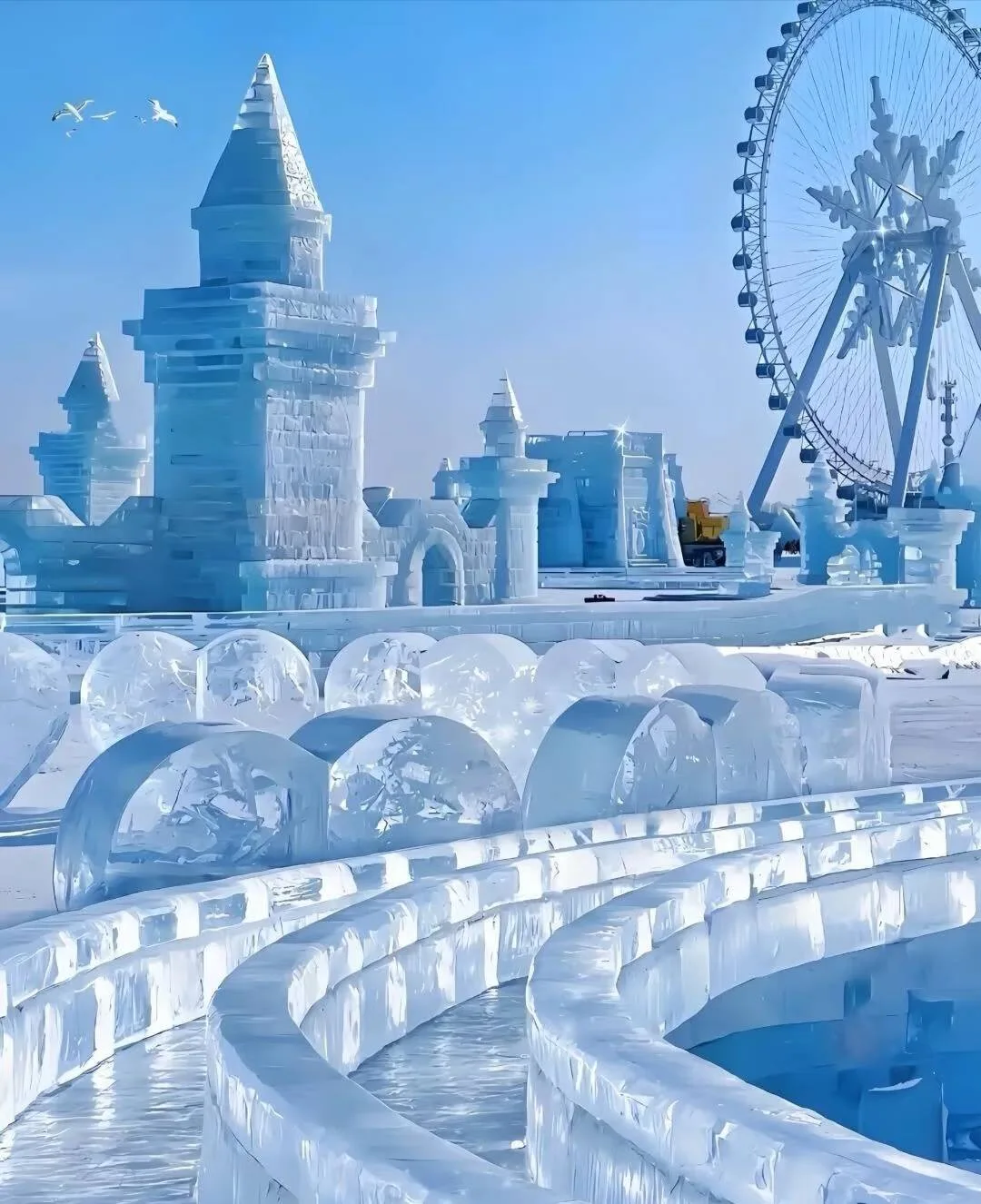
· 2025 / Harbin Ice & Snow World — daytime, photographed in 2025
After dark: the park lights up
It is dark by about 16:00, and the lights come on group by group. The ice is the same ice, but walls that read pale blue by day are now lit from within, shifting through blue, violet, orange and pink. The four frames above are daytime; the five below are the same park after dark.
🍽️ Eating on this day
Breakfastat the hotel, eat well before crossing.Lunchon Sun Island or in Songbei — there are snacks on the island, or bring food from Central Street.Dinnerafter the night show, back south of the river to Central Street / Sophia is easiest; food inside Ice and Snow World is pricey, so eat after you leave.
Day 2 schedule (north-bank)
| Time | Activity | Play | Commute |
|---|---|---|---|
| 08:00–08:40 | Cross to Songbei | — | ~40 min |
| 08:40–11:00 | Tiger Park | 2 h+ | shuttle |
| 11:00–11:25 | To Sun Island | — | 20–25 min |
| 11:25–12:30 | Snow expo | 1 h | — |
| 12:30–13:30 | Lunch | 1 h | — |
| 13:30–15:00 | Rest / head to Ice & Snow World | — | 2 ~20–30 min |
| 15:30–22:00 | 16:00 +Ice & Snow World | 4 h+ | — |
Under construction · stay tuned
Harbin Ice & Snow World — 2026–2027 season (28th edition)
The park expands to 1.25 million m² with 400,000 m³ of ice and snow — the largest scale in its history. For the first time it partners with Disney China to recreateFrozenin ice: Elsa, Anna and Olaf all appear, plus a Disney-themed pop-up store. The announced plan is to open around 21 December 2026 and run through end-February 2027, with a standard ticket at ¥328 (about $46) — exact dates, prices and layout are subject to the official notice.The park is still under construction and not yet open; stay tuned.
DAY 3 · Lao Dao Wai Baroque + Architecture detour
taxiAbout 10 min from Central Street (city centre) to Lao Dao Wai; once there, the Baroque zone is compact and walkable
Architecture detour
Harbin is a city the railway built: when the Chinese Eastern Railway broke ground in 1898, a small fishing village on the Songhua became an international treaty port almost overnight. Russians, Japanese, Jews, Poles and dozens of other nationalities settled here, raising churches, theatres, banks and trading houses street by street — earning it the names “Moscow of the East” and “Paris of the Far East”. In one city you can read Orthodox, Byzantine, Art Nouveau and Zaha’s contemporary lines — it is an architecture museum in itself. If the first two days left you wanting more, these are worth the detour:
- St. Alexeyev Church: a red-and-white Russian-style brick church in Nangang, built in 1931 and converted from Orthodox to Catholic in 1980 — onion dome and open bell tower, quiet and photogenic (free outside; usually closed inside except during services).
- Gogol Street: a Russian-style boulevard in Nangang named after the writer Gogol, lined with century-old buildings and time-honoured shops — good for a stroll and a feel for the Russian-émigré era.
- China Eastern Railway Park (Songhua rail bridge): the 1901 railway bridge over the Songhua, on the Binzhou line — the very point from which Harbin grew; after a century in service the steel trusses were retired and turned into an elevated walkway above the frozen river, pure industrial drama.
- Harbin Grand Theatre: in Qunli, designed by Zaha Hadid and completed in 2015; its flowing white shell looks like ice on the river, and facing the old town’s onion domes and Baroque façades across the water, it stages a dialogue between old and new (free outside, tickets for performances).
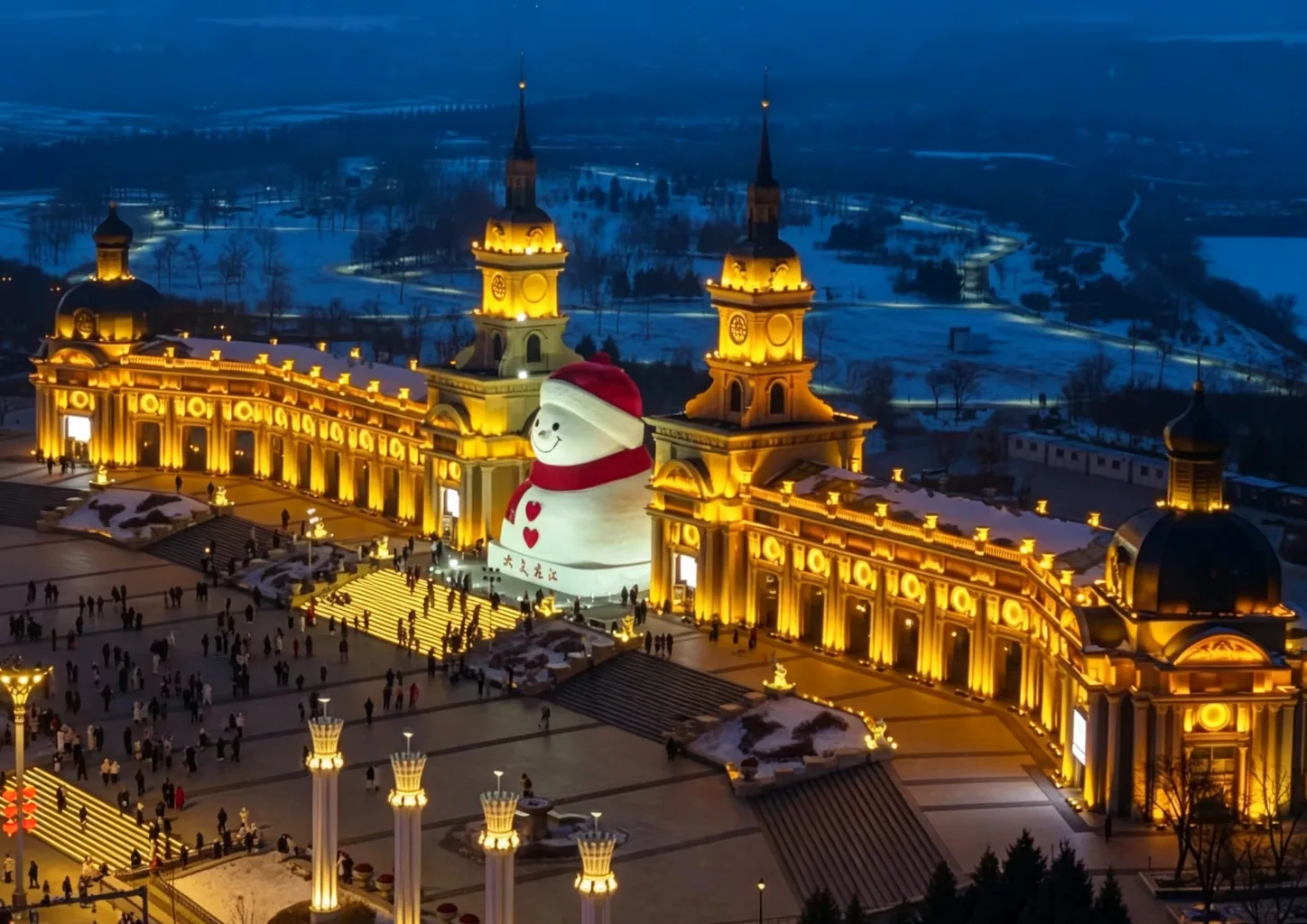
- Music Corridor (in Qunli Music Park): a long colonnade along the river, its arched bays running one after another with two clock-faced towers bracketing the walk and a cluster of green-domed pavilions at the far end; after dark the lights come up and turn the whole arcade warm gold. In winter a giant snowman — red hat, red scarf, two red hearts — stands in the middle of the square, the park’s seasonal landmark (open-air and free, accessible all day; lights on around 4 pm).
Lao Dao Wai
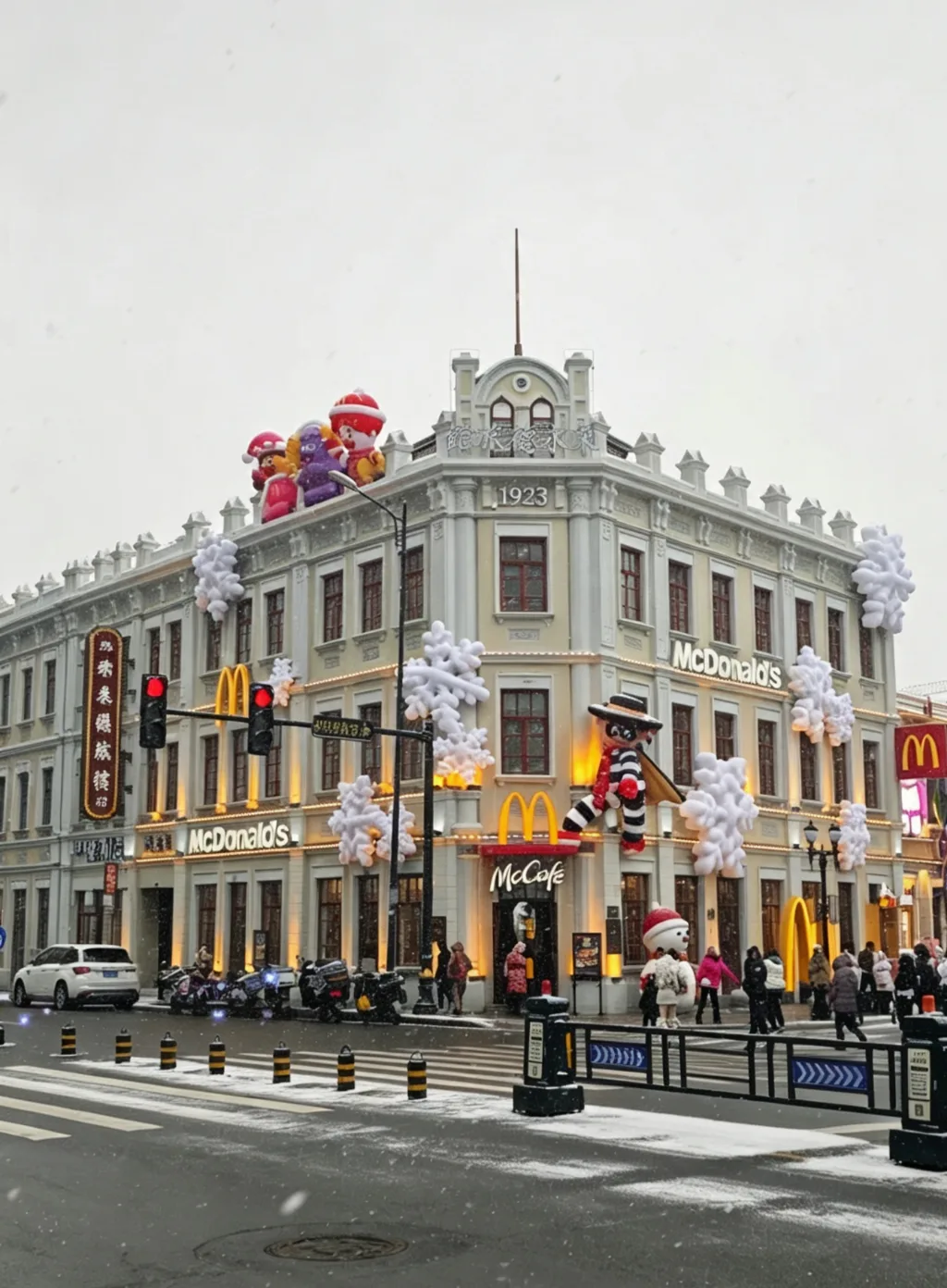
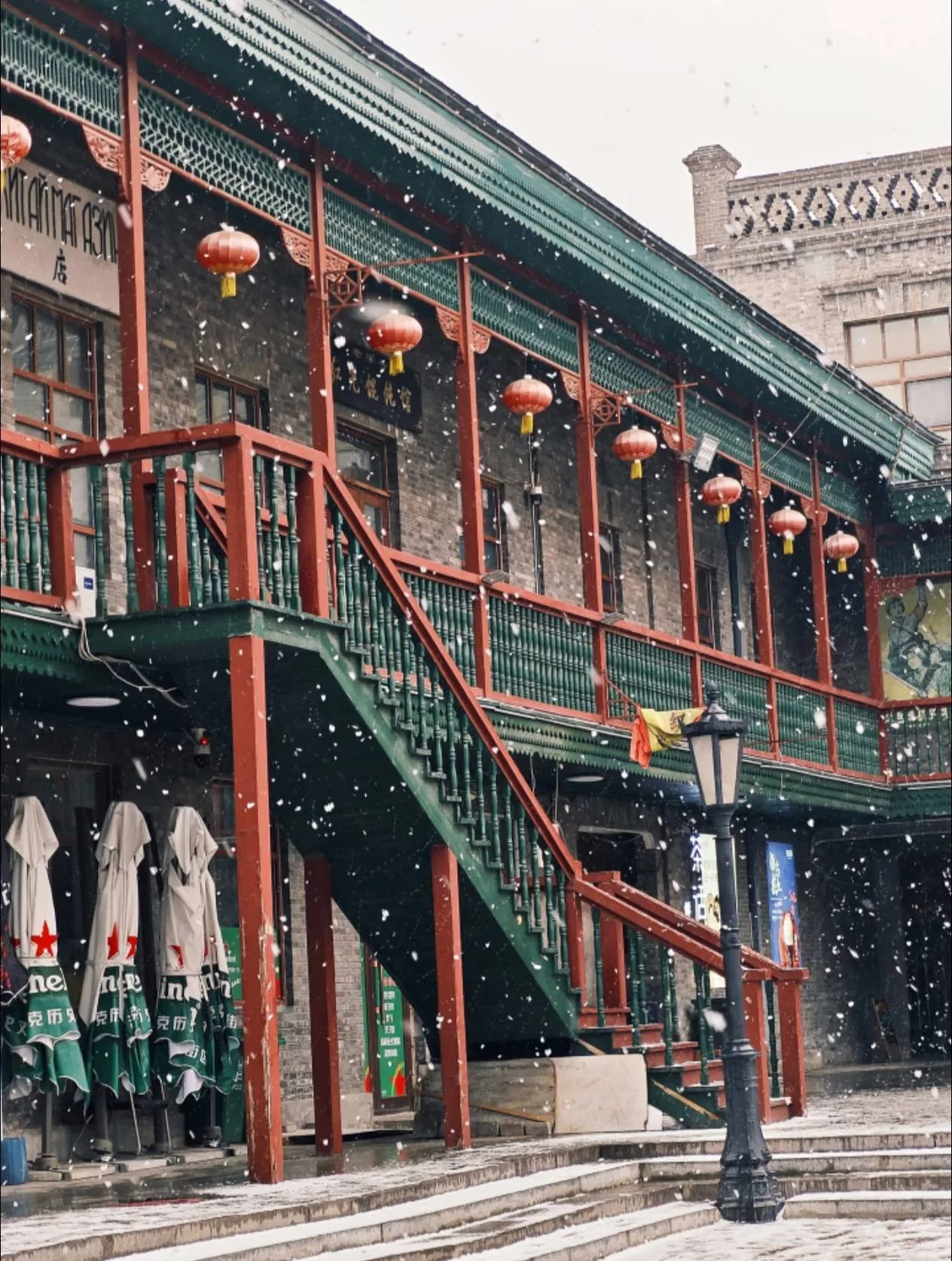
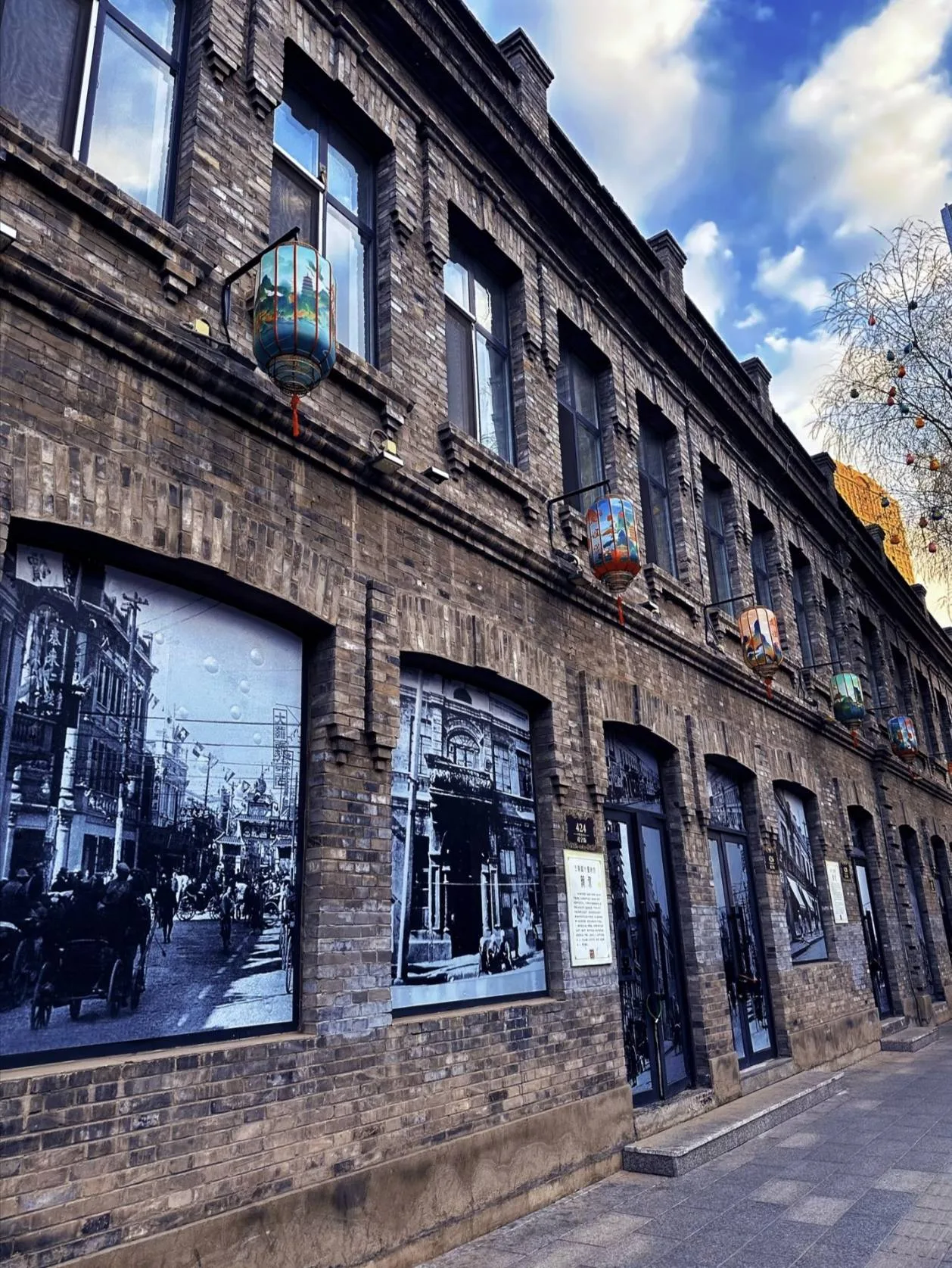
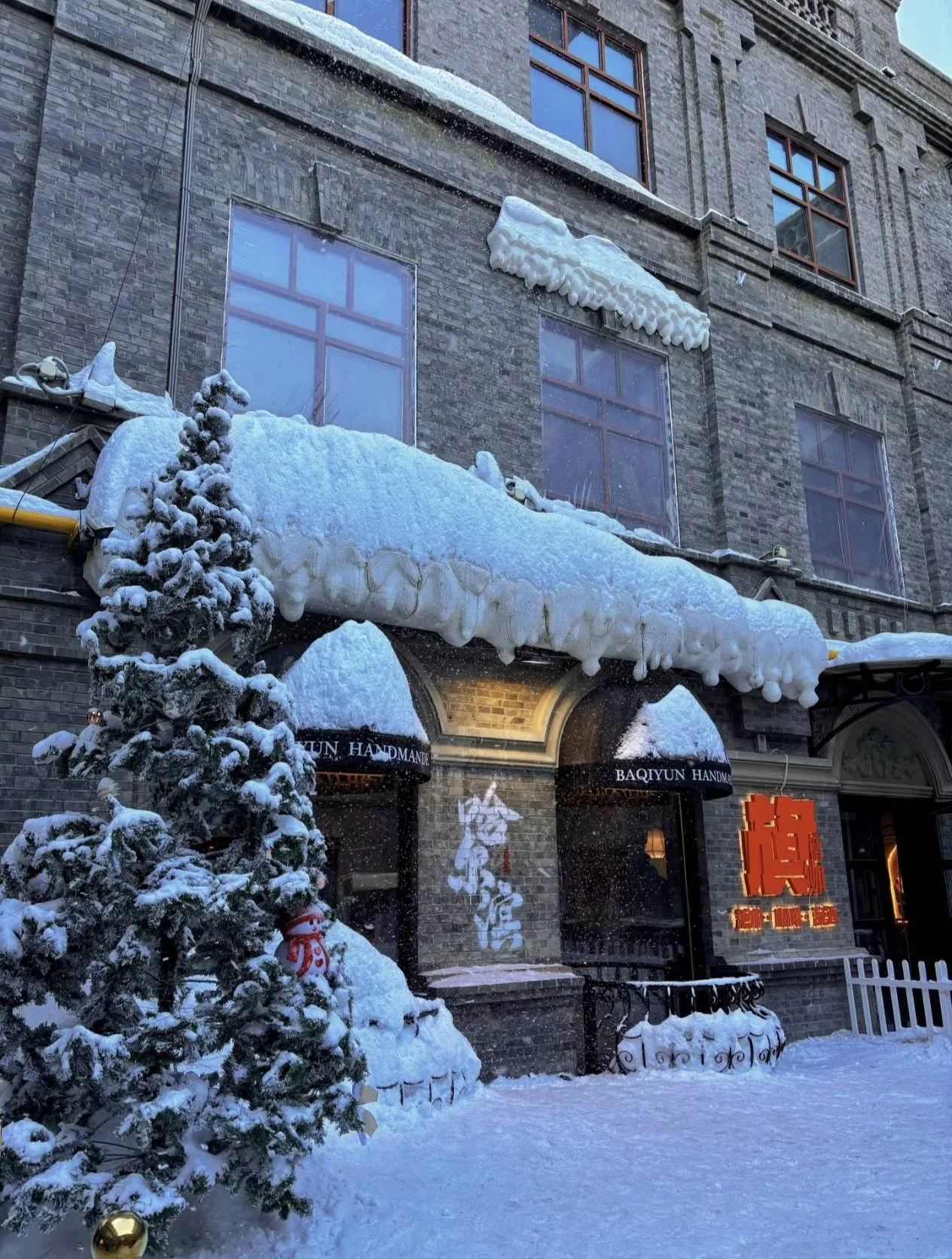
Lao Dao Wai is Harbin’s Chinese old town: in the early 20th century Chinese merchants and industrialists settled and traded here, raising rows of “Chinese Baroque” — Western Baroque façades wrapped around Chinese courtyard plans, carved with bats, peonies and pomegranates for good fortune. Around Jingyu Street whole blocks of these buildings survive, street food at ground level and century-old pediments above.
taxiAfter Lao Dao Wai, to St. Alexeyev Church (Nangang) — about 15–20 min
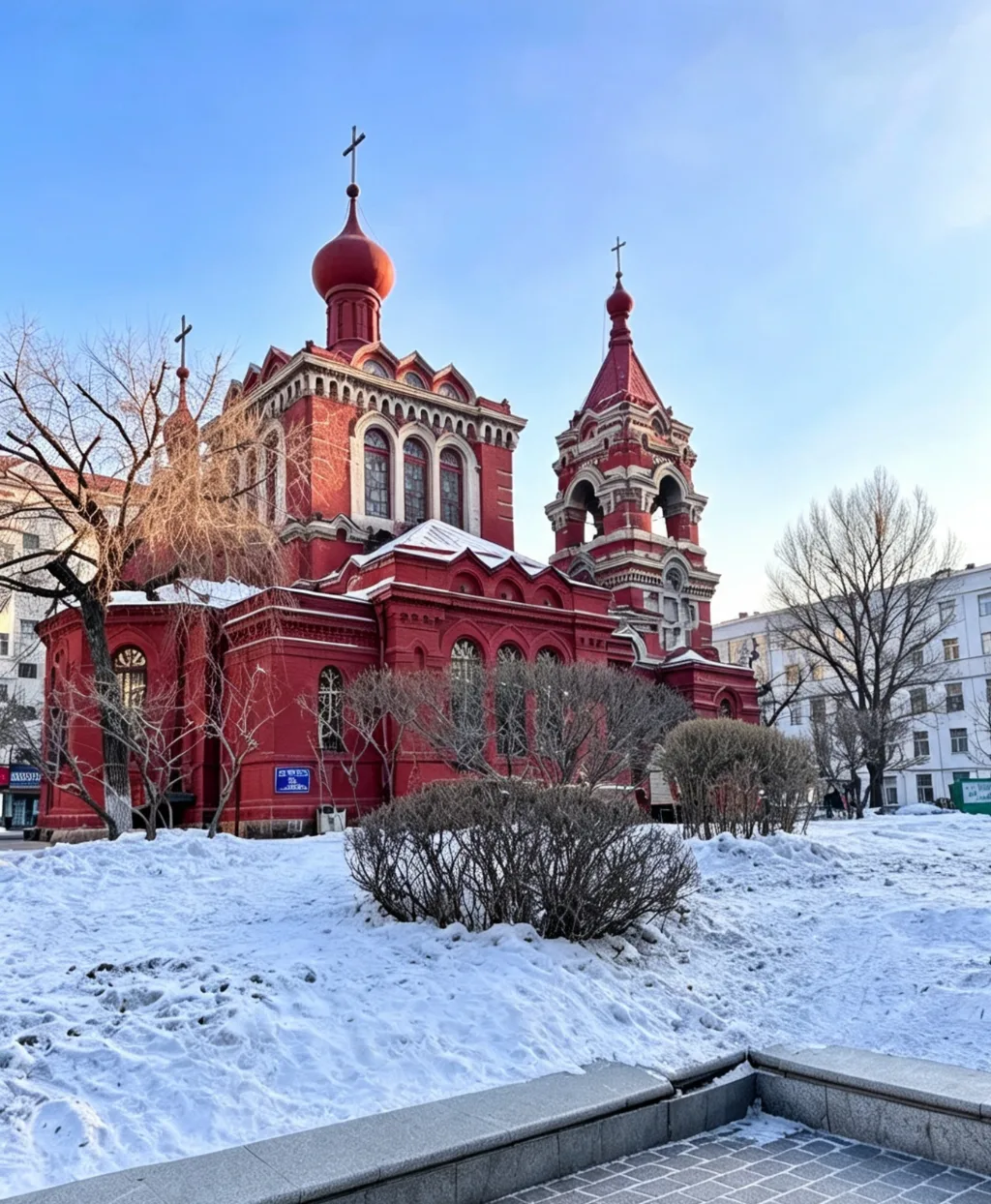
taxiSt. Alexeyev Church and Gogol Street are both in Nangang, about 10–15 min apart — easy to pair
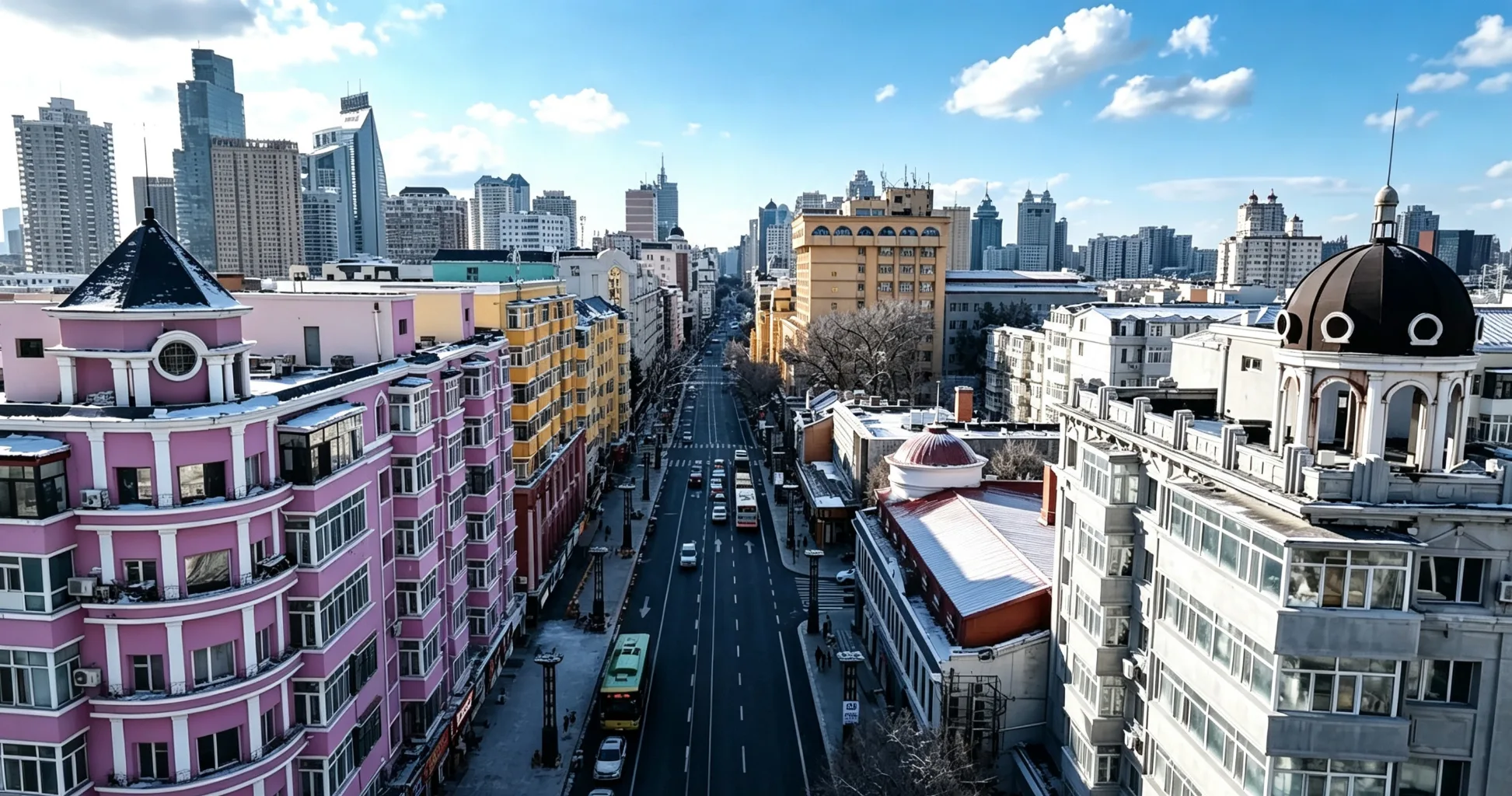
taxiGogol Street (Nangang) to the rail-bridge area — about 15–30 min
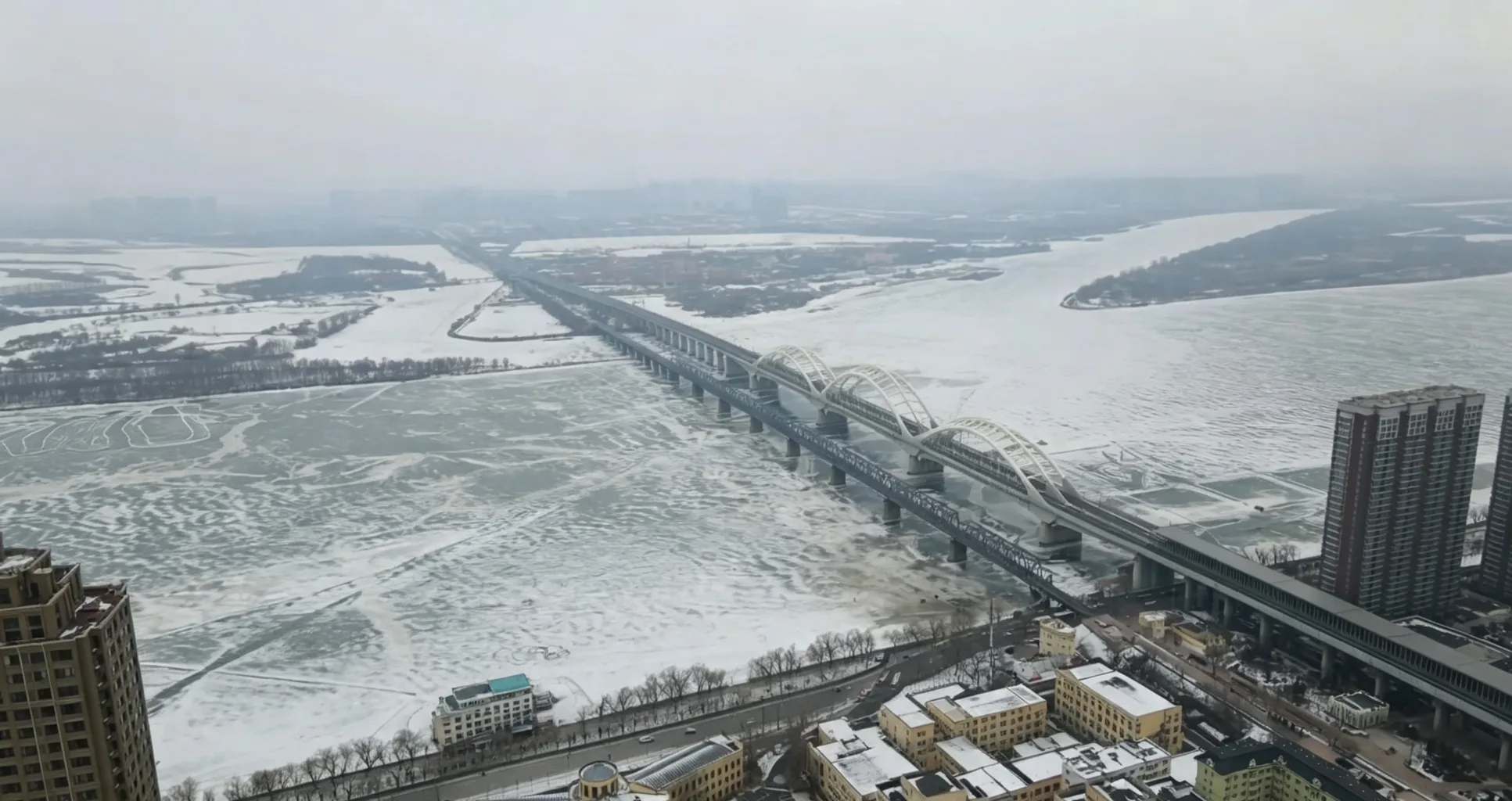
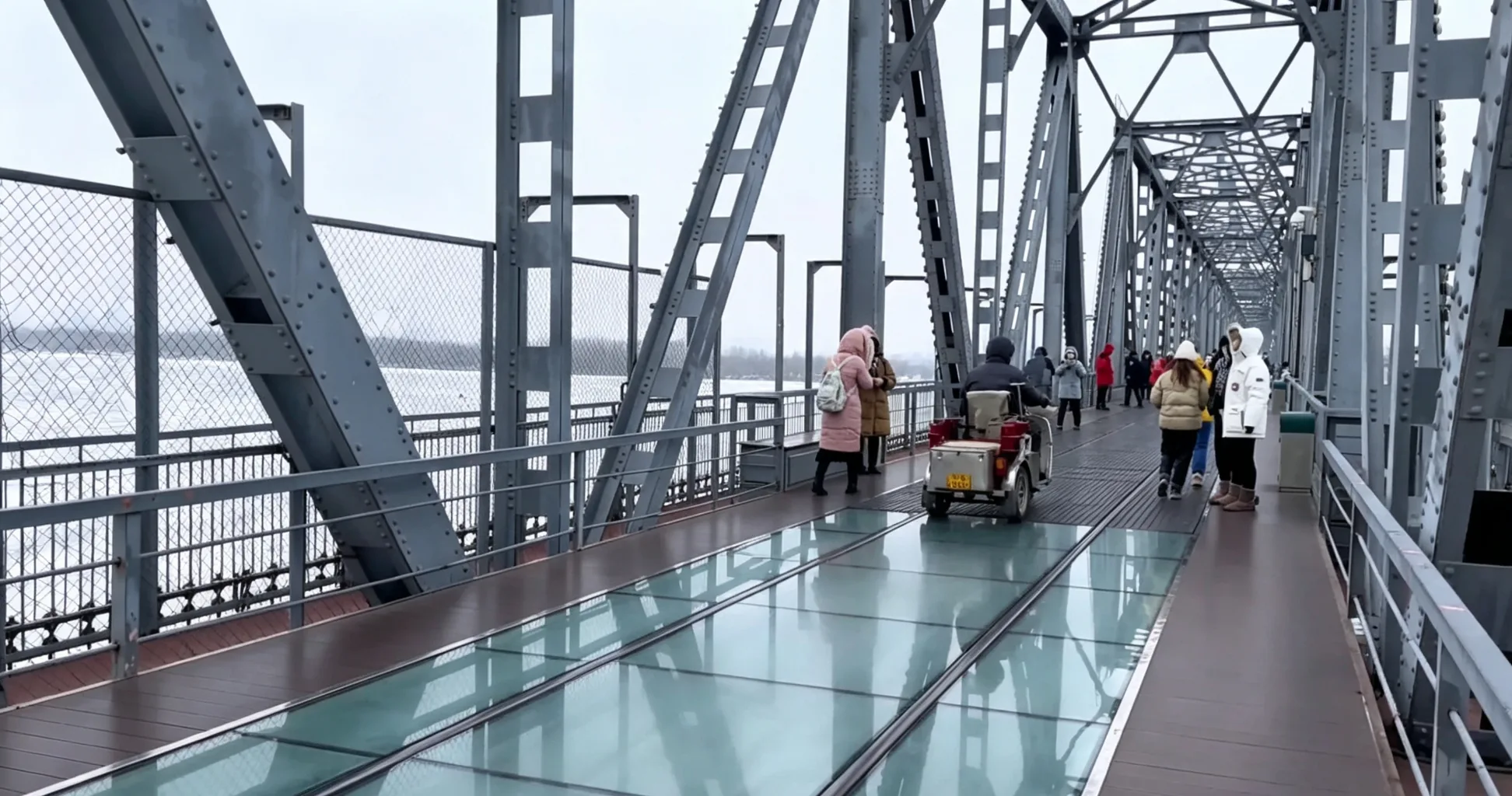
taxiRail bridge to the Grand Theatre (Qunli) — about 25–30 min
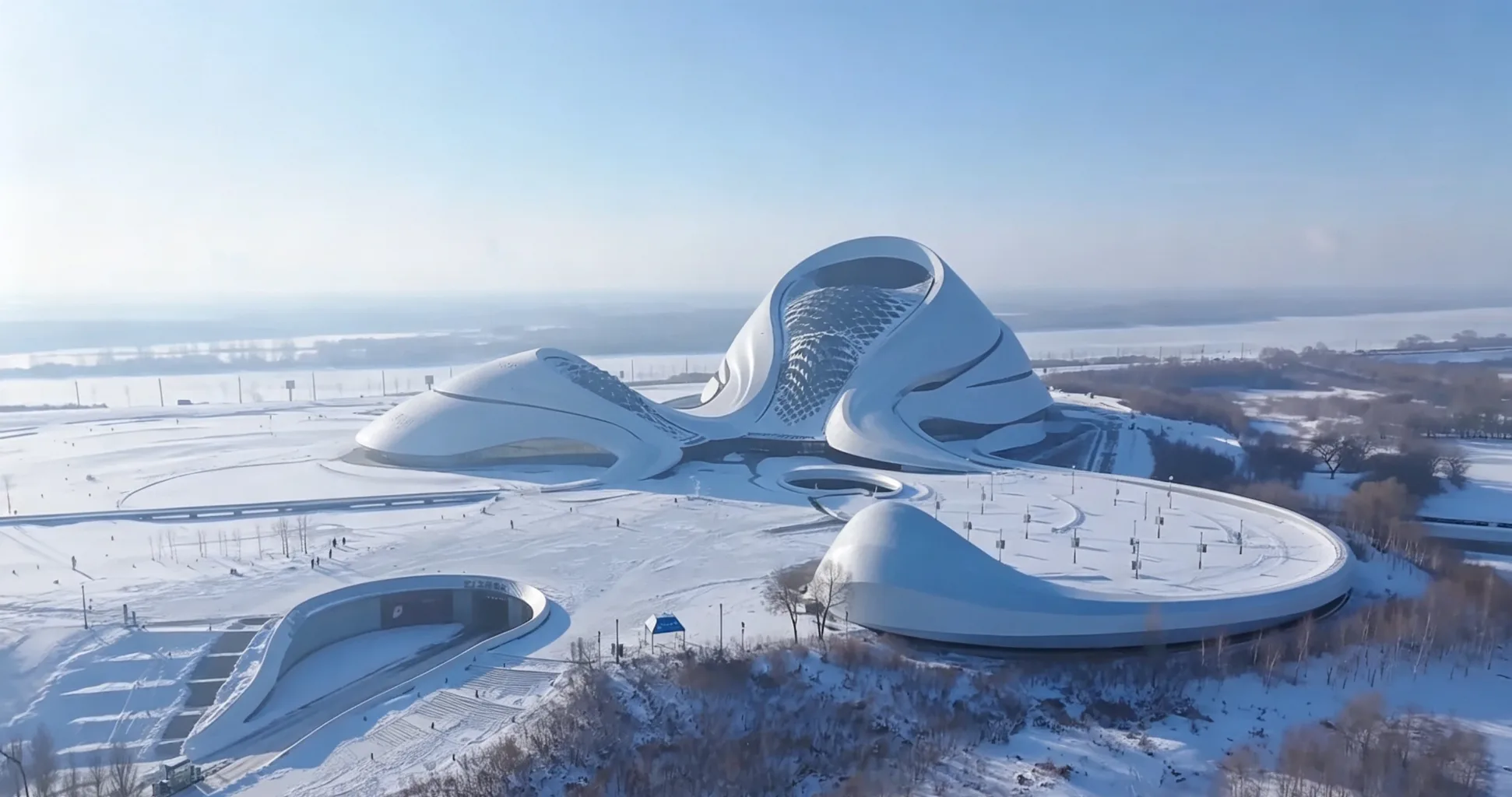
walkThe Music Corridor is right next to the Grand Theatre — a short walk; free after dusk, it’s the best spot for the lit-up theatre
🍽️ Eating on this day
Breakfastlocal breakfast in Lao Dao Wai or at the hotel.Lunchright here: Zhangbaopu’s pork-rib buns, Laochujia’s guobao rou, Guxiang’s sha-zhu-cai — all long-standing local names at fair prices.Dinnerhead to Qunli (by the Grand Theatre) or back to Central Street; or just keep it easy with street food in Lao Dao Wai.
Day 3 schedule
| Time | Activity | Play | Commute |
|---|---|---|---|
| 09:00–09:30 | To Lao Dao Wai | — | ~10–15 min |
| 09:30–10:30 | Breakfast | 1 h | — |
| 10:30–12:00 | Baroque street walk | 1.5 h | — |
| 12:00–13:30 | Lunch | 1.5 h | — |
| 14:00–15:00 | St. Alexeyev Church | 1 h | ~15–20 min |
| 15:00–15:45 | Gogol Street | 0.75 h | ~10–15 min |
| 15:45–16:45 | Railway park (rail bridge) | 1 h | ~15–30 min |
| 16:45–17:45 | Grand Theatre | 1 h | ~25–30 min |
| 17:45–19:00 | Music Corridor night view | 1.25 h | — |
| 19:00 | Dinner | — | — |
Practical Tips for Travelers
- Cold-weather gear:−15°C to −30°C. Layer: thermal base, fleece, windproof down jacket, snow boots, split-finger gloves (for photos), hat, neck gaiter. Bring hand warmers; tape one to your phone to prevent shutdown. Note: in winter almost every indoor space (hotels, malls, restaurants, train carriages) runs central heating and feels dry and hot — you’ll get parched and your skin will tighten easily, so drink plenty of water and pack lip balm and body lotion; the temperature swing between indoors and outdoors is large, so take care not to catch a cold.
- **Payments:**Mobile payments (Alipay / WeChat Pay) dominate; set them up in advance and carry some cash as backup.
- **Maps & apps:**Use Amap for navigation, together with DiDi, Alipay and WeChat for daily needs.
- **Entry policy:**Confirm the latest visa and entry requirements before you book.
- **Small towns:**If your trip extends to nearby towns, amenities are limited — booking transport and lodging ahead makes the trip smoother.
- **Safety:**Generally safe. Main risks are cold exposure and icy roads, not crime. Book intercity coaches/buses through official channels; avoid unlicensed “black cars.”
Was this guide helpful?
Frequently asked questions
Q1. When is the best time to visit?
Q2. How cold does it get, and is it dangerous?
Q3. Do I need a guide or tour group?
Q4. How do payments and navigation work?
Q5. Is 3 days enough for a first visit?
Q6. Is winter a good time to visit China, and what's on in January or February?
Last updated: 2026-10