China High-Speed Rail: Complete Guide for Foreign Visitors
Learn how to book China's high-speed trains with a foreign passport, choose seats, navigate stations, handle luggage, and travel between major cities.
Why travel China by high-speed rail
China’s high-speed rail network makes traveling between major cities surprisingly easy. For foreign visitors, trains can be faster and more convenient than flying on many routes — but the booking system, station procedures, passports, and different train classes can be confusing at first.
This guide explains everything you need to know, from buying your ticket with a foreign passport to finding your station, boarding the train, choosing a seat, handling luggage, and getting to your hotel after arrival.
A few reasons trains work so well for visitors:
- City centre to city centre. Many major stations are connected directly to urban metro systems, making train travel convenient for city-to-city trips.
- Comfortable. Standard trains offer spacious seating, power outlets, toilets, and plenty of luggage space.
- Convenient. You can avoid airport check-in, security procedures, and long transfers to airports on many domestic routes.
Train vs flight: time and price
When you are choosing between the train and a flight, two things decide it: total time and cost.
Time — station-to-station vs door-to-door. A Beijing–Shanghai high-speed train takes about 4½ hours measured station to station. The flight is only about 2 hours in the air, but once you add airport check-in, security, and the trip to and from airports that sit far from the city centre, the real door-to-door time is often 5–6 hours or more. A flight between two cities a similar distance apart in Europe (London–Paris) or the US (New York–Washington) also turns into a half-day trip once airport time is included — yet the Chinese train covers it in about 4½ hours.
Price — and which cabin you are comparing. On the Beijing–Shanghai route:
- High-speed train, second class (二等座): about ¥553 (≈ US$75) one way at the standard fare. First and business class cost more.
- Flight, economy (daytime): roughly ¥450–¥1,200 (≈ US$60–170) one way. These are daytime departures only. Overnight “red-eye” flights can dip to around ¥320, but they land at awkward hours and are poor for touring, so they are excluded from this range; full-service airlines at peak times reach the top of the daytime range.
So the train is not automatically the cheaper option — even a discounted daytime economy seat can cost less than a second-class ticket. What the train gives you instead is a predictable fare, a city-centre arrival, and no airport transfers. (Fares vary by date, route, and how far ahead you book; from May 2026 some flagship trains price about 20% above the base fare.)
For a sense of scale abroad, a similar-distance economy flight in Europe (London–Paris) is often around US$40–260 one way, and in the US (New York–Washington) around US$80–300 one way — yet both still come with the same airport check-in and transfer time the Chinese train lets you skip.
Train types: G, D, and C
Train numbers start with a letter. The main high-speed categories are:
- G — High-speed trains. The fastest services, designed to run at up to around 300–350 km/h. Used mainly for long-distance travel between major cities (such as Beijing–Shanghai or Beijing–Guangzhou).
- D — EMU trains. Modern electric multiple-unit trains that generally run at up to around 200–250 km/h. Common on regional and longer-distance routes.
- C — Intercity trains. Short-distance services connecting nearby cities, typically running at up to around 160–200 km/h.
- Z / T / K — Conventional trains. Traditional services that are generally slower. Some are useful for overnight or budget travel.
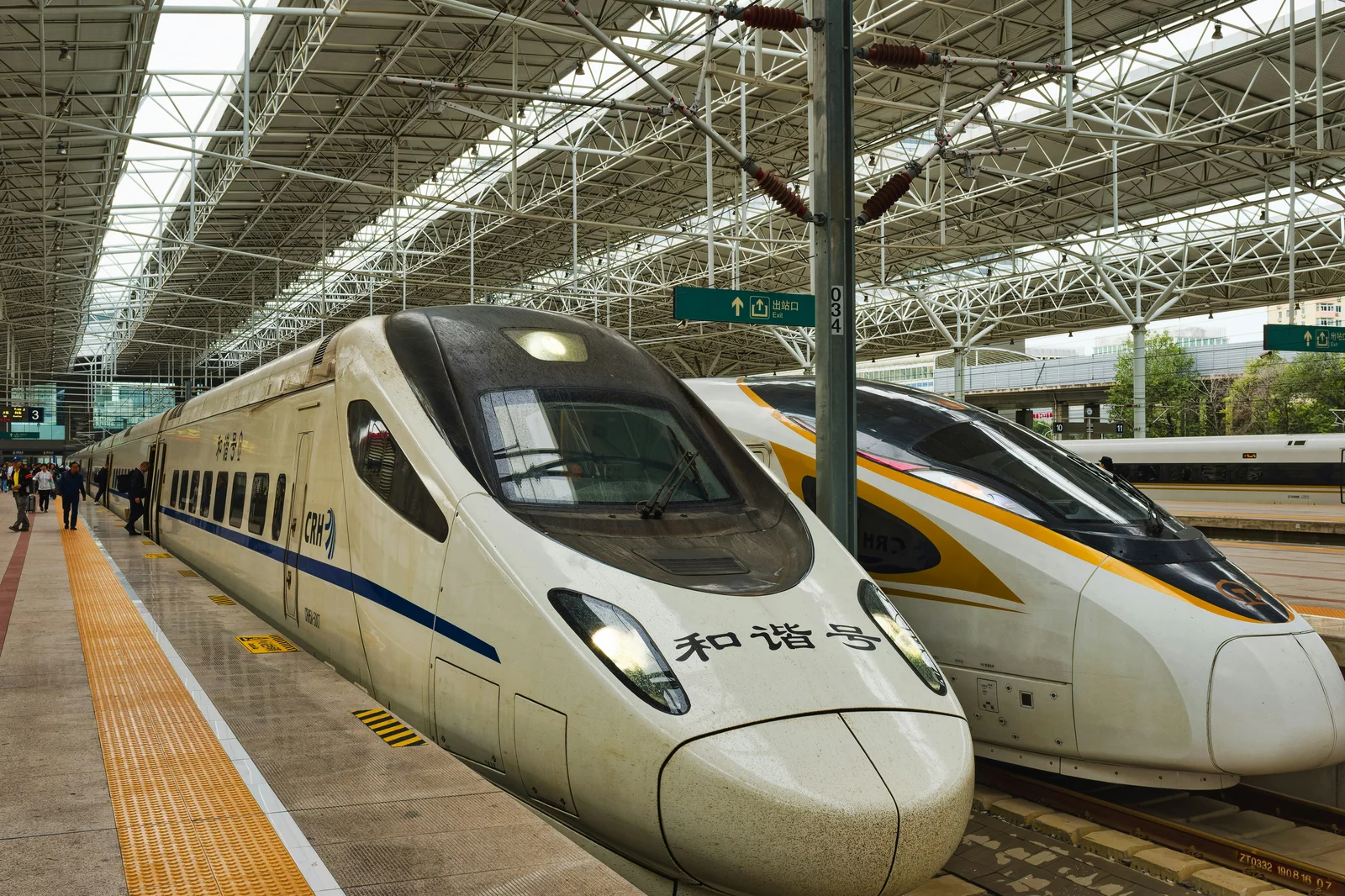
A train’s letter category does not guarantee a particular operating speed, so avoid reading too much into the label when comparing routes. You may also see different train models, including Fuxing and Hexie trains — for most travelers, the difference is not important when choosing a ticket.
Where can you go by high-speed rail?
China’s high-speed rail network is the largest in the world — more than 50,000 km of track as of 2025, reaching about 97% of Chinese cities with an urban population above 500,000. In practice, almost every major tourist city and most medium-sized cities are directly connected, so you can usually travel between them by train instead of flying.
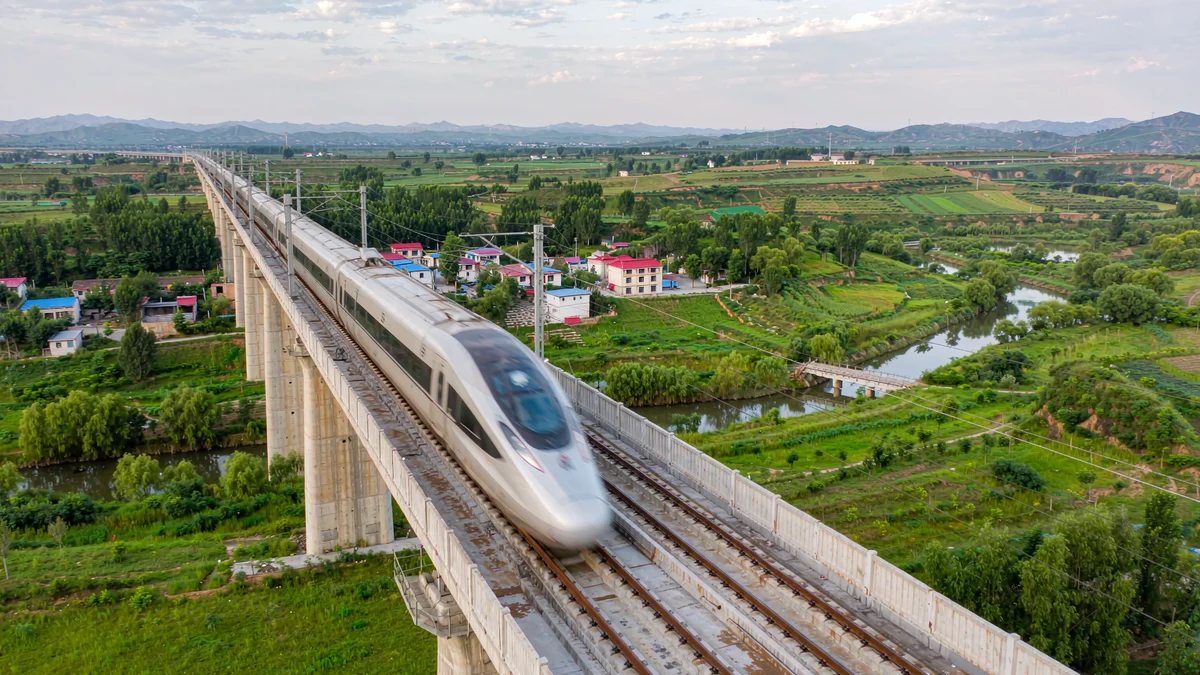
Destinations within easy reach include Beijing, Shanghai, Xi’an, Chengdu, Chongqing, Guangzhou, Shenzhen, Hangzhou, Nanjing, Suzhou, Guilin and many more. Popular pairings and typical journey times are listed in the routes table below.
Book your ticket
Trip.com — an English-language booking option
Trip.com is a convenient option for foreign visitors who prefer an English-language booking experience (see also the China Travel Apps guide):
- English-language website and app
- Supports foreign passports
- International payment methods are available
- Convenient for travelers who prefer a familiar booking interface
- Service fees may apply
12306 — the official railway booking platform
12306 is China’s official railway booking platform. Foreign visitors can register using a valid foreign passport and purchase train tickets.
The official website and app support English, and 12306 is the direct source for railway tickets without the reseller service fees charged by third-party platforms.
For visitors who find the official booking process unfamiliar, Trip.com provides an alternative English-language booking experience.
Payment methods, card acceptance, and available services can vary, so check the payment options shown during checkout.
At the station ticket window
You can also buy tickets at staffed ticket counters at railway stations. Bring the same passport used for booking. Payment methods can vary by station, so keep a backup payment method such as cash or a working mobile payment option — see the Alipay Guide for how mobile payment works in China.
Booking tips
- Popular trains can sell out quickly, especially around major Chinese holidays.
- Tickets generally become available 15 days before departure, but availability and booking rules can change, so check the current release information shown by 12306.
- Keep a flexible backup time in mind for peak departures.
Seat classes: second, first, and business
Three classes are sold:
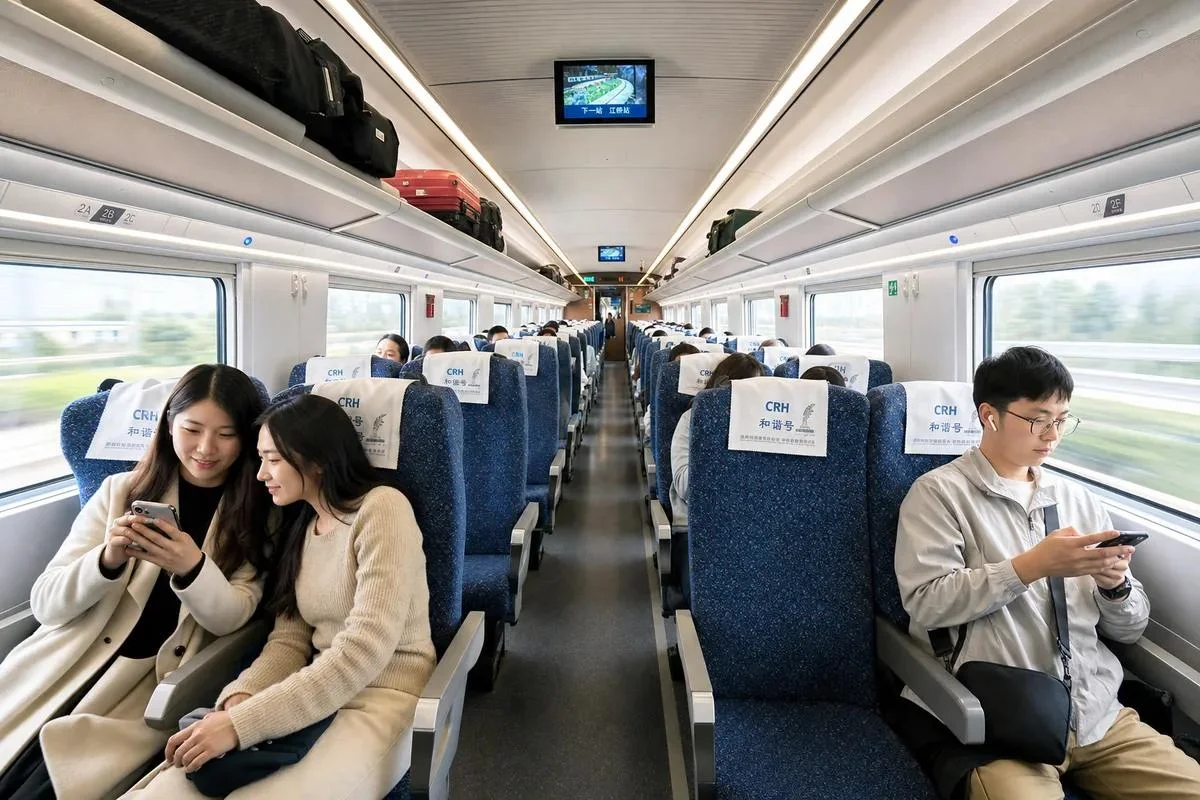
- Second class (二等座) — 3+2 seating. The standard and most common option for travelers.
- First class (一等座) — 2+2 seating. More space and fewer passengers than second class.
- Business class (商务座) — Premium seating with much more space and reclining seats. Available only on some trains.
Understanding your seat letter
On many Chinese high-speed trains:
- A / F = window
- C / D = aisle
- B = middle seat
Seat layouts can vary by carriage, so always check the seat map shown during booking.
Your ticket and the station name
Two things matter most here:
- Check the exact station. China has many stations with similar city names, so check the exact station carefully before leaving for the station. A single city can have several stations — for example Beijing has Beijing, Beijing South, Beijing West, and Beijing North, and they can be far apart. See the China Maps Guide for help reading station names.
- What the ticket shows. Your e-ticket lists the train number, date, departure station, carriage (车厢), seat, and boarding gate (检票口). Check the large departure screens at the station for your boarding gate and any updates, since procedures can vary.
Get to the station and board
When to arrive
Arrive at least 30 minutes before departure for your first trip. Large stations can be confusing, and security checks may take time. Give yourself extra time if you are unfamiliar with the station or traveling during busy periods.
At the station: step by step
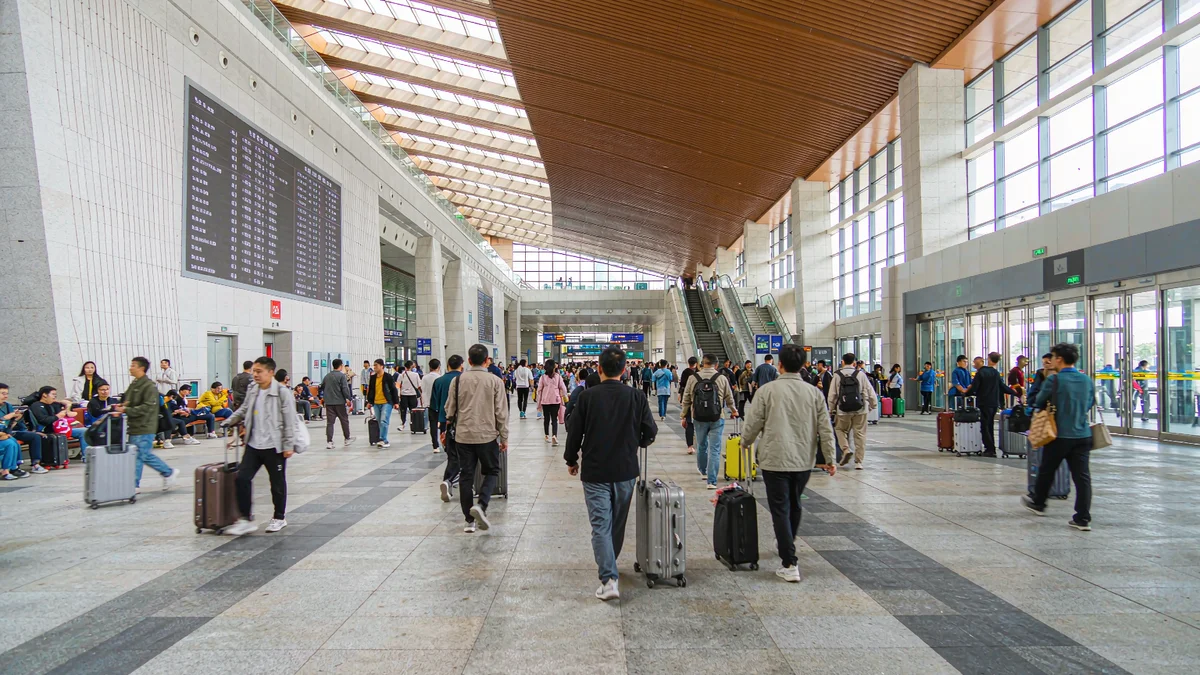
- Enter the station and pass security. Bags go through an X-ray; standard restrictions apply to dangerous or prohibited items.
- Check the departure board for your train number and note the boarding gate.
- Foreign visitors use the staffed manual lane (人工通道) — automated e-gates do not read foreign passports, so head there directly.
- Scan your passport at the gate; the system matches it to your ticket.
- Follow the platform signs and carriage markers to find your carriage.
- Take your seat and keep your passport with you — a conductor may check it on board.
On the train
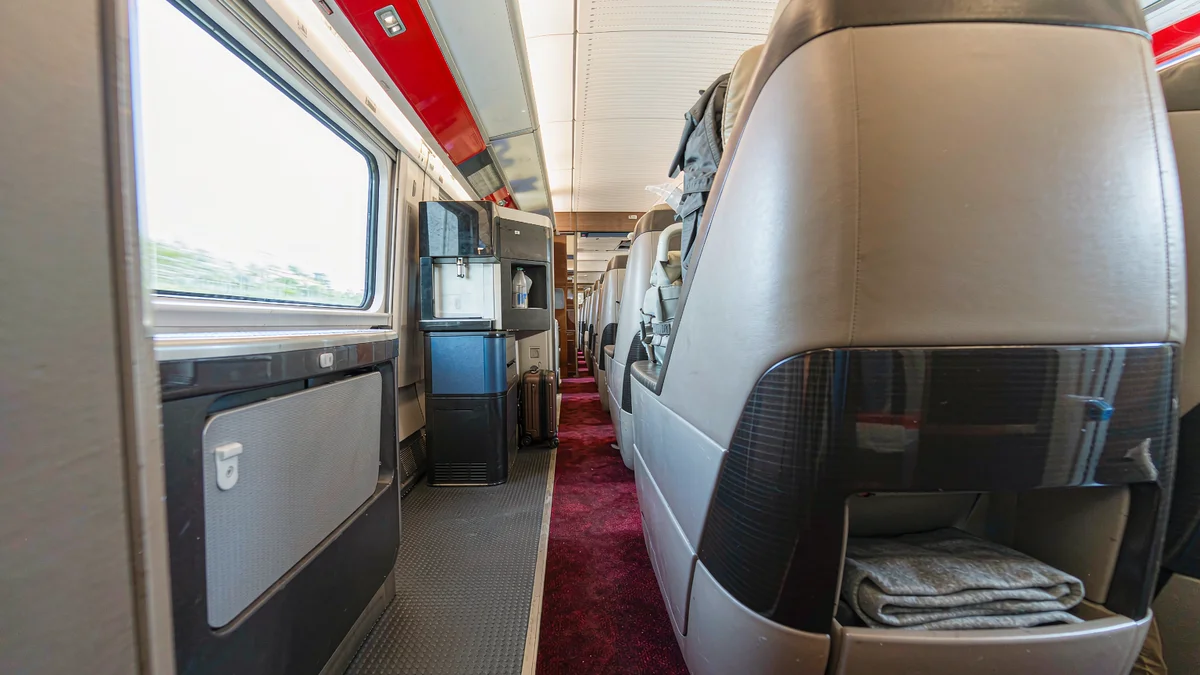
- Large luggage can be stored in designated luggage areas or overhead racks.
- Free hot water is available on all high-speed trains — look for the dispenser at the end of each carriage.
- Toilets are available on board.
- Some trains offer food, drinks, or trolley service.
- Announcements and station displays may include English.
- Wi-Fi. Free Wi-Fi is available on Fuxing (复兴号) trains on most major routes, but not on older Hexie (和谐号) trains. It usually requires a Chinese mobile number for SMS verification, or one-tap login with your 12306 account — a passport is not needed, but travelers without a Chinese SIM may not be able to complete registration, so don’t rely on it and use your own mobile data instead.
- Keep your passport and ticket information accessible.
Luggage rules
There is no airport-style checked baggage system for normal passengers. You generally bring your luggage onto the train with you.
Store luggage in the designated luggage areas or overhead racks, and keep valuables with you.
Railway security rules restrict certain dangerous, flammable, explosive, or otherwise prohibited items. Oversized or unusual items may have additional restrictions.
Arrive and get to your hotel
When you arrive, getting into the city is straightforward:
- Metro / subway — often the cheapest option for reaching central areas. Payment and ticketing methods vary by city; see the China Metro Guide.
- DiDi / taxi — convenient when carrying large luggage; see the China Taxi & DiDi Guide.
- Airport connections — many stations link onward to airports by express rail or metro; see Arrival & Customs.
Save your hotel’s Chinese name and address before leaving for the station. A screenshot works without mobile data and makes both taxi drivers and metro staff much easier to deal with.
Popular routes for tourists
| Route | Approx. train time | Why travelers go |
|---|---|---|
| Beijing → Shanghai | ~4.5 hours | Two of China’s biggest cities |
| Shanghai → Hangzhou | ~1 hour | West Lake and nearby attractions |
| Beijing → Xi’an | ~4.5–5.5 hours | Terracotta Army and historic Xi’an |
| Xi’an → Chengdu | ~3–4 hours | History, pandas and Sichuan food |
| Guangzhou → Shenzhen | ~30–60 min | Easy Pearl River Delta trip |
| Chengdu → Chongqing | ~1–1.5 hours | Food, nightlife and modern cityscapes |
Travel times vary by train and schedule. Check the exact journey when booking.
Common mistakes to avoid
- Booking the wrong station. Large cities have several stations. Beijing alone has major stations including Beijing, Beijing South, Beijing West, Beijing North and Beijing East — and they can be far apart. Always confirm the exact station, not just the city.
- Entering the wrong passport information. The passport details on your booking must match the passport you travel with.
- Arriving too late at a large station. For your first trip, plan to arrive at least 30 minutes before departure — allow 45–60 minutes at very large stations such as Beijing South or Shanghai Hongqiao, where security lines and walking distances are significant.
- Assuming every train has the same seat configuration. Layouts vary by carriage and train model.
- Forgetting which station you arrive at. Know your arrival station before you book accommodation or onward transport.
- Not saving your hotel address in Chinese. Keep the Chinese name and address on your phone.
- Relying on only one payment method. Keep a backup such as cash or a second app.
- Leaving your passport in your luggage. You need it at the gate and on board.
Frequently asked questions
Can foreigners buy high-speed train tickets in China?
Do I need my passport to ride a train in China?
How early should I arrive?
Can I pay for train tickets with a foreign credit card?
What is the difference between G, D and C trains?
How much luggage can I take?
Last updated: 2026-10