Taxis & Ride-Hailing in China: How Foreign Tourists Get Around
How do foreign tourists actually get a car in China — and find their driver? Ride-hailing through Alipay, WeChat, DiDi or AMap, plus traditional taxis, with no-Chinese-phone-number answers and airport tips.
The part that worries first-time visitors is never “which app do I tap.” It is the moment after you book: standing on a crowded curb, watching a dozen identical cars, and not knowing which one is yours.
So this is not a DiDi manual. It is about the real flow — how you get a car, where you wait, how you spot your driver, how you confirm it is the right car, what to do if you have no Chinese phone number, and how you pay. That is what lets this guide sit naturally alongside High-Speed Rail, Metro and Arrival & Customs as part of the Transportation set.
How to Get a Taxi in China
You have two broad ways to get a car:
- Ride-hailing — book through an app and a driver comes to you.
- Traditional taxi — hail one on the street, take one from a taxi stand, or queue at the airport.
Within ride-hailing there are four apps, but here is the important part:
You don’t need all four. Pick the option that fits the apps you already use.
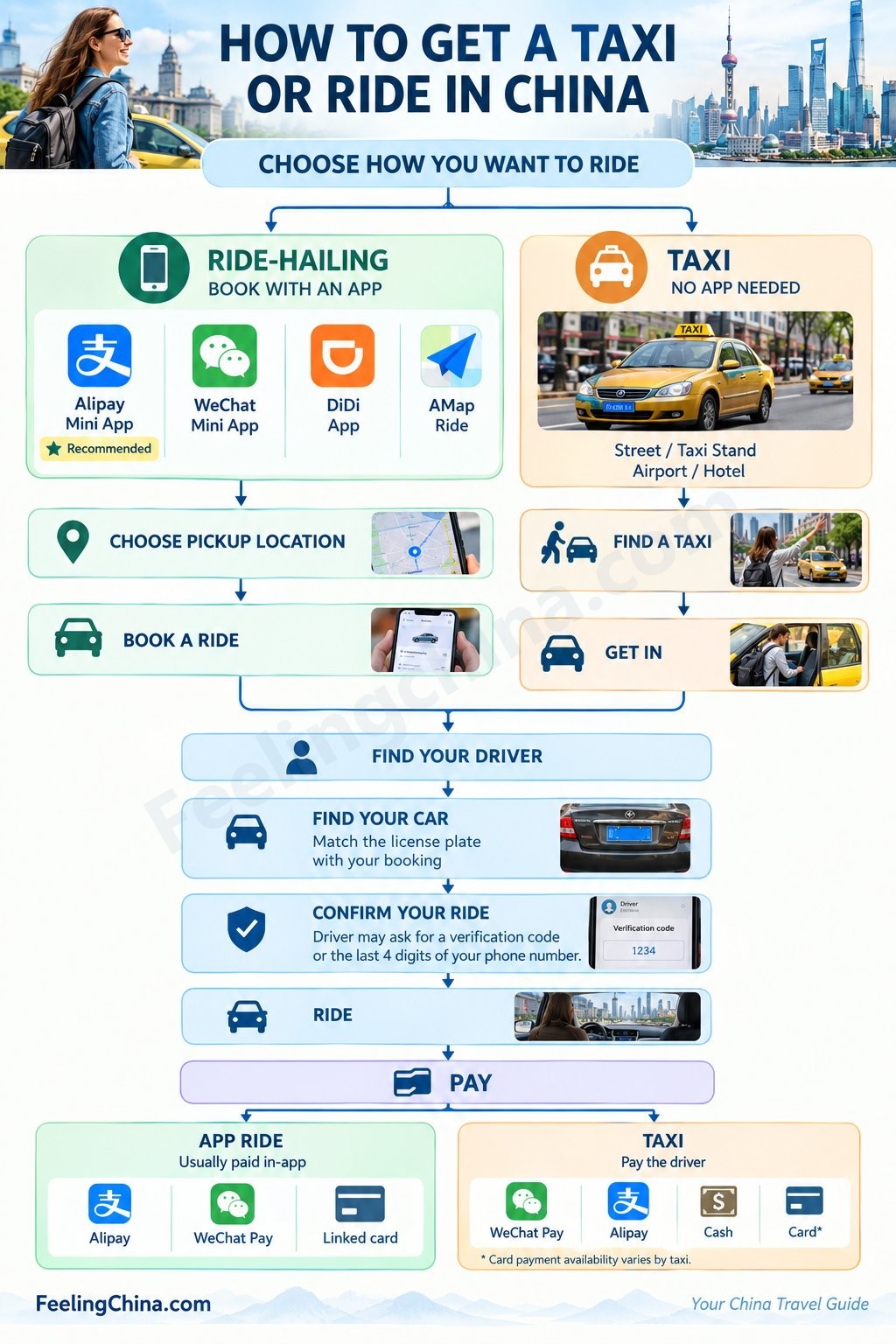
How to get a taxi or ride-hailing car in China — the whole process in one picture.
The next four sections cover each ride-hailing app, then traditional taxis. After that, the parts that actually trip people up: finding your driver, the phone last-four-digit check, and what to do without a Chinese number.
Option 1: Book a Ride with Alipay
If you already use Alipay (支付宝) for payments in China, you do not need to download DiDi separately.
- Open Alipay and tap Travel (出行) on the home screen (or search “Travel”), then tap Ride-hailing (打车) to open the booking screen.
- Set your pickup location (the app usually detects it, or you drop a pin).
- Type or pin your destination.
- Choose a car type (economy, comfort, etc.).
- Tap to book; a nearby driver accepts.
- Find your driver using the car model and license plate shown in the app.
- Get in and pay automatically through Alipay when the trip ends.
See Alipay In China For Foreigners to set up payments first.
Option 2: Book a Ride with WeChat
If you already use WeChat (微信), you can book a car without installing DiDi.
- WeChat has a ride-hailing entry through its Services / 服务 menu, or via a mini-program (search “打车” or your city’s ride mini-program).
- Set your pickup location.
- Enter your destination.
- Pick a car type.
- Book, then find your driver from the app’s car and plate details.
- Get in — payment is handled through WeChat Pay at the end of the trip.
See WeChat Pay For Foreigners for setup.
Option 3: Use the DiDi App
DiDi (滴滴) is China’s dedicated ride-hailing app. If you want one app just for getting around, it is a solid choice — but you do not need it if you already ride through Alipay, WeChat or AMap.
How to Book a DiDi Ride
- Set up your payment method. Prepare Alipay or WeChat Pay before your trip, or check the payment methods available in your DiDi app.
- Enter your destination. Use the address in Chinese when possible, especially for hotels and attractions with similar names.
- Check your pickup point. Large stations and airports may have designated ride-hailing pickup areas — the app names yours for you.
- Confirm your car. Check the vehicle details and licence plate before getting in.
- Keep your destination handy. Save the Chinese address in case you need to show it to the driver.
- Download & register. Install DiDi (the international version, DiDi Global, also exists) and sign up.
- Phone number. You can often register with a foreign number; verification rules vary, so see below.
- Payment method. Bind Alipay, WeChat Pay, or a card inside the app.
- Enter your destination, choose a car type, and book.
- Watch the driver and licence plate in the app.
- Find your driver, get in, and pay through the app at the end.

Can Foreign Tourists Use DiDi?
Many visitors can use DiDi through its international app or supported mini-programs. Available features, account verification and payment options may vary, so set up your account before travelling.
Is DiDi Better Than a Regular Taxi?
DiDi lets you enter your destination in the app and review the estimated fare before booking, which removes most of the language pressure. Regular taxis are still useful, particularly at official airport and station taxi ranks — use the meter, confirm where you are going, and avoid unsolicited ride offers.
Do You Need a Chinese Phone Number to Use DiDi?
Not necessarily “yes.” Foreign visitors can often use DiDi with an international phone number, but registration, verification and which features work can differ by platform and change over time. The practical rule is: whatever number you used to register is the number linked to your booking — keep that in mind for the driver-confirmation step below.
Option 4: Use AMap to Book a Ride
AMap (高德地图) deserves a place here, but not as a “fifth app you must install.”
FeelingChina already recommends AMap as the map tool for China (Google Maps barely works here — see Maps in China). So think of AMap as a map + ride-hailing combo, not extra baggage:
Already using AMap for navigation? You can also use it to book a ride.
- Open AMap, confirm your location, and tap the ride-hailing option.
- Enter your destination, choose a car type, and book.
- A driver comes to you; find them by plate, get in, and pay in the app.
You are not being asked to juggle four separate apps. If AMap is already your map, it is also your ride button.
All four ride-hailing apps let you pick a tier — economy, comfort, premium, and so on. A higher tier costs noticeably more, but at the premium end you'll often be in one of China's flagship new-energy vehicles (NIO, Li Auto, Zeekr, or BYD's Denza): quiet, tech-loaded cabins that are an experience in themselves. China's ride-hailing fleet is now mostly electric — upwards of 75% new-energy vehicles in major cities — though you'll still occasionally get a petrol car, especially in smaller cities. If you just want the cheapest ride, stay on economy; if you want a taste of where Chinese carmaking is now, try one premium trip.
Option 5: Take a Traditional Taxi
Traditional taxis are still everywhere, and they are the right call when:
- you don’t want to use an app,
- your phone has no data,
- an app isn’t working,
- you’re at an airport or train station, or
- you just want to hail one on the street.
How to get one:
- Taxi stand (出租车停靠点). Hotels, malls, stations and airports have marked stands with a queue.
- Street hailing. Step to the curb and raise your hand at an empty taxi with the 空车 (vacant) light on.
- Airport taxi queue. Follow the official taxi signs after baggage claim — uniformed staff often manage the line.
- Hotel help. Your hotel front desk can call a taxi for you and tell the driver where to go.
- Meter (计价器). Legal taxis run the meter; the fare shows on the dashboard display.
- Payment. You pay the driver directly — usually by scanning their personal QR code (个人收款码) with WeChat Pay (a WeChat transfer works too), with cash (RMB) as the reliable fallback. Taxis almost never have a card reader, so a physical foreign card — credit or debit — can’t be tapped or swiped here. (For ride-hailing you instead pay inside the app after linking a foreign Visa/Mastercard to Alipay or WeChat Pay.) See How to Pay below.

Keep your destination in Chinese on your phone. Save your hotel’s name, Chinese address and phone number, then show the screen to the driver — it is far more reliable than speaking the address in English.
A good phone note looks like — save it as a photo or a note in your phone and just show the screen to the driver:
How to Find Your Driver
This is the part that actually matters, so slow down here.
Booking takes one tap. The real task is at the pickup point, where a dozen near-identical cars are pulling up and many other passengers are hailing rides at the same time — at a Beijing or Shanghai airport pickup zone during a rush, it is genuinely easy to walk toward the wrong car.

What to do
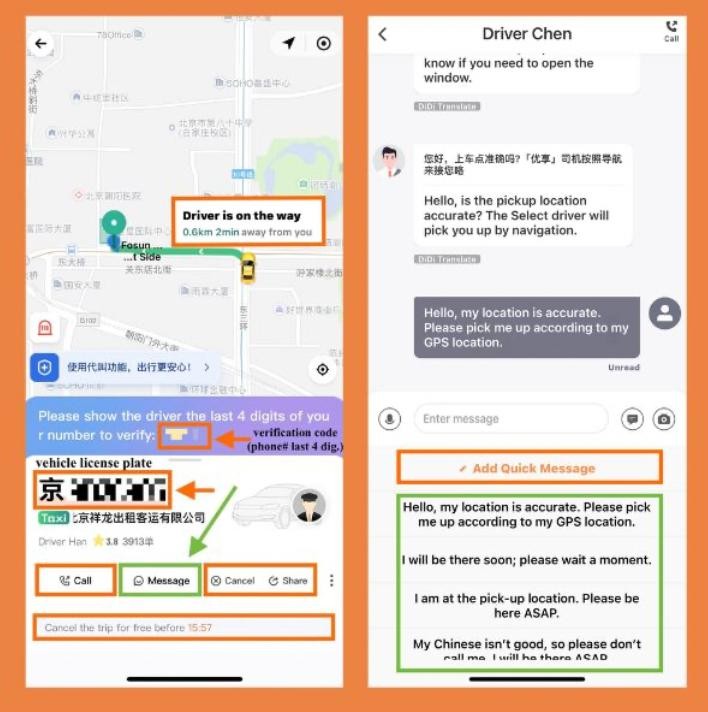
- After booking, the app shows the car model, license plate and driver name — keep that screen open.
- Walk to the pickup point the app names (a gate, a zone letter, a door number); don’t just drift toward the crowd.
- When a car pulls up, match the license plate on the app before you open the door.
Always check the license plate before getting into the car. It takes two seconds.
Why this matters. Confirming the exact plate is how ride-hailing in China protects you. Every trip is tied to a verified car and driver, so getting into the wrong — or a stranger’s — car is exceptionally rare, and your belongings stay with you. That simple plate check is a big part of why getting around by app is so safe here, and one of the quiet reasons China’s crime rate stays low. Match the plate, and the loop closes: you, the car, and the driver all line up.
What Is the Phone Number / Last Four Digits for?
A detail that confuses almost every foreign visitor: after you book, the driver may ask for the last four digits of the phone number linked to the booking.
You do not need a Chinese phone number to handle this — the “account number” is simply whatever number you used to sign up for the app.
+1 202 555 1234
1234
It is the last four digits of the number linked to your account — not necessarily a Chinese number.
The driver may ask for those four digits to confirm you are the right passenger — but don’t read this as “every driver will ask.” Different platforms, car types and trip flows handle it differently, and you do not normally need to give your full number; just confirm those last four if they do.
Can You Use Ride-Hailing Without a Chinese Phone Number?
Yes — this deserves its own answer, because “no Chinese number = no ride-hailing” is a myth that stops people before they try.
- Foreign visitors can use parts of ride-hailing in China.
- A Chinese phone number is not automatically required.
- Rules vary by platform and registration method, so one app may verify a foreign number while another asks for more.
- When you use your own international number, the number linked to the order is your number — and if a driver confirms the last four digits, that is your number’s last four, wherever it is from.
So: arrive with Alipay or WeChat already set up, and ride-hailing works for most visitors without a local SIM.
What If the Driver Calls You?
Another moment that throws people: the driver rings you, and you have no Chinese number, only data, or an international number you’d rather not answer.
The most useful fix has nothing to do with answering the phone:
After booking, don’t wander away from the system’s pickup point — especially at an airport, a high-speed railway station, a shopping mall, or a large tourist attraction.
Then lean on the app instead of the call:
- Watch the driver location moving toward you.
- Re-check the car model and license plate.
- Confirm the pickup location matches where you are standing.
- Use the app’s driver messages / contact options — many apps let you exchange a quick note without a voice call.
If the driver does call and you can’t take it, stay put at the pickup point; they will usually message or circle back, and the app shows exactly where each of you is.
Taking a Taxi from a Chinese Airport
Arriving by air is the most common first ride in China. The flow is the same as anywhere — get internet, open your app, set the pickup point, book, then find your driver by plate — but airports add a couple of wrinkles worth knowing.
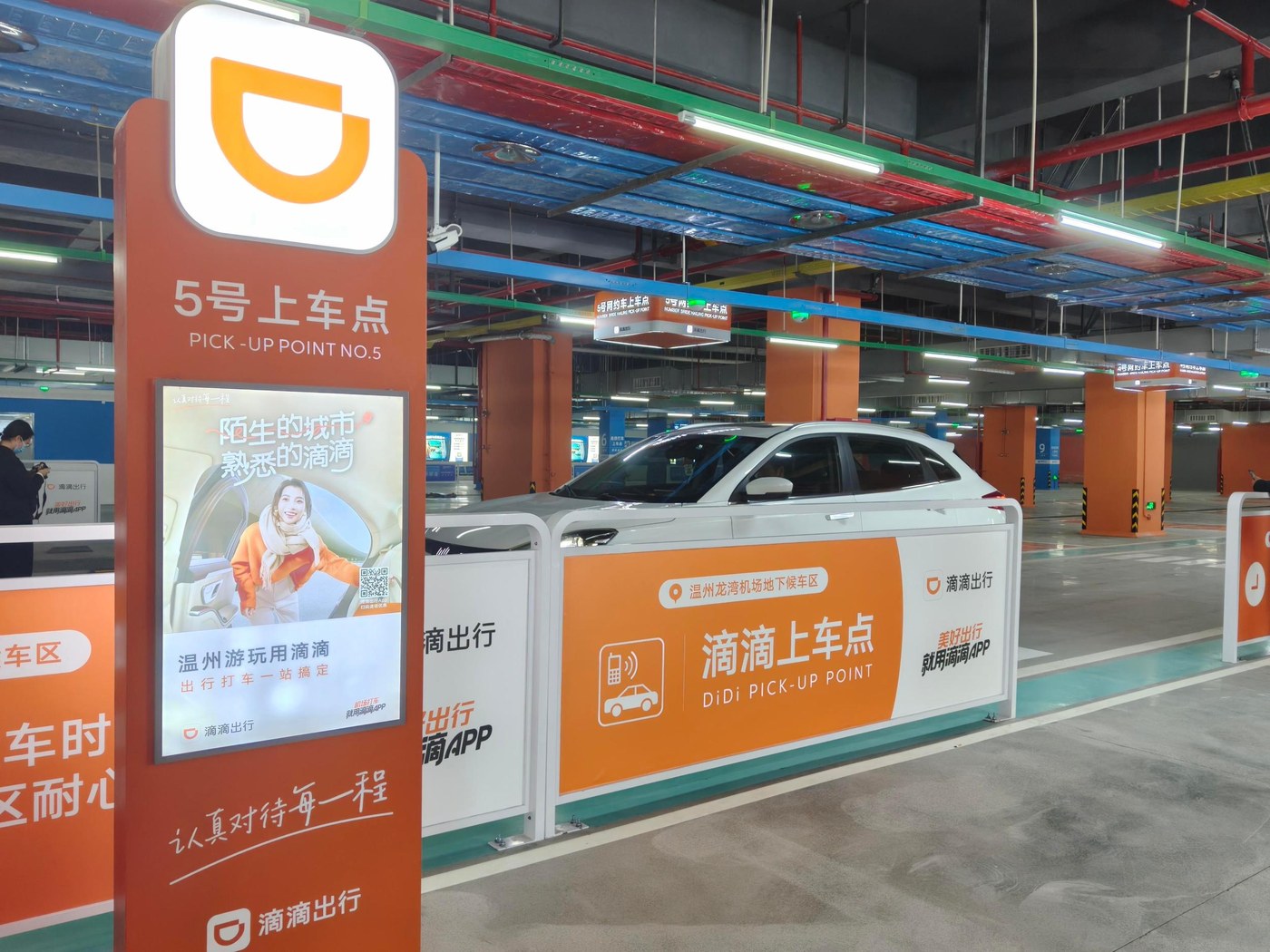
Big Chinese airports separate ride-hailing pickups from the taxi queue — follow the 网约车 (ride-hailing) or 出租车 (taxi) signs to the right floor or zone. Ride-hailing apps show a pickup point name/letter; match it before you wait.
Taxi vs Ride-Hailing at the Airport
- Traditional taxi — best if your data is patchy, you want zero app friction, or the official queue is short. Follow the taxi signs, take a metered cab, show the Chinese hotel address.
- Ride-hailing — best if you already have Alipay/WeChat/DiDi/AMap set up and want a fixed pickup point and plate shown in the app. Follow the ride-hailing pickup signs to the exact zone.
How to Get from the Airport to Your Hotel
Compare the metro or airport express, an official taxi, and a ride-hailing app. Public transport is usually the cheapest, while a car is more convenient with luggage or a late arrival. Before you leave the terminal, save your hotel’s full Chinese address and confirm the correct branch — see Hotels in China and Maps in China for the details.
Taking a Ride from a High-Speed Railway Station
The same logic applies when you roll out of a train (see China High-Speed Rail):
- Don’t walk off blindly after exiting the station.
- Find the pickup point the app names; large stations often have a designated ride-hailing zone (网约车专区).
- Check the license plate before you get in.
- If you are unsure where to wait, ask a staff member at the station help desk — they will point you to the ride-hailing area.
How Much Does It Cost?
Cheap, by most Western standards — a typical city trip is only a few dollars. Here’s the rough math:
- Traditional taxi (出租车): a flag-down fare of about ¥10–15 for the first 2–3 km, then roughly ¥2–3 per km. Beijing runs about ¥13/3 km then ¥2.3/km; Shanghai about ¥14/3 km then ¥2.4/km.
- Ride-hailing, economy / Express (快车): a little cheaper per km — about ¥1.5–2.5/km with a lower flag-down (often ¥8–12). Comfort and Premium tiers run ¥2.5–3.5/km; luxury cars ¥3.5–5/km.
- Real-world feel: a 5 km ride is roughly ¥15–20; a 10 km ride about ¥25–35; a cross-city 100 km run is around ¥200–300.
Watch the surcharges, not just the per-km rate. Fares rise at night (roughly 22:00–06:00, often +20–30%); during rush-hour dynamic pricing ride-hailing can cost 1.5–3× the base; and highway or bridge tolls are added on top (you pay them). Airports and remote spots sometimes quote a fixed price instead of a meter.
Always check the upfront price in the app before you confirm a ride-hail. Taxis use a meter — and there's no tipping in China, so the metered or quoted fare is the full price.
How to Pay for Taxis and Ride-Hailing
Payment depends on which way you rode:
- Ride-hailing (Alipay / WeChat / DiDi / AMap): paid inside the app automatically at the end of the trip. Alipay and WeChat Pay can bind foreign cards — see Alipay and WeChat Pay.
- Traditional taxi: you pay the driver directly, most often by scanning their personal payment QR code (个人收款码) with WeChat Pay — many drivers also accept a WeChat transfer (微信转账). Cash (RMB) is the reliable fallback, and Alipay QR works with most drivers too. A credit or debit card is rarely an option: few taxis have a working card reader, and foreign Visa/Mastercard taps are frequently declined, so keep QR or cash as backup — details in Cash & Cards in China.
* Some taxis display a card reader, but foreign cards are often declined — don’t count on it.
Do You Need to Speak Chinese?
No — you do not need to speak Chinese to get a car. But having your destination’s name and address in Chinese on your phone helps enormously, especially for:
- your hotel,
- a restaurant,
- a tourist attraction,
- the airport, and
- the railway station.
One catch in big cities: the same hotel or restaurant chain has many branches (分店) — “Hilton” or “Haidilao” alone is not enough. Save the exact branch name and Chinese address you booked, not just the brand, so the driver drops you at the right door.
For ride-hailing you type or pin the destination in the app, so no speaking is required. For a traditional taxi, show the screen rather than say the address — it removes the language gap entirely.
Taxi & Ride-Hailing Safety Tips
- Check the plate, every time. Match the license plate in the app before you open the door.
- Use the official apps. Book through Alipay, WeChat, DiDi or AMap — avoid off-app “private car” offers at stations.
- At the airport, use the official taxi queue or the app’s named pickup zone; ignore touts who approach you inside the terminal.
- Keep your destination in Chinese saved on your phone, plus the hotel phone number.
- Share your live trip with a friend if the app supports it; note the license plate.
- Sit in the back, buckle up, and keep your luggage where you can see it.
- Keep the receipt from a traditional taxi — it carries the plate and company number if you leave something behind.
Which Option Should Foreign Tourists Use?
| Situation | Recommended Option |
|---|---|
| Already using Alipay | Alipay ride-hailing |
| Already using WeChat | WeChat ride-hailing |
| Want a dedicated ride-hailing app | DiDi |
| Already using AMap for navigation | AMap ride-hailing |
| Don’t want to use an app | Traditional Taxi |
| No internet | Traditional Taxi |
| Arriving at an airport | Taxi or ride-hailing |
| Going from a railway station to a hotel | Ride-hailing or Taxi |
Don’t download everything. Use the option that fits the apps and payment methods you already have.
That is the whole thing: book where you already are, wait at the named pickup point, check the plate, show the Chinese address, and pay in the app or with cash. Once you have done it once, every later ride is the same routine.
Was this guide helpful?
Frequently asked questions
Do I need a Chinese phone number to use DiDi?
Can I pay for a taxi with a foreign credit card?
Is tipping expected in Chinese taxis?
What if I leave something in the taxi?
Can I book a taxi in English?
Last updated: 2026-10